





A new CryptoQuant analysis highlights how Bitcoin’s market structure in 2025 stands on much firmer ground than in past cycles, despite recent volatility. One analyst explained that the ongoing price turbulence does not signal structural weakness, instead, it reflects a maturing ecosystem driven by long-term accumulation and shrinking exchange reserves.
Exchange Reserves Hit Multi-Year Lows
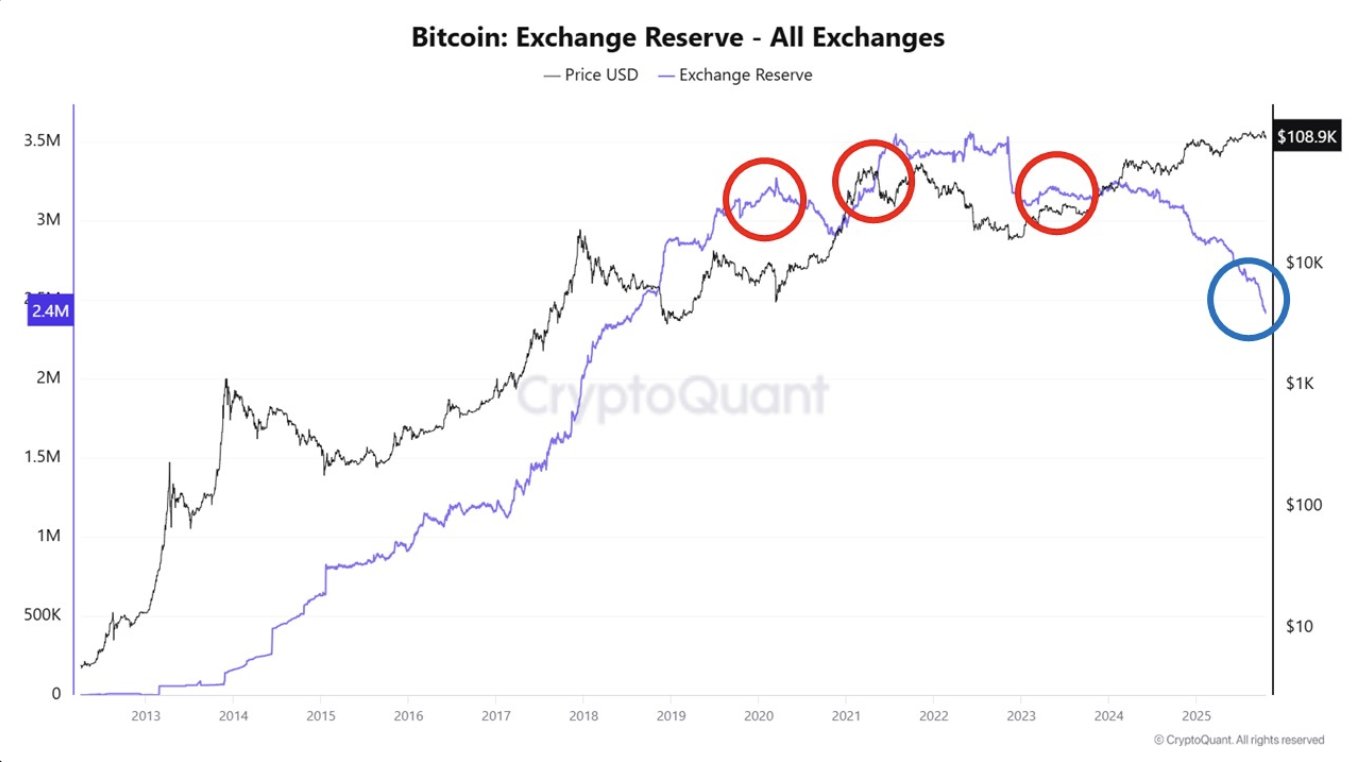
The first chart shows Bitcoin’s exchange reserves, the total amount of BTC held on centralized exchanges, which have continued to decline sharply since 2020.
Historically, rising reserves have coincided with major market tops as traders send coins to exchanges to sell. In contrast, the current downtrend in reserves suggests that investors are moving Bitcoin off exchanges into cold storage, a classic sign of long-term confidence.
In the 2017 and 2021 bull markets, reserves surged just before major corrections, as marked by the red circles on the chart. However, in 2025, reserves have hit their lowest level in years, represented by the blue circle, indicating that holders are unwilling to sell even during periods of heightened volatility.
Long-Term Holders Remain Unshaken
The second chart, Bitcoin’s Long-Term Holder SOPR (Spent Output Profit Ratio), further supports this thesis. SOPR measures whether long-term investors are selling at a profit or loss. Historically, high SOPR peaks (above 1.3) have aligned with market euphoria and profit-taking, while deep corrections occur when holders capitulate.
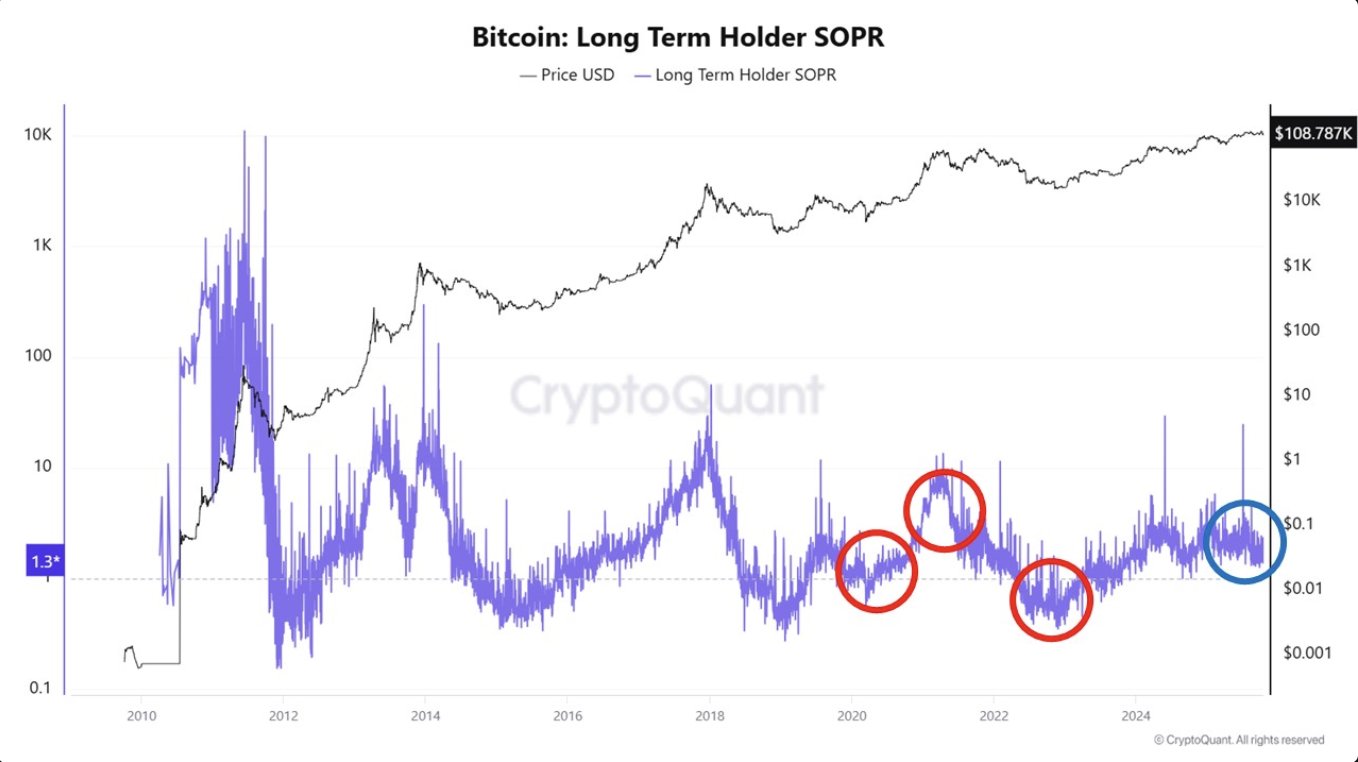
In the current cycle, SOPR remains remarkably stable, showing minimal profit-taking despite recent price swings. This suggests that long-term investors are holding firm and accumulating rather than exiting positions. CryptoQuant notes that this consistency contrasts sharply with previous cycles, when SOPR spikes preceded major sell-offs.
A Mature Market, Not a Bubble
Together, these on-chain signals, shrinking exchange reserves and steady long-term holder metrics, paint a picture of a more resilient Bitcoin market. While the cryptocurrency still experiences short-term volatility, the underlying structure has evolved. Institutional inflows, self-custody trends, and ETF participation have replaced the retail-driven speculation of 2021.
As CryptoQuant concludes, “With exchange reserves shrinking and long-term holders steady, temporary volatility does not equate to structural weakness.” In short, Bitcoin’s 2025 foundation appears stronger, leaner, and more mature, marking a decisive break from the boom-and-bust cycles of previous years.



