


A new report breaks down what investors actually own when they buy $1,000 worth of Berkshire Hathaway stock, and the results reveal just how conservatively positioned Warren Buffett remains heading into 2026.
According to the analysis, nearly $371 of that $1,000 sits entirely in cash and U.S. Treasury bills, underscoring Berkshire’s defensive posture amid elevated interest rates, record equity valuations, and geopolitical uncertainty. Buffett’s growing cash pile, now above $180 billion, continues to be both a buffer and a war chest, ready for deployment when markets offer the kind of bargains he’s known to seize.
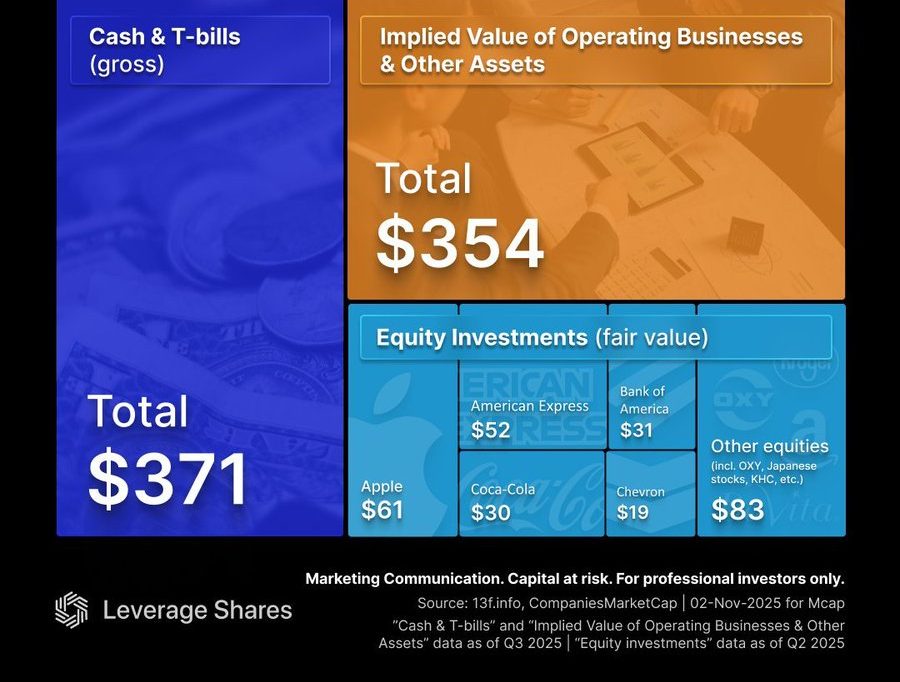
The company’s equity investments account for another $245, anchored by iconic holdings such as Apple ($61), American Express ($52), Coca-Cola ($30), Chevron ($19), and roughly $83 in other equities, including energy, Japanese trading houses, and financial firms like Bank of America. These long-term stakes continue to deliver consistent dividends, aligning with Berkshire’s steady compounding philosophy.
The remaining $354 reflects the implied value of Berkshire’s vast operating businesses, a diversified empire spanning insurance, railroads, manufacturing, and energy infrastructure. Together, these entities generate billions in annual profit and serve as the backbone of the conglomerate’s stability.
In essence, a $1,000 share of Berkshire isn’t just an investment in the stock market, it’s a portfolio of disciplined liquidity, blue-chip equities, and cash-rich industrial powerhouses. Buffett’s strategy may look cautious on the surface, but as market volatility rises, that mountain of cash positions Berkshire to strike decisively when opportunity returns.