



- VeChain’s Stargate enables NFT staking for 15% validator returns, expanding participation to 500k users with simplified access.
- Institutions join as validators, strengthening global network security across US/Europe/Asia/Africa while backing long-term sustainability goals.
Sunny Lu, leading VeChain, stated this year serves as a clear marker for the blockchain sector. He highlighted the Stargate release during an interview. Lu emphasized VeChain’s push for concrete outcomes across its developments.
Lu aims to solve practical problems. He supports environmental initiatives through planned growth phases. The first phase started in 2017 with core technology development. The second phase began in 2019 tracking physical items like food origins. The current phase launched in 2023 under “Web3 for Better.” This phase promotes sustainable habits.
Accessible Network Participation
Stargate activated on July 1st. It allows broader user participation by removing technical barriers. The upgrade modifies VeChain’s rules and token setup. It uses an NFT-based staking system.
Users lock VET tokens through automated contracts. Staked amounts determine NFT tiers. These tiers represent participation levels. Seven distinct NFT tiers exist based on locked VET. Users may withdraw funds anytime. They can cancel NFTs when choosing.
Annual returns reach 15% for validators. Users delegating stakes via NFTs can get 12%. Stargate expands operations to support 500,000 participants. It uses delegated staking. Existing XNode holders may convert status to new NFTs. Econode holders have the same option.
Lu confirmed VET and VTHO tokens comply with Europe’s MiCA regulations. VeChain’s model follows SEC requirements.
Sustainability and Addressing Superficial ESG
Lu restated sustainability as VeChain’s central principle. vBetterDAO backs startups and corporations. It rewards eco-friendly practices through tools. Examples include GreenCard, EVN, and BYB.
He acknowledged concerns about Environmental, Social, and Governance efforts. Some use ESG as promotion without real effect. VeChain’s approach works oppositely. It enables small sustainable choices. These choices achieve measurable results.
VeChain’s global reach now spans the U.S., Africa, Europe, and Southeast Asia. Institutions participate as validators, not just investors. This strengthens network security. It supports VeChain’s sustainability commitment.
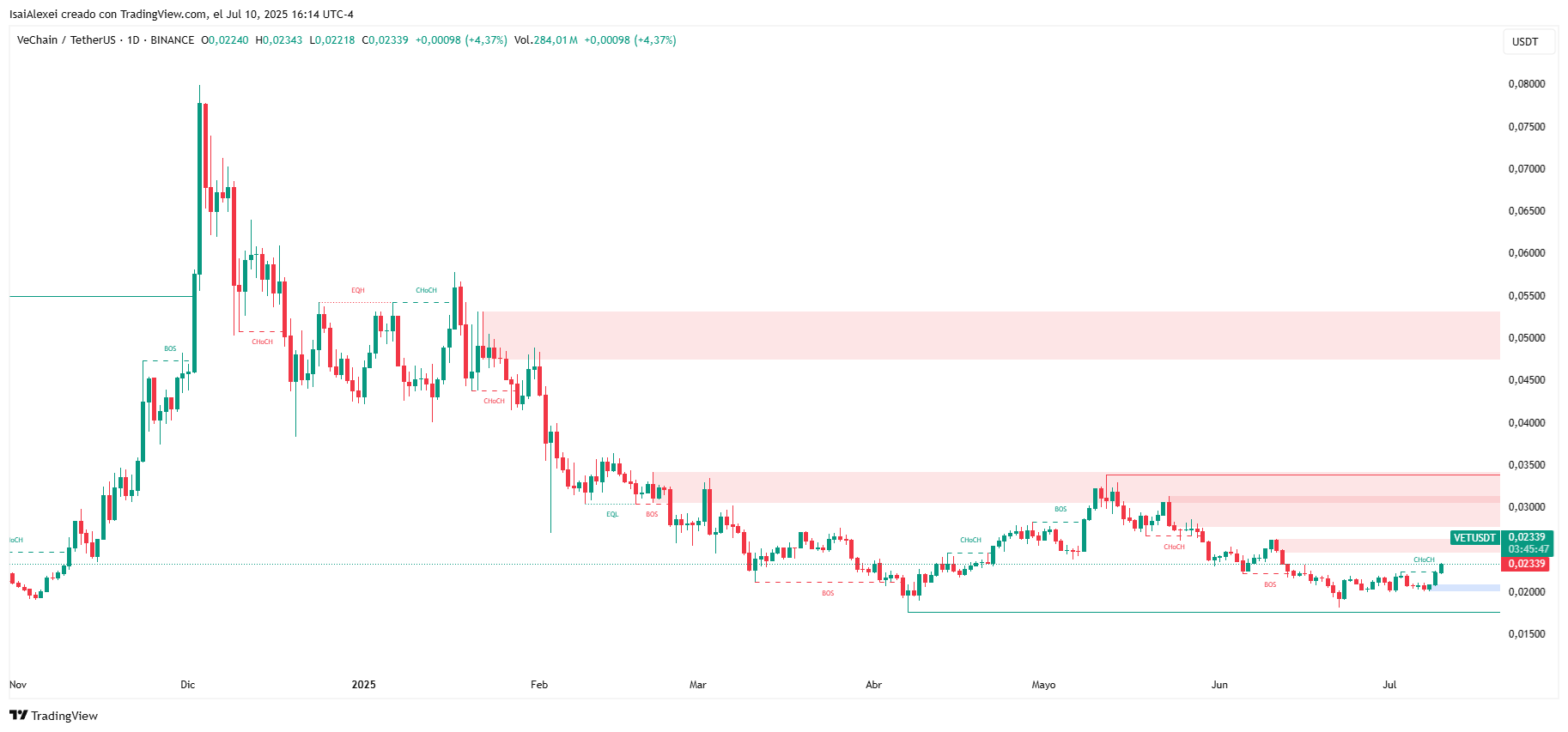
VeChain (VET) is trading at approximately $0.02324 USD, registering a 4.82% increase over the last 24 hours. This positive movement comes amid renewed interest in real-world asset tokenization, a sector where VeChain has been gaining strategic traction.
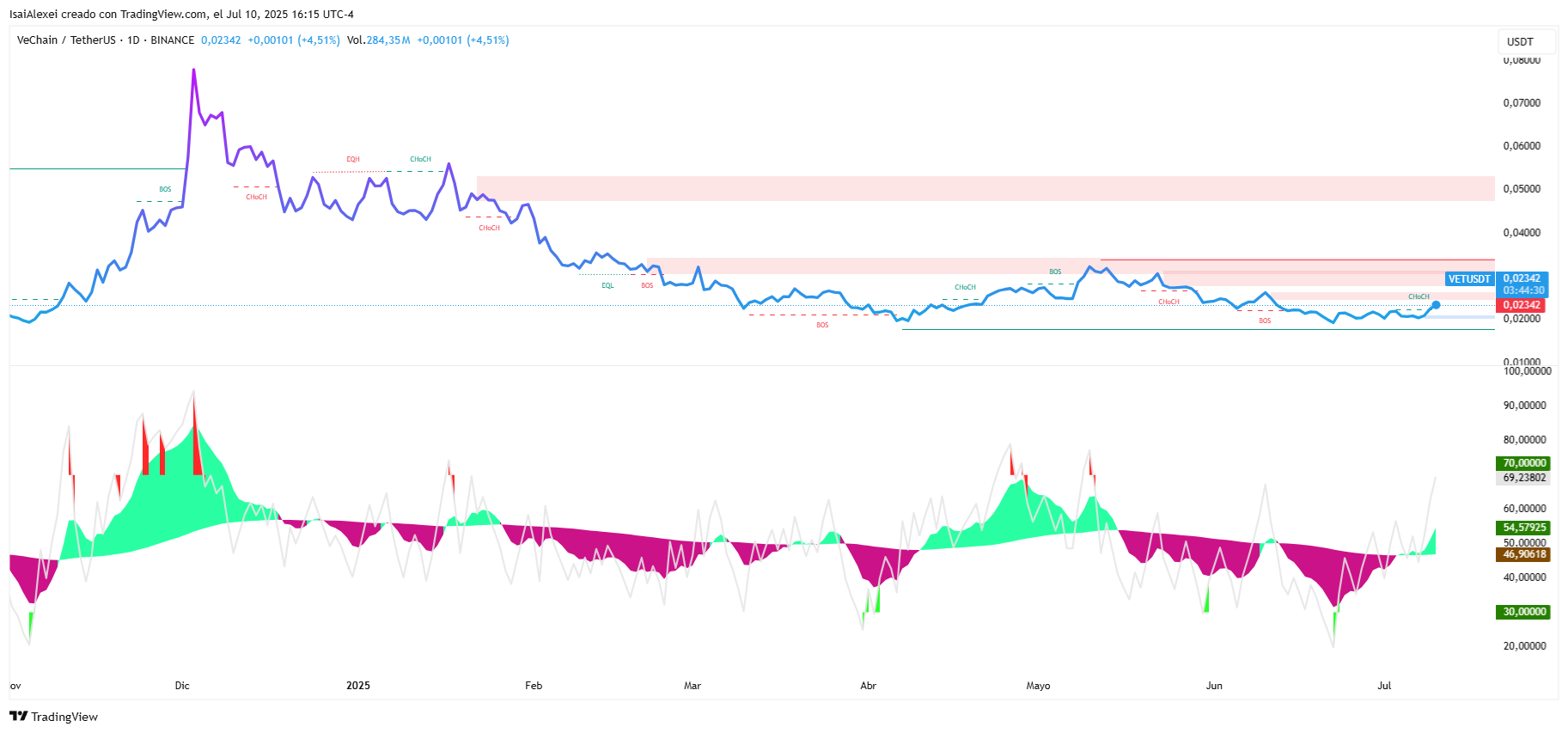
With a market capitalization nearing $2 billion and a daily trading volume of $49.05 million, VeChain remains a mid-cap altcoin with strong enterprise fundamentals and increasing global utility.
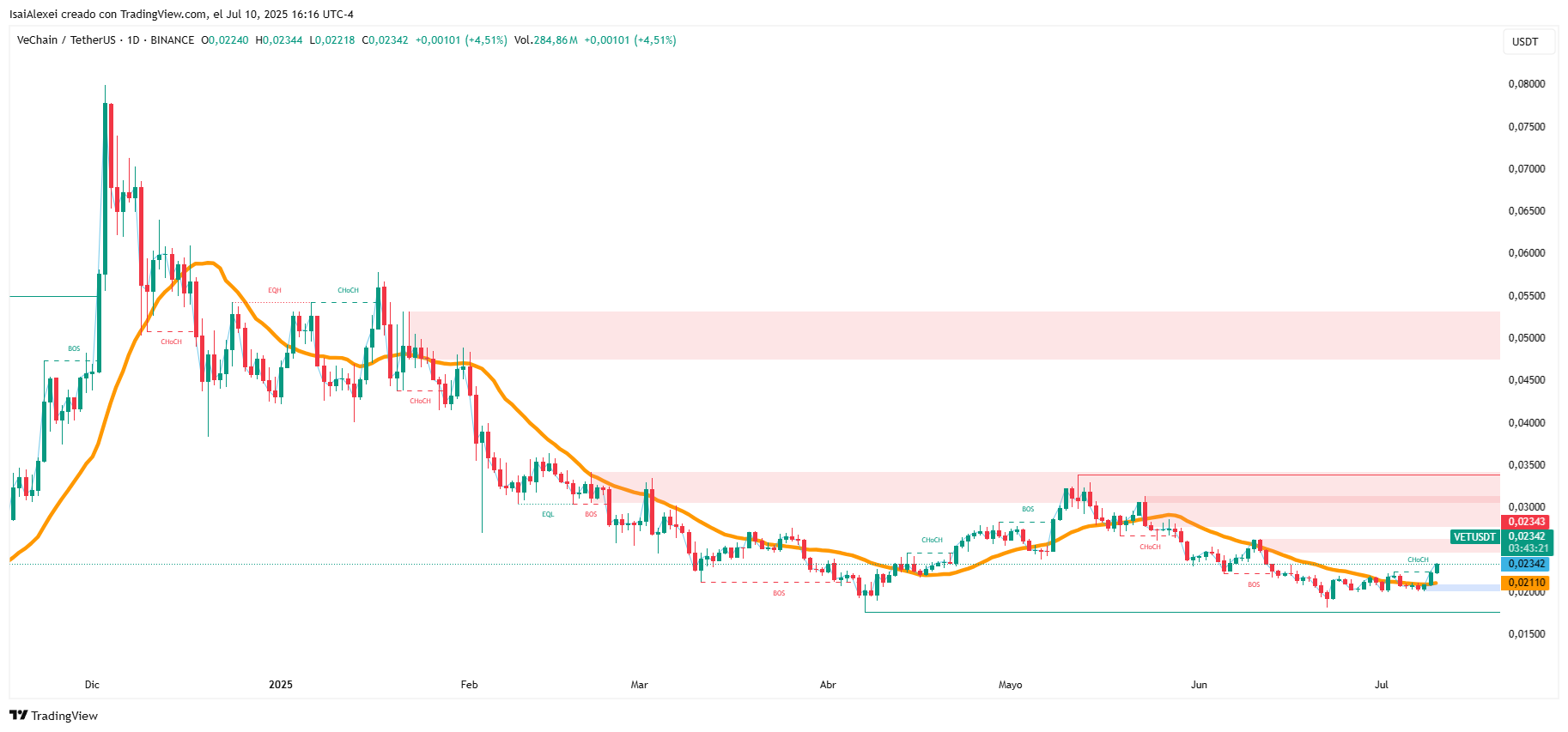
From a technical analysis standpoint, VET has recently bounced off its monthly support zone near $0.021, forming a minor ascending channel on the daily chart. The 20-day moving average is beginning to curl upward, suggesting potential momentum building for a bullish breakout if buying pressure continues.
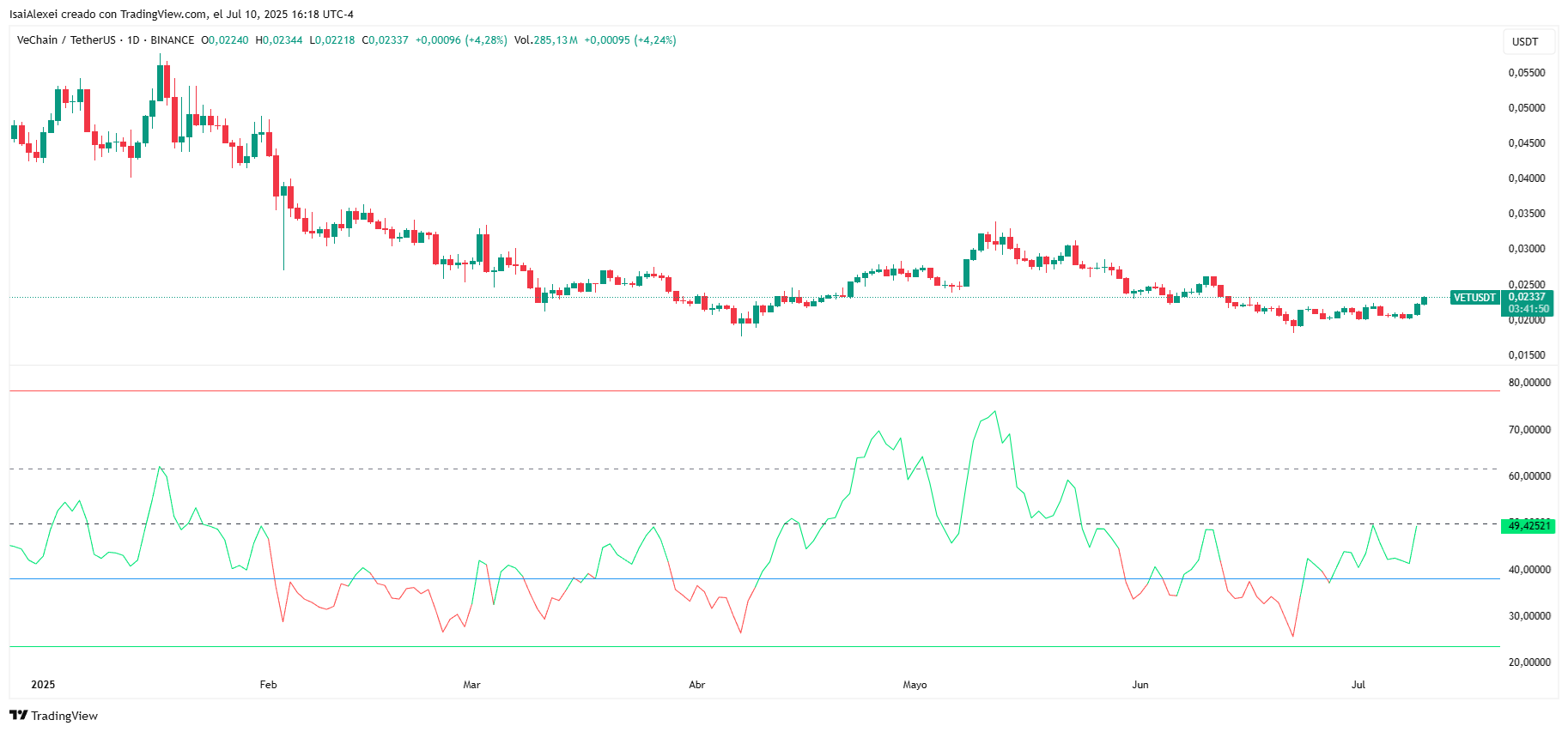
The next resistance is expected around $0.0255–$0.0262, a level it previously failed to break during early Q2. RSI levels are still neutral, which means VET has room to run before reaching overbought conditions. While volume has not yet returned to peak bull cycle levels, it is steadily climbing, indicating early accumulation by traders positioning for a medium-term rally.
On the fundamental side, VeChain is experiencing a resurgence in relevance due to multiple recent announcements. Most notably, VeChain has launched a new initiative in collaboration with a logistics conglomerate in Southeast Asia, leveraging blockchain for transparent supply chain management.
Additionally, VeChain’s toolchain is now being piloted in European carbon credit tracking, a use case that aligns with increasing regulatory demands for sustainability transparency. These developments are not just speculative narratives—they are real-world integrations that offer recurring utility and long-term network value.
In the broader Web3 context, VeChain is also benefiting from the increased focus on tokenized real-world assets (RWAs), where its dual-token model (VET for value transfer, VTHO for gas fees) provides enterprise-friendly economics.
The foundation continues to be active in community development, R&D, and multi-sector partnerships. With governance improvements rolled out in early 2025 and increasing adoption of VeChainThor Layer 1 capabilities, the platform is positioning itself as a leading enterprise blockchain for real-world data verification.




