


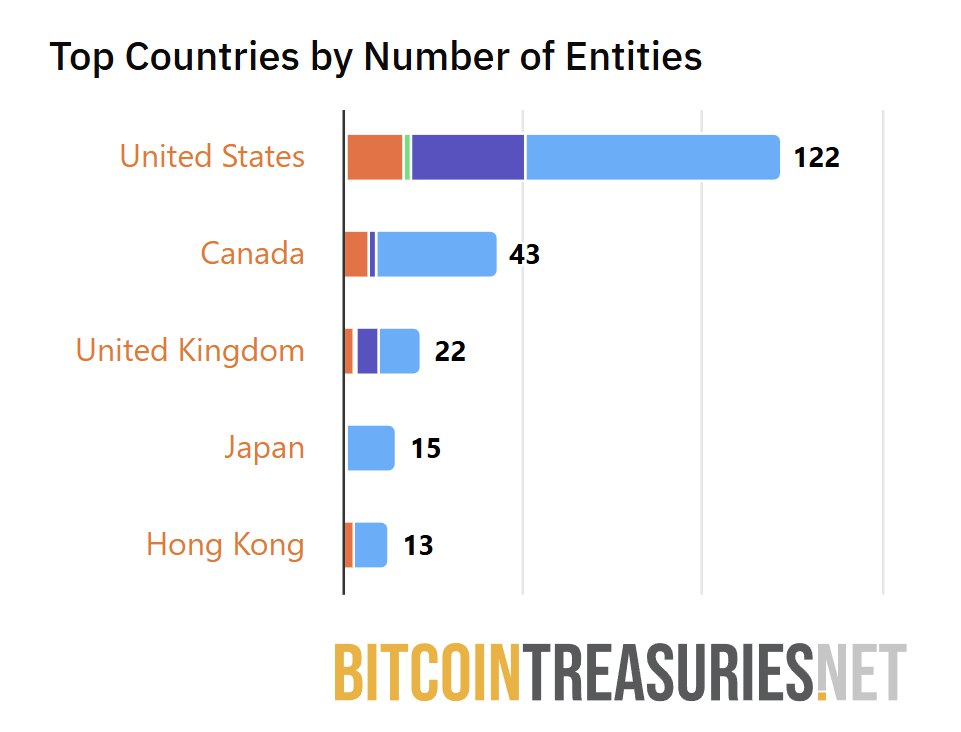
According to fresh data from BitcoinTreasuries.net, the United States has taken a commanding lead in institutional Bitcoin adoption, with 122 entities, including corporations, funds, and public institutions, now holding Bitcoin on their balance sheets.
This figure far exceeds other major economies. Canada ranks second with 43 entities, followed by the United Kingdom (22), Japan (15), and Hong Kong (13). The data underscores America’s growing dominance in the digital asset space, reflecting both increasing institutional confidence and regulatory clarity following the approval of multiple Bitcoin ETFs earlier this year.
Analysts attribute the surge in U.S.-based holdings to the convergence of two factors: ETF-driven inflows and a wave of corporate treasury diversification. Companies ranging from tech innovators to financial firms have begun accumulating Bitcoin as both a strategic reserve and an inflation hedge amid ongoing macroeconomic uncertainty.
Meanwhile, Canada continues to strengthen its reputation as a global crypto hub, leveraging its progressive financial regulations and early adoption of Bitcoin ETFs. The United Kingdom and Japan are also showing signs of growth, though both markets remain relatively conservative compared to North America.
The report marks a turning point in Bitcoin’s institutionalization. What began as a niche investment for risk-tolerant corporations is rapidly evolving into a mainstream financial strategy, with the U.S. leading a new era of global digital reserve accumulation.