


New unemployment insurance data for the week ending December 6 points to fresh softening in the U.S. labor market, with initial jobless claims rising sharply and several key indicators moving higher.
The latest release shows that labor-market conditions are losing momentum heading into year-end, even as insured unemployment rates remain relatively low by historical standards.
Initial Claims Rise by 44,000
Seasonally adjusted initial claims increased to 236,000, up 44,000 from the previous week’s revised level of 192,000. The four-week moving average edged up to 216,750, continuing a modest upward trend that reflects gradually cooling hiring conditions.
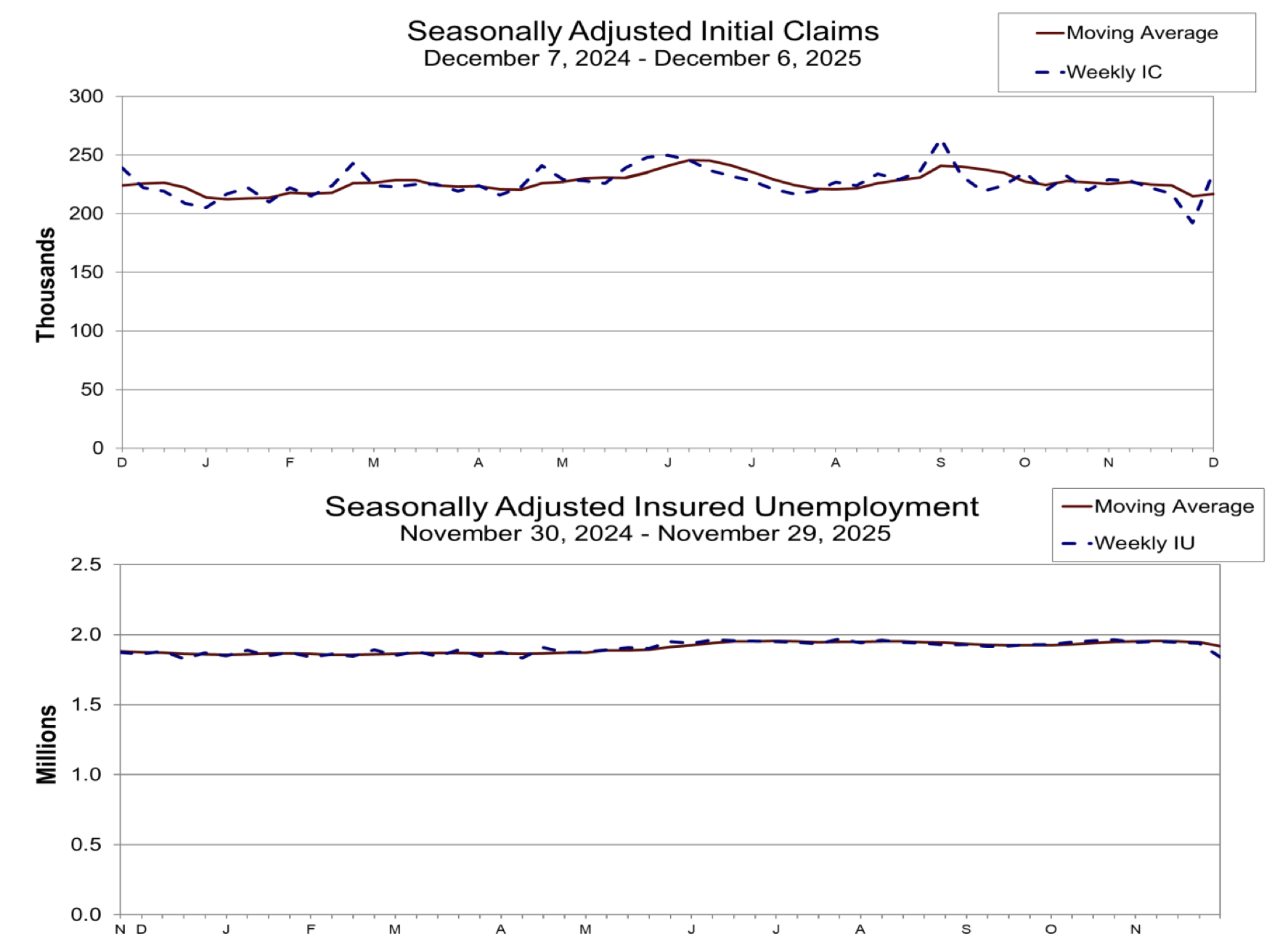
On an unadjusted basis, initial claims totaled 313,140, a significant increase of 114,967, far above the level anticipated by seasonal factors. Compared with the same week in 2024, claims remain slightly higher, signaling a labor market that is no longer as tight as earlier in the year.
Insured Unemployment Declines but Unadjusted Figures Rise
The seasonally adjusted number of people receiving unemployment benefits fell to 1,838,000, a decrease of 99,000 from the prior week. That pushed the insured unemployment rate down to 1.2%, a 0.1 percentage point improvement.
However, the unadjusted numbers show a different picture. Insured unemployment climbed to 1,964,961, an increase of 268,460, suggesting a growing pool of workers relying on benefits as the holiday season progresses.
The four-week moving average for insured unemployment dropped to 1,918,000, but remains elevated compared to earlier months.
State-Level Shifts Point to Regional Divergence
Several states saw notable shifts in initial claims:
- Largest increases: Pennsylvania (+2,208), Wisconsin (+1,092), Nebraska (+870), Iowa (+605), Ohio (+493).
- Largest decreases: California (-19,844), Texas (-7,836), New York (-3,453), Illinois (-2,216), Florida (-2,185).
The highest insured unemployment rates for the week ending November 22 were recorded in New Jersey and Washington (2.2%), followed by Massachusetts (1.9%) and a cluster of states, including Alaska, Connecticut, Nevada, Puerto Rico, and Rhode Island, all at 1.8%.
Federal Civilian and Veteran Claims Decline
Claims filed by former federal employees dropped to 643, while newly discharged veterans filed 223 initial claims, a week-over-week decrease for both groups. Continued weeks claimed for federal employees and veterans also fell notably, reinforcing a downward trend in these categories.
Total Benefit Claims Decrease Across All Programs
Across all unemployment insurance programs, continued weeks claimed fell to 1,731,322, a decline of 92,675. That level remains above the comparable week in 2024 but signals some stabilization despite the recent jump in initial claims.
A Labor Market Losing Its Edge
The combination of rising initial claims, higher unadjusted insured unemployment, and regional disparities suggests a labor market transitioning away from the extremely tight conditions of the past two years. While the insured unemployment rate remains historically low, the momentum of job gains appears to be cooling, consistent with broader economic data pointing to slower growth.