





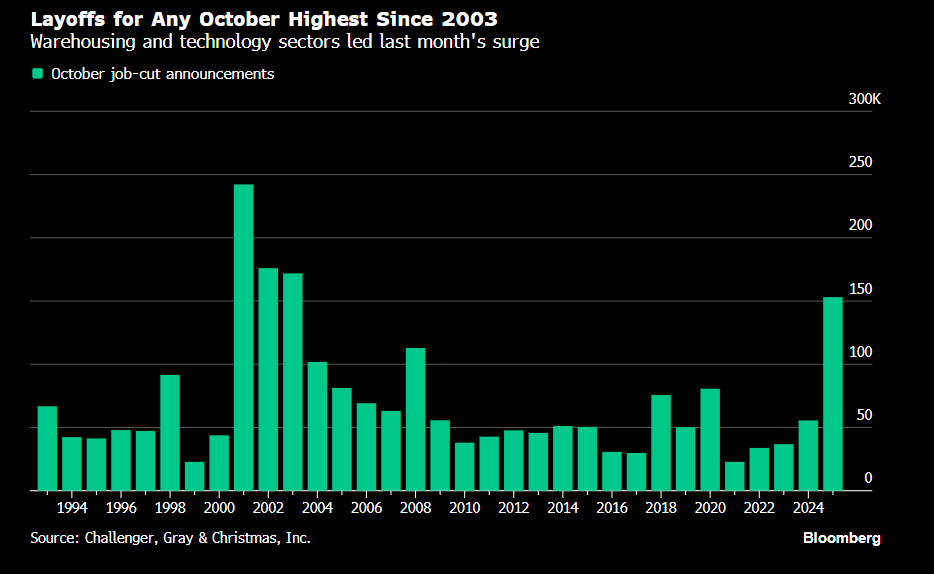
U.S. companies announced 153,074 job cuts in October 2025, marking the highest total for that month since 2003, according to data from Challenger, Gray & Christmas. The report reveals a steep rise in layoffs driven by AI automation, cost-cutting measures, and slowing consumer demand, underscoring growing strain in the U.S. labor market.
AI and Cost-Cutting Lead the Charge
The surge in job cuts highlights the ongoing transformation in U.S. corporate strategy as companies increasingly turn to automation and restructuring to preserve margins.
According to Challenger, Gray & Christmas, cost-cutting accounted for 50,437 layoffs, while artificial intelligence-related restructuring led to 31,039 job losses. Analysts say firms are accelerating AI integration to streamline workflows and reduce labor costs amid economic uncertainty.
“AI adoption has moved from experimentation to implementation,” the report noted, “and that shift is beginning to displace thousands of administrative and support roles.”
Warehousing and Tech Sectors Bear the Brunt
The warehousing industry saw the steepest decline, with nearly 48,000 jobs eliminated, reflecting a post-pandemic correction as shipping volumes and consumer goods demand normalize. UPS led the cuts, citing structural reorganization and automation in distribution centers.
The technology sector followed with 33,281 job losses, a 60% increase from September, driven by continued workforce reductions at major firms such as Amazon, Meta, and Salesforce.
While tech companies were among the earliest to adopt large-scale AI initiatives, October’s data suggests the second wave of cuts is targeting mid-level and operations roles previously considered stable.
Hiring Plans Stall to Decade Low
In addition to mass layoffs, the report revealed that announced hiring plans have plunged to their lowest year-to-date level since 2011. Employers have slowed recruitment amid declining consumer spending and elevated borrowing costs.
The combination of rising automation and cautious hiring signals a shift in corporate behavior, with firms preparing for a prolonged period of weaker economic growth.
Policy Implications and Economic Outlook
The October data adds pressure on the Federal Reserve, which has closely monitored employment figures as a key gauge of economic resilience. Analysts warn that if job losses continue to climb into early 2026, it could prompt the Fed to reconsider its rate stance to prevent a broader slowdown.
Still, some economists believe that productivity gains from AI could offset long-term employment risks. “The short-term pain from automation may translate into higher efficiency and lower inflation down the line,” Challenger’s report suggested.
Conclusion
With over a million jobs cut so far in 2025 and AI-driven restructuring accelerating, the U.S. labor market is undergoing one of its sharpest transitions in decades. For policymakers and workers alike, the coming months will test whether this wave of automation leads to renewed growth, or a deeper employment downturn.



