



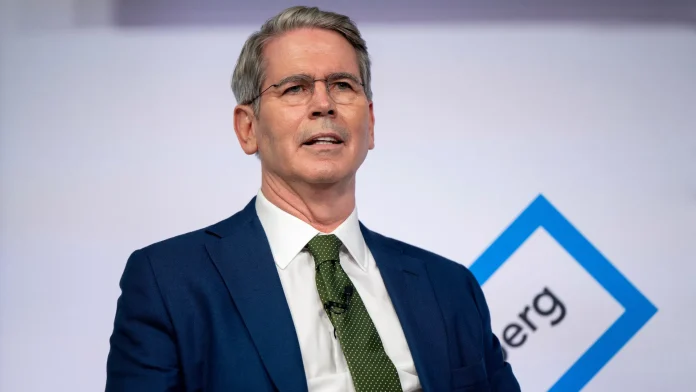

During a high-stakes Senate Banking Committee hearing on February 5, 2026, Treasury Secretary Scott Bessent delivered a blistering critique of a “nihilist group” within the crypto industry.
Bessent accused these market participants of actively sabotaging the Digital Asset Market Clarity Act (CLARITY Act), the administration’s flagship market structure bill, to avoid federal oversight.
In one of the most polarizing moments of the hearing, Bessent issued a direct ultimatum: those who refuse to accept U.S. regulatory standards should “move to El Salvador,” a reference to the nation’s Bitcoin-friendly, but less stringent, regulatory environment. “It is impossible to proceed without it,” Bessent stated, emphasizing that federal rules are the only path forward for the U.S. digital asset industry.
The Stablecoin Yield Battleground
The primary catalyst for the current legislative stalemate is a controversial provision involving stablecoin rewards. The banking lobby has exerted significant pressure on lawmakers to prohibit crypto exchanges from paying interest on stablecoin balances, fearing a “deposit flight” from traditional community banks to digital wallets.
- The “Nihilist” Divide: Bessent’s “nihilist” label targeted firms that he believes would rather see the bill fail than accept a ban on yield.
- Banking Lobby Influence: Traditional financial institutions argue that yield-bearing stablecoins function as “uninsured deposits,” creating an unfair competitive advantage and systemic risk.
- Congressional Frustration: Senator Mark Warner (D-VA) echoed the Secretary’s exhaustion, describing the months-long negotiation process as “crypto hell” and noting that national security protections in decentralized finance (DeFi) remain a major hurdle.
Industry Withdrawal: The Coinbase “Rug Pull”
The gridlock intensified in January 2026 when Coinbase CEO Brian Armstrong officially pulled the exchange’s support for the bill. Armstrong’s reversal came after a Senate rewrite introduced several “poison pill” provisions that the industry found untenable.
| Key Industry Grievance | Description of Provision |
| Stablecoin Yield Ban | Effectively prohibits interest or rewards on USD-pegged stablecoins. |
| Tokenized Equity Ban | A de facto block on trading tokenized stocks on crypto infrastructure. |
| SEC Power Expansion | Grants the SEC significantly more control over markets than the industry-preferred CFTC. |
| DeFi Prohibitions | Brings decentralized protocols under strict Bank Secrecy Act and AML rules. |
Armstrong’s stance, “we’d rather have no bill than a bad bill”, effectively stalled the Senate markup, as the legislation requires bipartisan support to reach the 60-vote threshold.
Market Reaction: “Black Thursday” Deepens
Bessent’s testimony, combined with his firm ruling out of any federal bailouts for digital asset firms, sent Bitcoin into a tailspin. On the day of the hearing, Bitcoin plummeted over 12%, hitting a session low of $62,353 before recovering slightly to the $65,000 range.
The market is currently pricing in a “worst-case” regulatory scenario: one where the U.S. remains without a clear federal framework, leaving companies trapped in a cycle of “regulation by enforcement” while institutional capital remains sidelined by the lack of legal clarity.
Strategic Takeaway: The Offshore Threat
The Secretary’s El Salvador comment underscores a growing rift between the “innovation-first” wing of the crypto industry and the “compliance-first” mandate of the Treasury. For the CLARITY Act to survive 2026, the administration must resolve the stablecoin yield conflict. If the banking lobby succeeds in banning rewards, analysts warn that the “Digital Dollar” innovation could migrate permanently offshore, fulfilling Bessent’s ultimatum in a way that may ultimately harm U.S. financial competitiveness.



