

New data from River shows that 14 of the top 25 U.S. banks are now actively building Bitcoin-related products for customers, marking a clear shift in how traditional financial institutions approach digital assets.
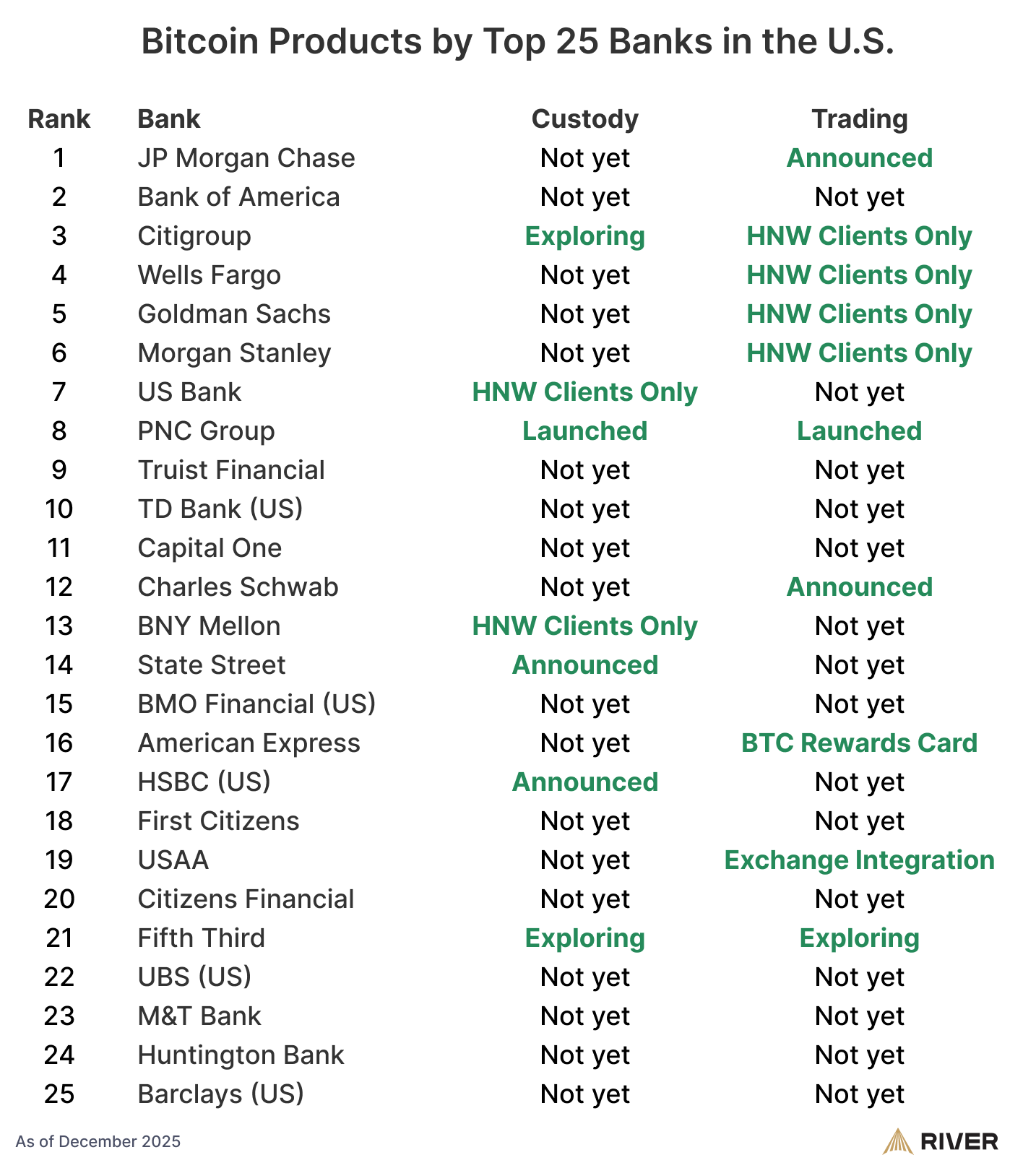
The chart, current as of December 2025, highlights how Bitcoin adoption is moving from exploratory discussions into concrete product development across the U.S. banking sector.
Bitcoin Moves From Experiment to Strategy
Among the largest banks in the United States, Bitcoin services are no longer limited to isolated pilots. Several institutions have already launched or announced Bitcoin trading and custody offerings, while others are actively exploring entry points.
Notably:
- PNC Group stands out as one of the few banks that has launched both custody and trading.
- JP Morgan Chase and Charles Schwab have announced Bitcoin trading, signaling intent to expand access.
- State Street and HSBC (U.S.) have announced custody plans, positioning themselves for institutional-grade crypto services.
High-Net-Worth Clients Lead Early Access
The chart also shows that Bitcoin access remains tiered at many institutions. Several major banks, including Citigroup, Wells Fargo, Goldman Sachs, Morgan Stanley, U.S. Bank, and BNY Mellon, currently limit Bitcoin exposure to high-net-worth (HNW) clients only.
This approach suggests banks are prioritizing controlled rollouts, targeting wealth management clients before expanding services to broader retail audiences.
Alternative Entry Points Beyond Trading
Not all banks are entering through spot trading or custody. Some institutions are offering indirect Bitcoin exposure:
- American Express provides a Bitcoin rewards card
- USAA supports exchange integrations
- Fifth Third is exploring both custody and trading
These models indicate banks are testing multiple pathways into Bitcoin without fully committing to direct custody or execution.
A Gradual Shift That’s Gaining Momentum
While 11 of the top 25 banks still list Bitcoin services as “not yet,” the overall trend is clear. Adoption is unfolding gradually, but once foundational infrastructure and regulatory clarity align, expansion tends to accelerate quickly.
The chart supports the idea that Bitcoin adoption by U.S. banks is following a familiar pattern: slow progress at first, followed by rapid normalization as products move from pilot stages into standard offerings.
Big Picture
With more than half of the largest U.S. banks now involved in building Bitcoin products in some form, Bitcoin is steadily integrating into the traditional banking system. What was once viewed as a fringe asset is increasingly being treated as a core financial product, first for institutions and wealthy clients, and eventually for the broader market.