


In a rare statistical anomaly, two solo miners independently solved valid Bitcoin blocks within the same week of January 2026, each capturing the entire block reward worth roughly $300,000.
The back-to-back wins stood out in a mining environment overwhelmingly dominated by large industrial pools.
A Rare Week for Solo Mining
Solo block discoveries are unusual in 2026, as major pools control more than 57% of total network hashrate. Yet despite the odds, two independent operators succeeded just days apart:
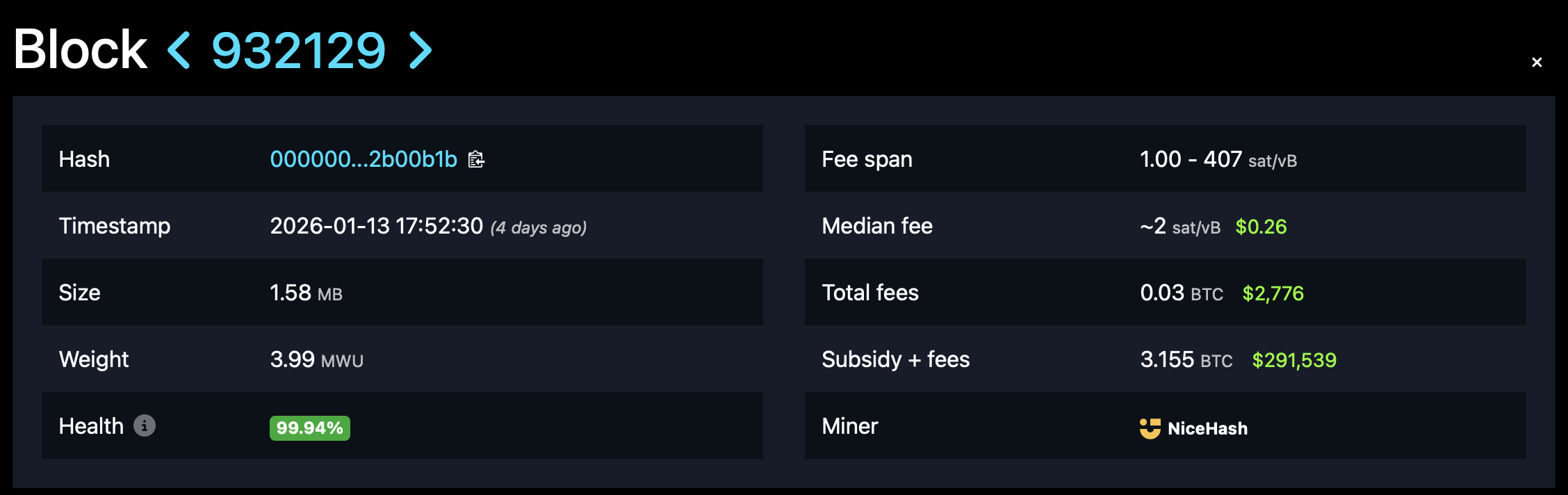
- Tuesday, January 13: An unknown solo miner processed Block 932,129, earning approximately $295,000 from 3.125 BTC plus transaction fees.
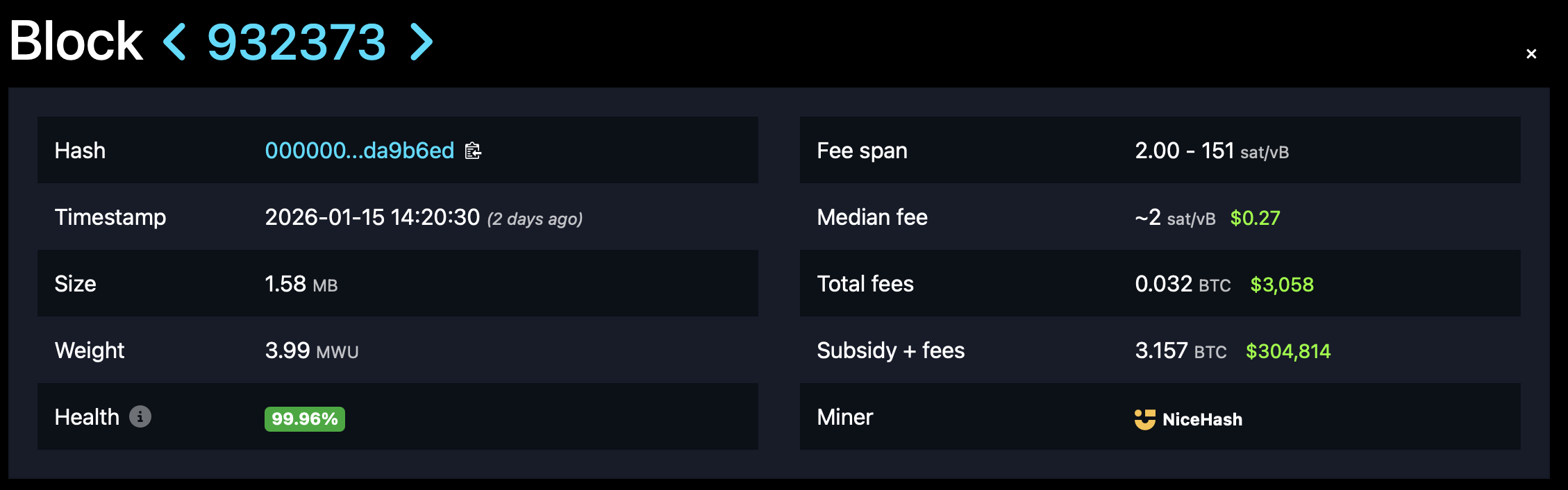
- Thursday, January 15: A second solo miner solved Block 932,373, securing a payout of $304,814, totaling 3.157 BTC.
Each miner kept the full reward rather than sharing it with a pool, an outcome many consider the ultimate long-shot in modern Bitcoin mining.
Why Solo Wins Are So Unlikely
The difficulty of solo mining continues to rise as network power reaches new highs. By mid-January 2026, the Bitcoinnetwork’s hashrate surged to about 1,024 exahashes per second (EH/s), reflecting intense global competition.
For context, a hobbyist running a typical home ASIC at 6 terahashes per second (TH/s) faces odds comparable to a global lottery. Statistically, such a setup has roughly a 1-in-170-million chance of finding a block on any given attempt.
Even so, solo miners do occasionally succeed. Over the past 12 months, independent operators validated 22 blocks, averaging one solo win every 15.6 days. January’s two-block streak simply compressed that probability into an unusually short window.
How Solo Miners Compete Without Pools
Most solo miners don’t operate entirely alone. Instead, they rely on specialized infrastructure that avoids reward sharing while still coordinating work across the network:
- CKPool is a popular choice, enabling solo miners to keep 98% to 100% of the block reward when successful.
- Public Pool offers an open-source alternative, allowing miners to run local solo-mining infrastructure without joining a traditional profit-splitting pool.
These services don’t improve the odds of winning, but they ensure that if a miner does succeed, the payout remains theirs alone.
A Reminder of Bitcoin’s Open Design
The twin January wins serve as a reminder that, despite industrialization, any participant can still mine a block under Bitcoin’s rules. While the economics favor scale, the protocol remains open, and probability occasionally rewards even the smallest players.
For many hobbyists, that slim chance, and the possibility of a life-changing payout, continues to define the enduring appeal of solo Bitcoin mining.