
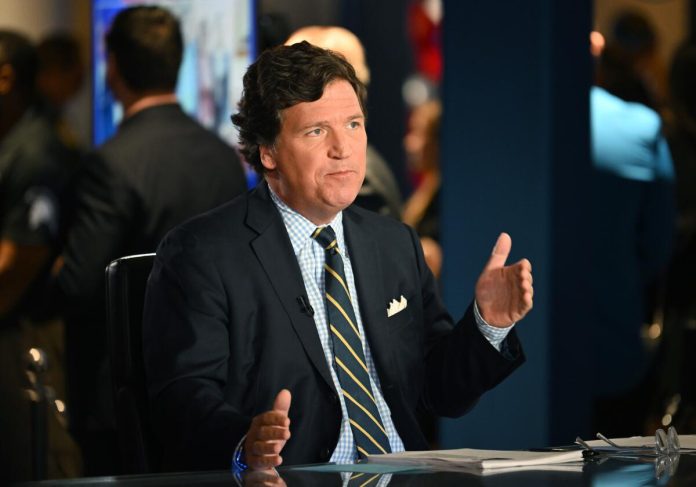

At a Turning Point USA event this week, television host Tucker Carlson reignited controversy in the crypto world by suggesting that Bitcoin’s mysterious creator, Satoshi Nakamoto, may have ties to the CIA.
Carlson, known for his sharp political commentary, told the audience he avoids investing in Bitcoin because of its opaque origins and the significant amount of dormant BTC tied to Nakamoto’s wallets.
“I don’t invest in things I don’t fully understand,” Carlson said, adding that his “guess” is Satoshi was a creation of the CIA, though he admitted he has no concrete evidence. The statement echoes similar remarks he made during the Bitcoin 2024 conference, where he described the cryptocurrency as a possible “honeytrap.”
Despite his skepticism, Carlson acknowledged that Bitcoin embodies an appealing ideal of financial freedom and autonomy, comparing its ethos to encrypted apps like Signal, another technology he noted has connections to the intelligence community.
“Just because the government is interested in something,” he said, “doesn’t mean they didn’t build it.”
The crypto community responded swiftly. Many Bitcoin advocates dismissed Carlson’s theory, arguing that Satoshi’s identity no longer matters because Bitcoin operates on an open-source, decentralized protocol that anyone can audit. Jack Mallers, CEO of Strike, called the claim a “misunderstanding of how decentralization works,” emphasizing that no single entity, including governments, can control Bitcoin.
For long-time Bitcoiners, the debate over Satoshi’s identity is largely symbolic. As one developer put it, “It doesn’t matter who made fire, what matters is that everyone can use it.” Carlson’s remarks, however, have reignited a familiar conversation about trust, control, and the blurred lines between innovation and surveillance in the digital age.