

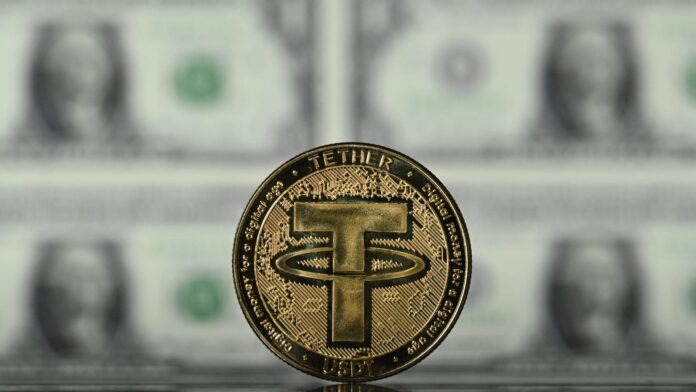

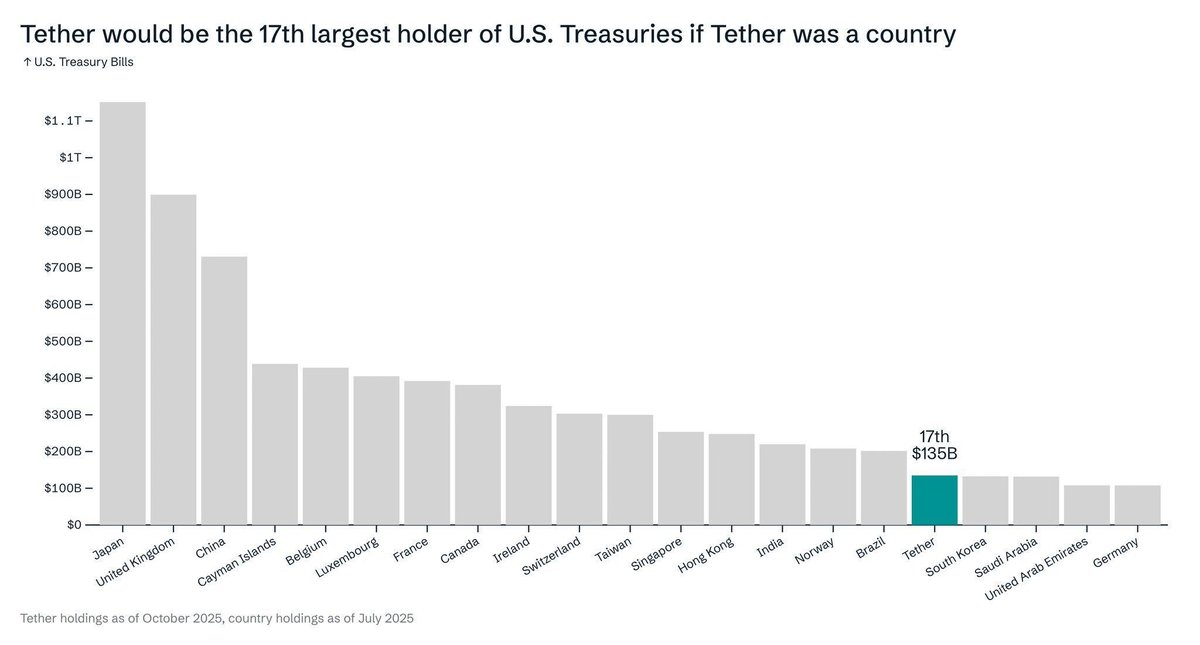
Tether has quietly climbed the ranks of global finance, becoming the 17th largest holder of U.S. Treasury securities, surpassing major economies like Saudi Arabia and Germany. With $135 billion in U.S. Treasuries, the stablecoin issuer now sits among the world’s largest institutional creditors to the U.S. government.
A New Force in Global Liquidity
If Tether were a country, its Treasury holdings would place it just behind Brazil and South Korea, according to data compiled in October 2025. This rapid accumulation underscores how stablecoin issuers have evolved into major players in the global liquidity system, bridging digital finance and traditional markets.
Tether’s portfolio growth also highlights the increasing integration of crypto-backed assets into mainstream financial infrastructure. As global demand for stablecoins expands, issuers like Tether have been converting user deposits into short-term U.S. debt, effectively injecting additional liquidity into the Treasury market.
Competing with Nations
The company’s position now rivals sovereign investors, with a portfolio on par with that of major central banks and foreign governments. Analysts note that this represents a profound shift in market structure, where private digital currency issuers are now absorbing a share of the same instruments that underpin global monetary stability.
Tether’s holdings also serve as a stabilizing anchor for its USDT reserves, which remain the most widely used stablecoin in crypto trading and cross-border settlement. Its Treasury exposure has grown consistently over the past two years as the company restructured its reserves to reduce risk and improve transparency.
Stablecoins Cement Their Role in Finance
Tether’s rise marks another milestone in the convergence between crypto and traditional finance. Stablecoins, once dismissed as niche tools for traders, are now becoming systemic liquidity providers with influence comparable to that of smaller national economies.
As regulatory clarity around digital dollars improves, Tether’s scale shows just how deeply blockchain-based financial entities are embedding themselves in the global monetary ecosystem, turning crypto liquidity into a core component of the U.S. debt landscape.