
- Bithumb launched a SUI staking vault offering daily rewards, institutional custody, and a 9.6% APR to retail investors.
- Mysten Labs released a composable Move SDK supporting cross-chain deployment, modular storage, NFT issuance, and DeFi strategy tools.
In March 2025, Canary Capital filed a proposal for a spot SUI ETF with the U.S. SEC, signaling growing institutional interest. This move was followed by a strategic partnership with 21Shares aimed at expanding regulated access to SUI globally. In another key development, World Liberty Financial (WLFI) added SUI to its crypto reserves, strengthening Sui’s position in DeFi infrastructure.
Following a mid-2025 security exploit that resulted in a $29 million loss, the Sui team partnered with Blockaid to reinforce its security framework. The network also introduced zkLogin and WebAuthn passkey support, greatly enhancing user authentication and onboarding experience.
Ecosystem Growth and User Adoption
The Sui ecosystem has grown rapidly. By early 2025, the network had surpassed 50 million accounts and supported over 100 decentralized applications. Its total value locked (TVL) ranged between $1.8 and $2.1 billion, and its daily DEX trading volume typically fluctuated between $400 million and $800 million. Notable projects such as Scallop, a DeFi lending protocol, have secured over $130 million in TVL, underscoring Sui’s growing appeal among developers and DeFi users alike.
Controversies and Token Unlocks
Despite strong momentum, Sui has faced controversy. In late 2024, accusations surfaced regarding insider token sales by the Sui Foundation, allegedly worth $400 million. The foundation denied any misconduct, emphasizing its compliance protocols and vesting schedules.
Additionally, large token unlock events in late 2024 and mid-2025—releasing over $50 million and later $265 million worth of tokens—introduced short-term price volatility. However, continuous whale accumulation.
Meanwhile, Binance introduced two new perpetual futures pairs: SUI/USDC and SUI/FDUSD. The exchange cut maker fees for thirty days to encourage institutional arbitrage. As a result, traders can expect higher derivatives volume and deeper order books. Lower fees should make it easier for large participants to enter and exit positions.
In South Korea, Bithumb launched a SUI staking vault with daily payouts and institutional-grade custody. Retail investors can lock tokens and earn an initial 9.6 percent APR. The service covers more than two million verified accounts in Korea. Therefore, local users gain reliable access to yield without complex setup or high minimums.
Mysten Labs rolled out a composable SDK for Move-based dApp creation. The toolkit supports cross-chain deployment, modular storage, and streamlined NFT issuance. Developers can now build DeFi strategies and tokenized assets with fewer code dependencies. Thus, the update aims to reduce integration friction and speed up time to market for new applications.
Finally, Sui Network began a private beta with a European telecom operator to test smart contract use in IoT infrastructure. The trial will track and certify energy‑efficient sensors using on-chain data signatures. If successful, telecom firms may adopt blockchain as a standard layer for connected hardware.
Overall, today’s announcements reflect Sui’s push to broaden its reach. The token unlock, trading incentives, staking options, developer tools, and IoT pilot form a multifaceted strategy. In practice, these steps may boost network activity and draw fresh interest to the Sui platform.
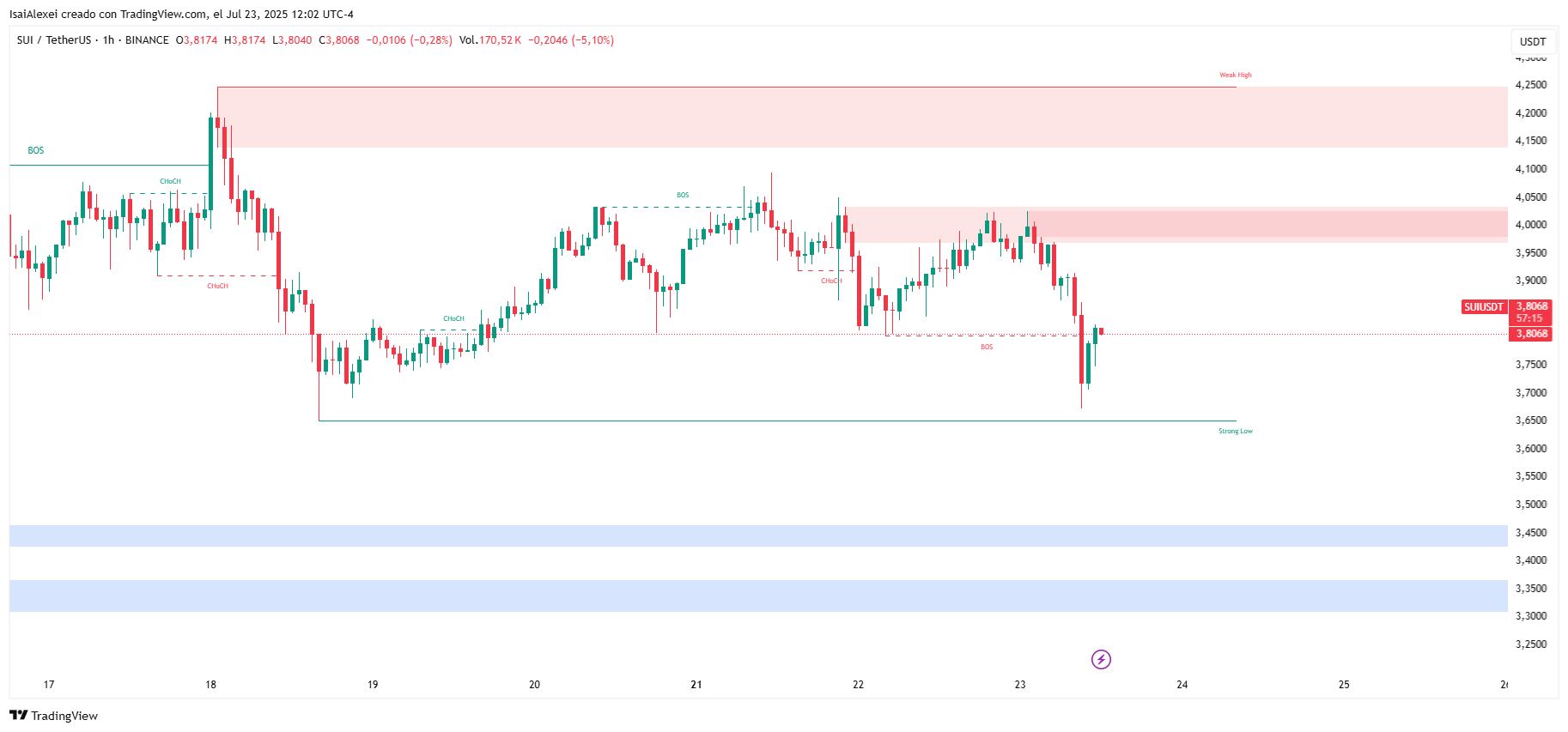
SUI (Sui Network) is priced at $3.77, marking a daily increase of 3.39%. The market capitalization is $13.05 billion, positioning SUI within the top 15 cryptocurrencies globally.
Its 24-hour trading volume is approximately $1.74 billion, up nearly 20%, indicating strong participation across spot and derivatives markets. The circulating supply is 3.45 billion SUI, out of a maximum supply of 10 billion, giving the token substantial room for supply unlock events in the future.
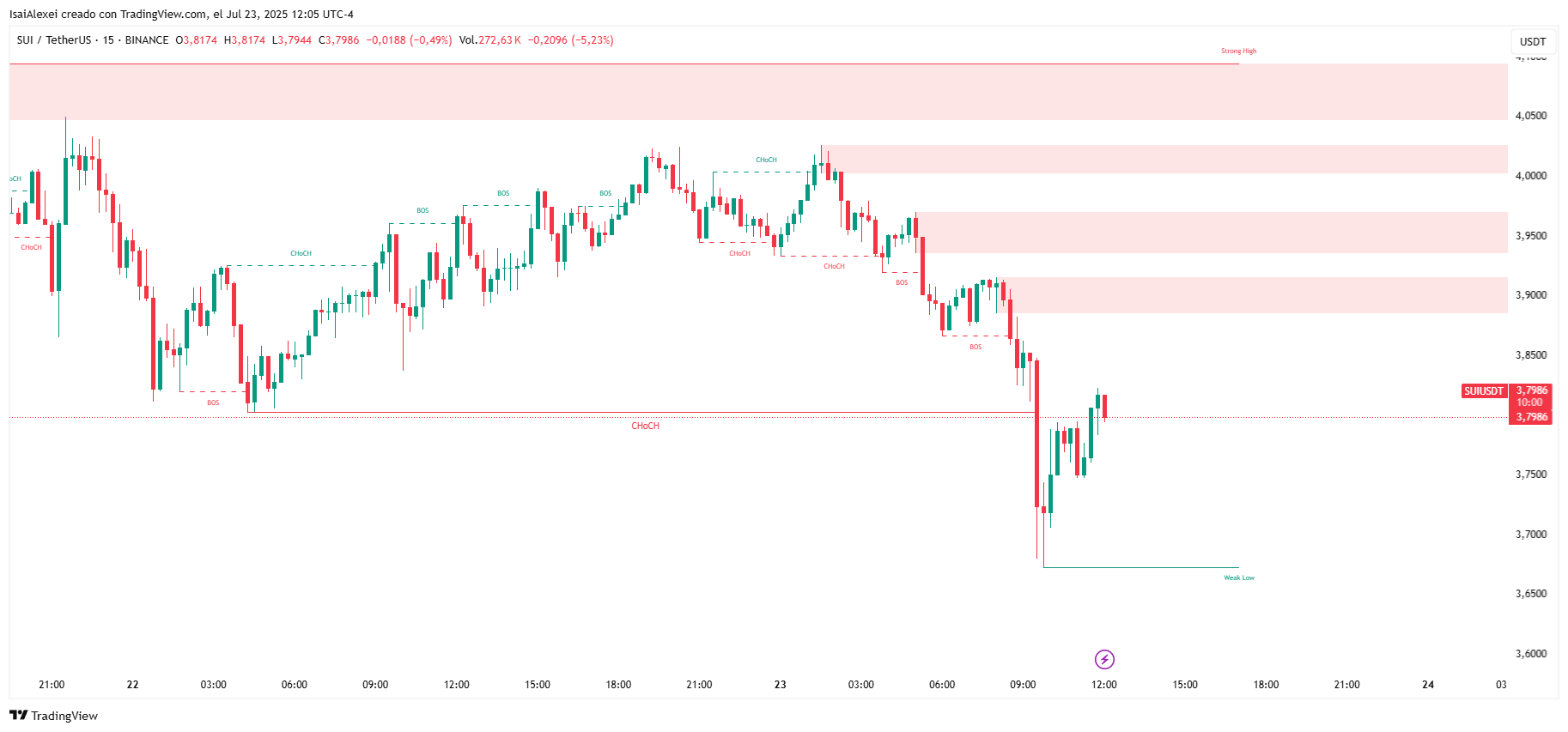
If SUI breaks through $3.80, the next upside target is $4.05, based on price projection from prior breakout zones. Support levels are currently established at $3.52 and $3.31.