





Michael Saylor’s Strategy has outlined a stress scenario showing it could withstand an 88% Bitcoin drawdown to $8,000 and still fully cover its debt obligations.
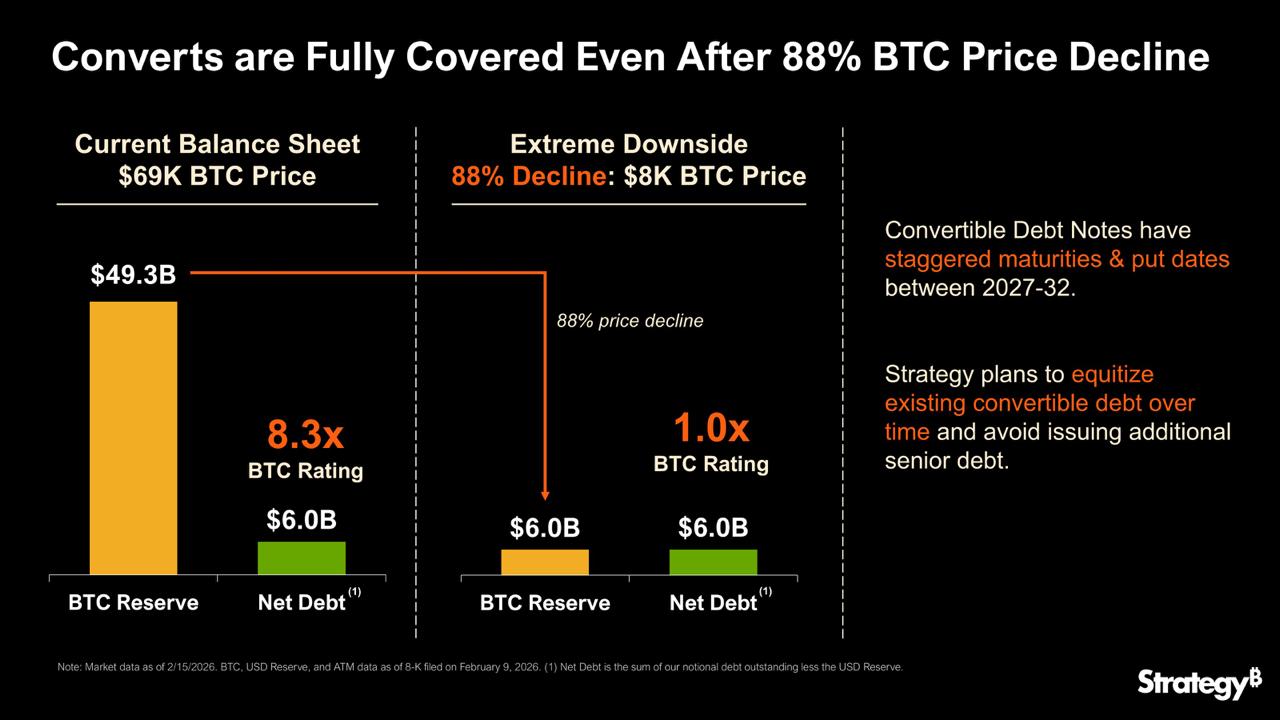
The slide presented by the company compares its current balance sheet at a $69,000 BTC price with an extreme downside case.
Current Position: $69K Bitcoin
At a BTC price of $69,000, Strategy reports:
- $49.3 billion in Bitcoin reserves
- $6.0 billion in net debt
- 8.3x BTC coverage ratio
This means the value of its Bitcoin holdings exceeds net debt by more than eight times under current conditions. The company defines net debt as total notional debt outstanding minus its USD reserves.
Stress Test: 88% Decline to $8K
In the extreme downside scenario:
- Bitcoin falls 88% to $8,000
- BTC reserves decline to approximately $6.0 billion
- Net debt remains at $6.0 billion
- Coverage ratio compresses to 1.0x
Even at that level, Strategy states it would still have sufficient assets to fully cover its debt. In other words, the company’s Bitcoin holdings would equal its net debt in value, avoiding insolvency under this modeled stress.
Debt Structure and Maturity Profile
The company also highlighted that its convertible debt notes have staggered maturities and put dates between 2027 and 2032, reducing short-term refinancing pressure.
Management has indicated it plans to:
- Gradually equitize existing convertible debt
- Avoid issuing additional senior debt
This structure is designed to limit forced liquidation risk during periods of volatility.
What This Means Structurally
The key takeaway is not just the size of the Bitcoin position, but the liability design behind it. Strategy is signaling that its capital stack is built to absorb extreme downside without triggering immediate solvency issues.
However, while the company may withstand such a move mechanically, a prolonged period at $8,000 would still test market confidence, equity valuation, and capital access.
The stress test frames Strategy’s approach clearly: high volatility is expected, and the balance sheet is structured to survive it, even in a historically severe Bitcoin drawdown scenario.



