




- Circle launched CCTP V2 on Stellar, enabling seamless USDC transfers across fifteen blockchains without needing a Circle account.
- PayPal’s PYUSD launch on Stellar supports low-cost transactions, reinforcing the network’s role in cross-border payments and remittance services.
Circle expanded USDC’s reach on 18 September by launching Cross-Chain Transfer Protocol (CCTP) V2 on Stellar. The upgrade allows users to move USDC between Stellar and 15 other networks—including Ethereum, Solana, and Base—without opening a Circle account. Stellar’s XLM traded around $0.4018 at publication, up roughly 4% on the day and week, reflecting steady interest after the release.
CCTP V2 adds new programmability. Developers can embed cross-chain transfers directly into apps and attach metadata that triggers automated actions on the destination chain through “Hooks.” In practice, a payment sent from Stellar to another network can also submit settlement instructions, update order records, or confirm delivery—clean, auditable steps that remove manual handoffs.
Circle’s market footprint widened in parallel
On 17 September, the firm announced a partnership with Kraken to bolster stablecoin rails for clients and introduce EURC support on the exchange. Separately, Circle detailed an integration for AI agents to pay for online services autonomously in USDC.
An agent calling a paywalled API, for example, can authorize and settle fees in one programmatic flow. The design aims to cut delays and lower error rates for machine-to-machine payments—more assembly line than art.
Stellar’s governance arm is also aligning with regulated on-chain finance. The Stellar Development Foundation joined the ERC-3643 Association, a standard used for permissioned digital securities. The move signals interest in compliant issuance and transfer controls while keeping settlement on public rails.
For market participants, the additions matter in three ways. First, they reduce friction for moving dollar liquidity across chains. Second, they give developers predictable tooling for automating post-trade steps.
Third, they position Stellar as a practical venue for both retail payments and institution-grade assets. Risks remain—cross-chain bridges and autonomous execution require strict monitoring, change controls, and incident response. Even so, the direction is clear: faster transfers, simpler app flows, and broader access to dollar tokens, with XLM tracking sentiment as adoption data arrives.
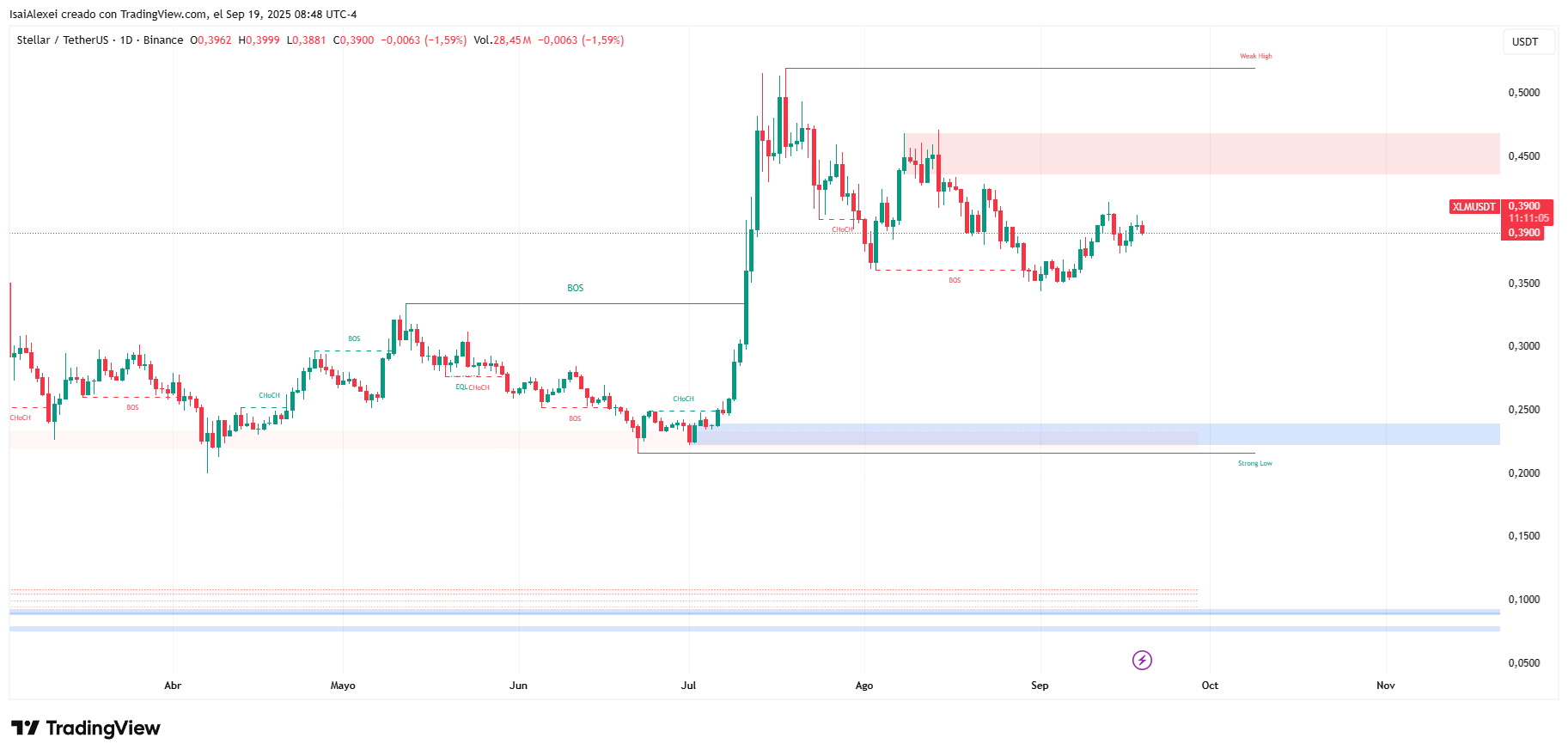
Stellar (XLM) is trading at $0.391, down 1.29% in the last 24 hours. Despite the dip, XLM has surged 307% year-over-year and remains up nearly 43% over the past six months, with a current market capitalization of $12.48 billion and daily trading volume of about $291 million.
Recent developments have kept Stellar in focus. PayPal integrated its PYUSD stablecoin with Stellar, allowing low-cost transactions and confirming plans to extend PYUSD to eight blockchains.
This partnership adds weight to Stellar’s role in payments infrastructure. At the same time, institutional interest continues through collaborations with companies such as IBM and MoneyGram, which use Stellar to facilitate cross-border transactions at reduced costs.
From a technical standpoint, Stellar is showing range-bound behavior. Resistance is forming near $0.40–$0.41, while support is observed around $0.369–$0.372, aligned with the 200-day simple moving average.
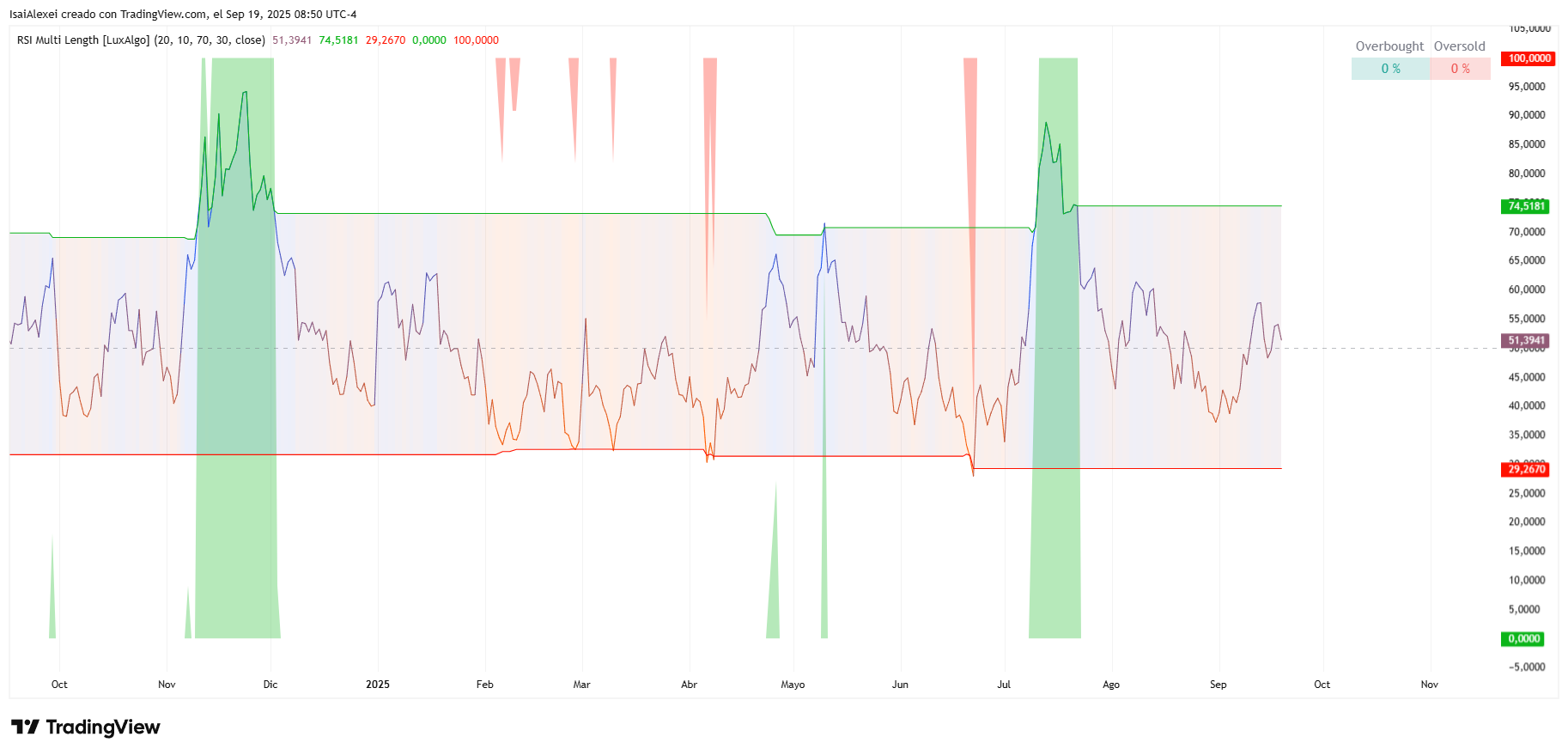
RSI indicators have cooled off from higher levels, hinting at short-term selling pressure. ETHNews analysts project a corrective move to $0.36, while others argue a successful close above $0.40 could open the path toward $0.47 in the near term.
In broader context, Stellar’s positioning is reinforced by its participation in projects like remittances, stablecoin infrastructure, and tokenized assets. By joining alliances such as the ERC-3643 Association, Stellar aims to expand into regulated markets, supporting its strategy of bridging traditional finance with blockchain-based systems.
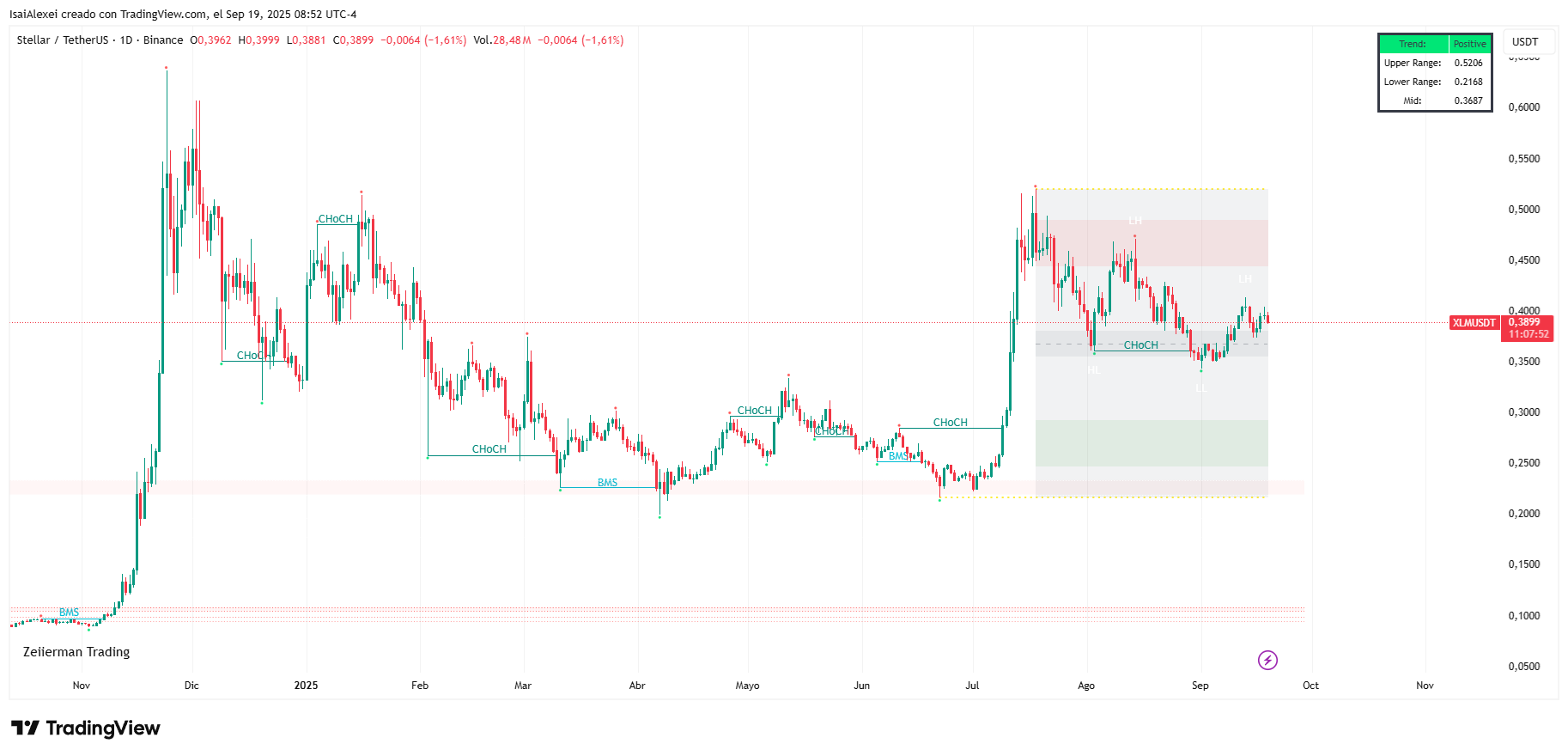
ETHNews prediction: If XLM holds above $0.372 and breaks past $0.41, it could climb toward $0.45–$0.47 within the next week. Failure to defend support could trigger a pullback toward $0.36 before any rebound.




