





XLM traded at $0.1662 on Binance as of the afternoon of March 20, up 0.12% on the hour but sitting below its declining 50 SMA at $0.1672, after climbing into a key resistance area through a triangle pattern breakout and quickly losing momentum, with analyst GainMuse identifying the rejection as a potential reversal signal pointing toward a deeper retracement.
What the 1-Hour Chart Shows
Stellar was trading near $0.1705 on the evening of March 19 and declined through a series of red candles into the early morning of March 20, dropping toward $0.1645 by around 09:00 UTC. Volume during that decline was mixed, with alternating pink and teal bars suggesting no sustained directional conviction from either side.
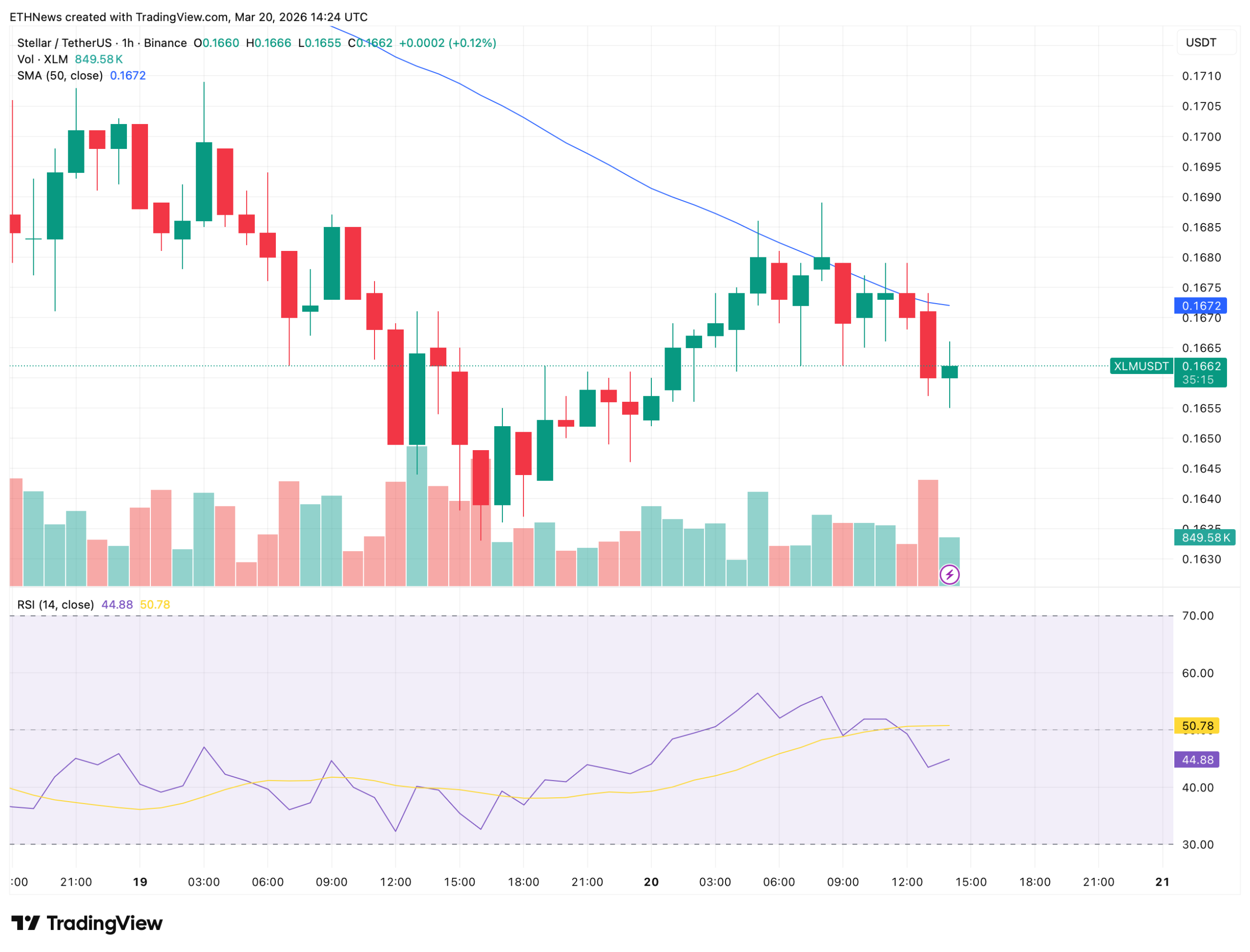
A recovery began around midday on March 20. A sequence of green candles pushed price from $0.1648 back toward $0.1689, with the 50 SMA declining from above near $0.1700 toward the $0.1672 level visible at the time of capture. Price briefly approached but did not sustain above the 50 SMA during that recovery. The most recent candle on the right edge of the chart shows a red bar pulling back from $0.1675 toward $0.1662, with the 50 SMA now sitting 0.6% above current price and sloping downward.
Volume on the most recent bar reads 849.58K XLM, among the larger volume bars visible on the right side of the chart, accompanying the afternoon pullback rather than the recovery that preceded it.
The RSI Crossover
The RSI indicator shows the faster purple line at 44.88, having crossed below the slower yellow line at 50.78. That crossover is the key near-term signal from the 1-hour chart. The purple line reached its highest visible reading near 58 during the midday recovery session before declining sharply back below the yellow line on the afternoon pullback. The yellow line sits precisely at the 50 midpoint.
A faster RSI crossing below the slower signal while the slower signal sits at exactly 50 reflects a momentum shift from neutral recovering to weakening. The purple line dropping from 58 to 44.88 in a single session confirms the recovery attempt lost its follow-through at the resistance level rather than consolidating above it.
The Longer Timeframe Structure
Crypto Trader GainMuse published a technical read on XLM/USDT covering a multi-week timeframe. The chart identifies a sequence of structural patterns: a wedge pattern forming through February, a consolidation channel developing into early March, a triangle pattern building through mid-March, and a breakout from that triangle that carried price into the resistance line visible at the top of the chart.
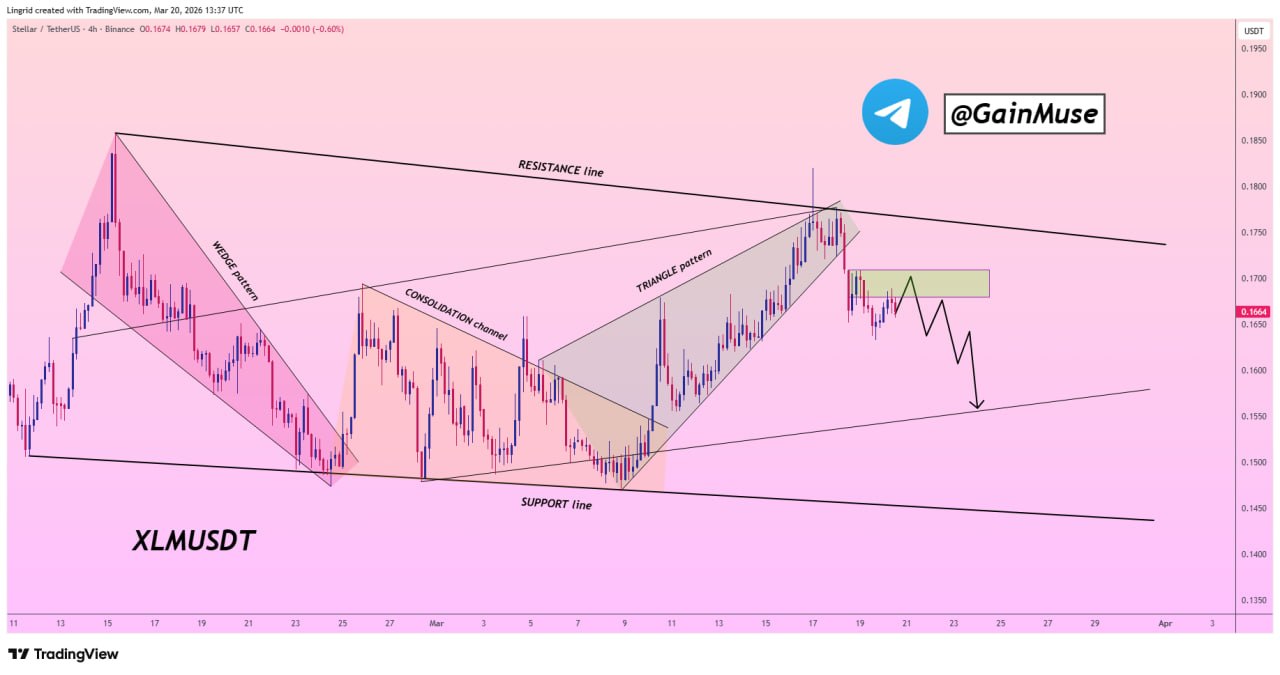
The critical observation is what happened at resistance. XLM climbed into the key resistance area on the back of the triangle breakout’s momentum and quickly lost strength. The pullback that followed is what GainMuse describes as a sign of exhaustion. The ascending structure that generated the breakout has not been able to sustain price above the resistance zone, which is the condition that turns a breakout into a failed breakout.
The near-term scenario GainMuse identifies is that a minor bounce from current levels could attract fresh selling interest and lead to a deeper retracement. The support line visible in the lower portion of the longer chart is the destination if that selling materializes. The invalidation is a sustained hold above the resistance zone, which would shift the structure toward continuation higher rather than reversal.
The Decision Level
Current price at $0.1662 sits 0.6% below the declining 50 SMA and below the resistance zone that rejected the triangle breakout on the longer timeframe. The RSI faster line has crossed below the slower line at the midpoint. Volume accompanied the afternoon pullback rather than the recovery. All three signals point in the same direction.
The triangle pattern that generated the breakout is structurally complete. Whether price finds support at current levels and makes another attempt at resistance or follows through lower toward the support line depends on whether buyers can reassert control before the faster RSI declines further toward the oversold zone it spent much of the March 19 session recovering from.



