


Stablecoins quietly delivered one of the strongest growth stories of 2025. On-chain data shows total stablecoin supply approaching $310 billion by mid-December, up more than 50% from roughly $205 billion at the start of the year.
The move places stablecoins at their largest footprint to date and confirms their expanding role across crypto markets.
Rather than a short-lived spike, the chart reflects a steady and accelerating climb throughout the year, ending 2025 far larger than most market participants expected.
What the Chart Reveals
The long-term supply curve shows a clear structural trend. After years of gradual growth, stablecoin supply surged sharply in earlier cycles, consolidated, and then resumed a powerful expansion in 2025. The latest leg higher stands out for both its scale and persistence.
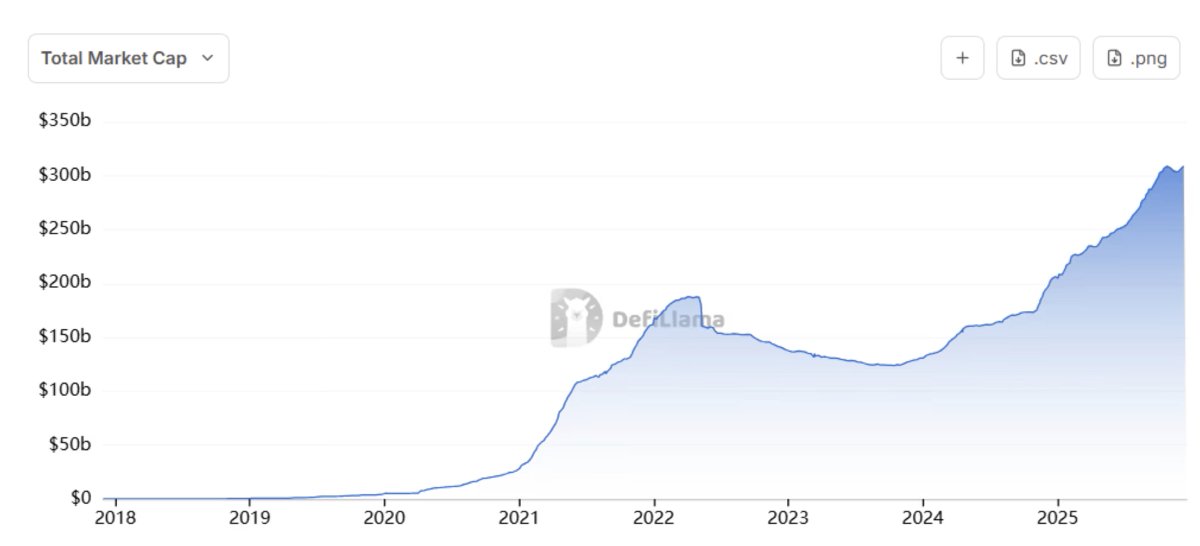
By mid-December, total stablecoin market capitalization is pressing toward the $310 billion level, marking a decisive break from the subdued conditions seen earlier in the cycle. The trajectory suggests that stablecoins are no longer just a defensive tool during downturns, but a core layer of crypto market infrastructure.
Liquidity, Not Speculation, Drives the Expansion
Unlike speculative token rallies, stablecoin growth typically reflects capital positioning rather than price appreciation. Rising supply signals that users, traders, and institutions are moving funds on-chain and keeping them there.
This behavior aligns with several broader market dynamics visible in 2025:
- Capital parking during volatile price action
- Increased use of stablecoins for trading, settlement, and transfers
- Growing reliance on stablecoins as a bridge between traditional finance and crypto markets
The chart suggests that liquidity is building inside the ecosystem, even when risk appetite fluctuates elsewhere.
A Bigger, Louder Finish to 2025
Stablecoins did not simply grow in the background this year—they finished 2025 as one of the most dominant forces in crypto. Ending the year with supply up more than 50% underscores how essential they have become for market structure, from centralized exchanges to on-chain activity.
Rather than signaling excess or instability, the data points to deeper adoption and normalization. As stablecoin supply pushes toward new highs, it highlights a market that is increasingly liquid, interconnected, and prepared for rapid shifts in opportunity.
In that context, 2025 may be remembered as the year stablecoins firmly established themselves as the backbone of on-chain capital.