


Stablecoin payments have grown sixfold in eighteen months, and the dominant use case is not what most of the industry predicted. Businesses paying other businesses have quietly become the engine behind one of the most significant shifts in how money moves globally, according to new data shared by payments infrastructure company BVNK.
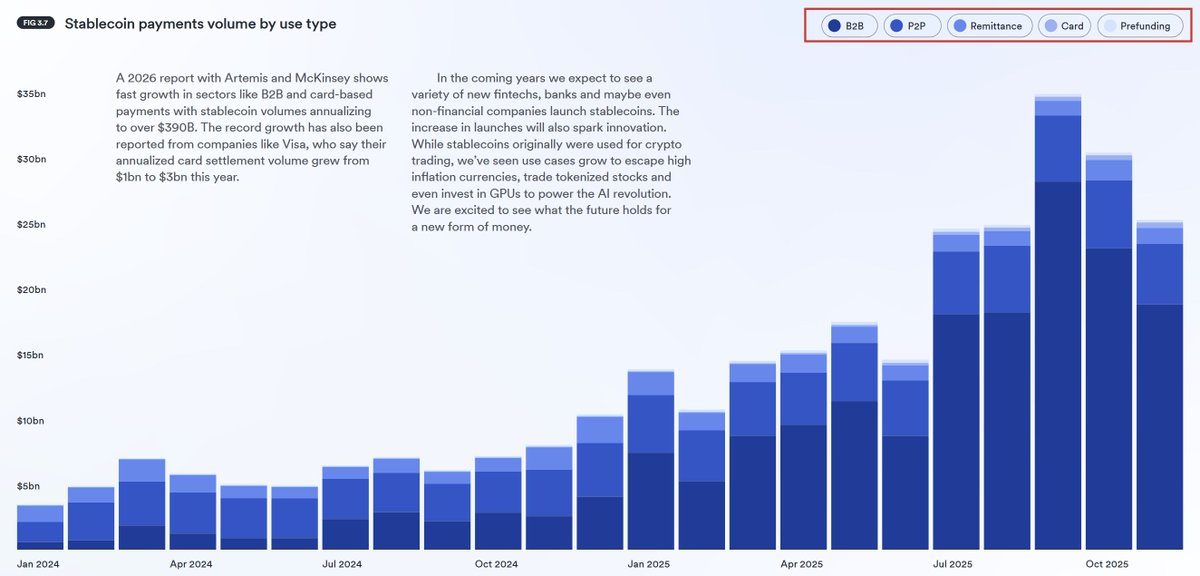
Citing a joint report from analytics platform Artemis and McKinsey, BVNK puts monthly stablecoin payment volume at over $30 billion as of early 2026, up from $5 billion in January 2024. Annualized, that figure runs above $390 billion. The breakdown by use type tells the more important story: B2B transactions account for the largest share of that volume by a considerable margin, outpacing peer-to-peer transfers, remittances, card payments, and prefunding combined. The chart accompanying the data shows B2B volume accelerating sharply from mid-2024 onward, with the steepest growth arriving in the second half of 2025.
Why Businesses Chose Stablecoins Over the Existing System
The appeal for corporate treasurers and finance teams is not ideological. It is operational. SWIFT, the messaging network that underpins most international bank transfers, can take one to five business days to settle a cross-border payment. Correspondent banking adds fees at each intermediary hop, and those hops can be numerous depending on the currency corridor. Stablecoins settle in seconds, operate around the clock including weekends and holidays, and require no intermediary network to function.
For businesses running high volumes of international transactions, those differences compound quickly. A company paying suppliers in multiple countries no longer needs to manage currency conversion windows, correspondent bank relationships, or settlement delays that tie up working capital. The Artemis and McKinsey data suggests a growing number of finance teams have done that math and acted on it.
The Use Cases Expanding Beyond Payments
BVNK notes that the original assumption about stablecoin adoption, that remittances and consumer transfers would lead the way, has not played out as the primary growth driver. B2B has taken that role instead. Card-based stablecoin payments have also grown, with Visa reporting its annualized card settlement volume rising from $1 billion to $3 billion, but that category remains well behind B2B in absolute terms.
The Artemis and McKinsey report points to several emerging use cases extending beyond straightforward payments. Stablecoins have found application in trading tokenized assets, providing an alternative store of value in high-inflation currency environments, and more recently in funding GPU infrastructure for artificial intelligence operations. Each of these represents a demand source that did not meaningfully exist two years ago, and each adds volume that sits outside the traditional payments categories the data tracks.
What Comes Next
The Artemis and McKinsey report, as cited by BVNK, anticipates that the next wave of growth will come from new entrants rather than existing participants scaling up. Fintechs, banks, and potentially non-financial companies are expected to launch their own stablecoins as the infrastructure matures and regulatory frameworks become clearer in major markets. More issuers mean more competition on fees, more liquidity across currency pairs, and potentially faster settlement in corridors that currently remain underserved.
The open question is whether the infrastructure supporting this volume can scale without introducing the counterparty and custodial risks that have historically followed rapid growth in crypto-adjacent financial products. Monthly volume crossing $30 billion is a milestone. Whether the systems, compliance frameworks, and institutional guardrails surrounding that volume are growing at the same pace is a question the next eighteen months will begin to answer.