


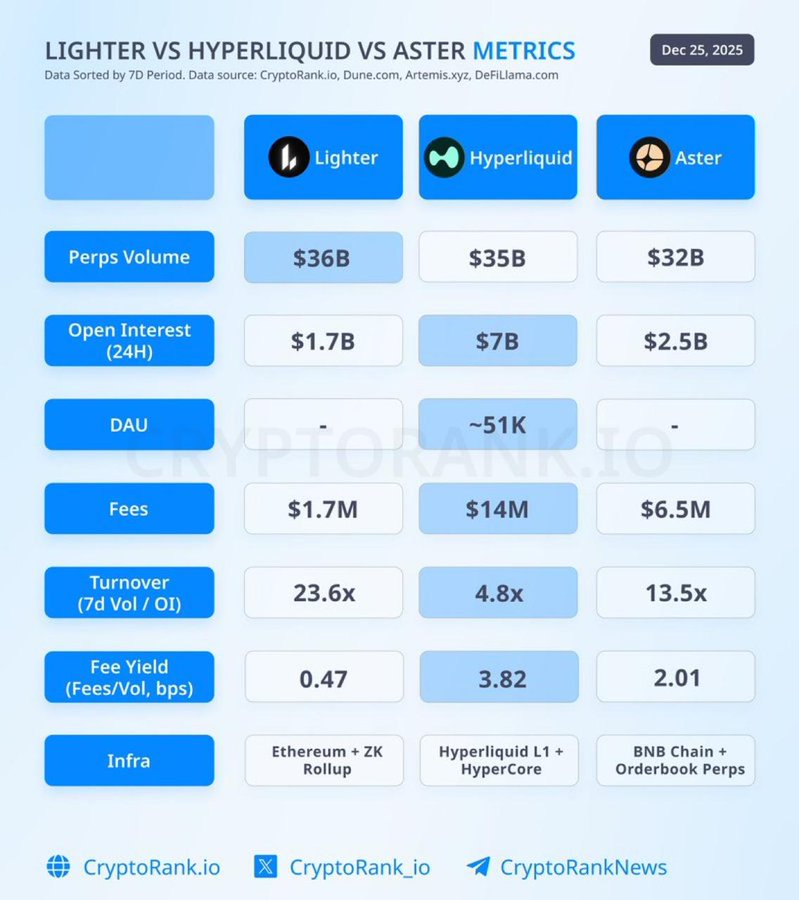
A side-by-side metrics comparison dated December 25, 2025 highlights how three onchain perpetual platforms, Lighter, Hyperliquid, and Aster, are scaling in sharply different ways, despite operating in the same fast-growing perp market.
The data, sorted over a seven-day period, shows that headline volume alone doesn’t tell the full story. Capital efficiency, fee extraction, and infrastructure choices are creating distinct performance profiles across the three venues.
Perpetual Volume Is Tight, But Capital Isn’t
At first glance, weekly perpetual volume looks closely matched. Lighter leads with $36 billion, followed by Hyperliquid at $35 billion, and Aster at $32 billion. The similarity ends there.
Open interest diverges sharply. Hyperliquid stands out with $7 billion in open interest, far exceeding Aster’s $2.5 billionand Lighter’s $1.7 billion. This suggests Hyperliquid is hosting significantly more outstanding positions relative to traded volume, pointing to deeper capital commitment per trader.
Turnover Shows How Aggressive Each Market Is
Turnover, measured as seven-day volume divided by open interest, reveals how quickly positions recycle.
Lighter posts an aggressive 23.6x turnover, implying rapid position rotation and high trading velocity. Aster follows at 13.5x, while Hyperliquid trails at 4.8x, reflecting a more capital-heavy, lower-churn environment.
These differences suggest Lighter is optimized for speed and frequent trading, while Hyperliquid supports larger, longer-held positions.
Fees and Yield Paint a Clear Revenue Picture
Fee generation highlights the strongest contrast. Hyperliquid dominates with $14 million in fees over the period, compared with $6.5 million for Aster and $1.7 million for Lighter.
Fee yield, measured in basis points relative to volume, reinforces this gap. Hyperliquid posts 3.82 bps, well above Aster’s 2.01 bps and Lighter’s 0.47 bps. Despite similar volumes, Hyperliquid extracts substantially more revenue per dollar traded.
Infrastructure Choices Shape Outcomes
The underlying infrastructure helps explain these patterns.
Lighter runs on Ethereum with a ZK rollup, prioritizing execution speed and capital efficiency. Hyperliquid operates on its own Layer-1 with HyperCore, enabling deep liquidity and higher fee capture. Aster combines BNB Chain with an order-book perps model, sitting between the two extremes.
Each architecture aligns closely with the platform’s observed trading behavior.
What the Comparison Signals
The chart makes one thing clear: onchain perp platforms are not converging on a single model. Lighter emphasizes velocity, Hyperliquid prioritizes depth and monetization, and Aster balances both.
As onchain derivatives continue to mature, these metrics suggest competition will hinge less on raw volume and more on how efficiently platforms convert activity into sustainable liquidity and revenue.