


Robinhood Derivatives, the trading platform’s derivatives arm, has filed lawsuits against regulators in New Jersey and Nevada, seeking to block any enforcement action over its sports event contracts.
Robinhood Follows Kalshi’s Lead
The lawsuits, filed Tuesday, come after federal courts earlier this year ruled in favor of prediction market Kalshi, which had sued both states over cease-and-desist letters related to its sports contracts. Kalshi argued that as a platform regulated by the Commodity Futures Trading Commission (CFTC), state-level enforcement attempts were preempted by federal law.
Courts in both states agreed, halting regulatory action against Kalshi though both cases remain ongoing.
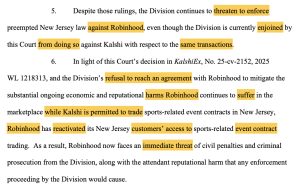
Robinhood argues it should be afforded the same treatment, claiming that regulators have attempted to block it from offering contracts even though federal rulings already shield Kalshi for identical transactions. In its complaint, Robinhood said it began offering event contracts after the courts cleared Kalshi but faced pushback that threatened its competitive standing.
Event Contracts and Market Competition
Event contracts allow users to take positions on the outcomes of real-world events, ranging from sports games to elections. While the concept resembles traditional sports betting, event contracts are structured as derivatives, with roots in prediction markets and blockchain-based transparency.
Robinhood says the inability to compete with Kalshi on equal footing would cause significant harm. “If regulators are permitted to take action against Robinhood but not Kalshi, then Robinhood will lose out in the event contracts space,” the company argued in its filings.
The platform emphasized that it merely facilitates the placement and liquidation of trades on Kalshi’s marketplace, contending that any restriction undermines its users’ access and its business model.
Regulators Push Back
In both lawsuits, Robinhood accuses regulators of disregarding federal court precedent. In New Jersey, Robinhood said it reached out to the Division of Gaming Enforcement to clarify its rights to offer event contracts under the court’s ruling. However, the division “could not agree to refrain from enforcement action,” even with the Kalshi order in place, according to Robinhood.
A similar dispute unfolded in Nevada, where the Gaming Control Board reportedly warned Robinhood that offering the contracts could be treated as “willful violations” of law. The company also alleged that regulators refused to consider a temporary arrangement to provide customers in the state access to the same contracts already allowed for Kalshi.
In both complaints, Robinhood has requested court orders to prevent the regulators from taking action against it, including temporary restraining orders in each state. The company argues that without judicial intervention, it risks being unfairly disadvantaged in a rapidly evolving sector.
The lawsuits highlight a broader regulatory question: whether state gaming laws can override federal oversight of derivatives markets. For Robinhood and Kalshi alike, the outcome could determine who gains the upper hand in the growing industry of event-based financial products.