



- Injective Mainnet 2.0 improves speed, enhances security, and supports perpetual futures, options, and decentralized spot order book infrastructure.
- The platform’s cross-chain bridge Peggy 2.0 enables seamless asset transfers across Ethereum, Solana, and Cosmos networks without intermediaries.
Injective Labs has expanded its developer and business operations team to over 50 members, including former professionals from centralized exchanges, fintech startups, and asset management firms. Backing continues from investors like Jump Trading, Binance Labs, and Pantera Capital.
Injective is also pushing its developer incentive fund, which has surpassed $100 million in grant allocations. These incentives fuel DeFi innovations such as prediction markets, perpetual AMMs, and governance dApps being launched across Injective-native applications.
Injective Launches New Derivatives Module for Real World Assets (RWAs)
Injective has rolled out a derivatives platform enabling on-chain trading of tokenized treasury notes and credit products, bringing real-world assets (RWAs) into its native markets.
INJ Burn Rate Crosses 11 Million Tokens
Cumulative token burns now exceed 11% of the max supply, driven by trading volume on dApps like Helix and Astroport-INJ. This supports a long-term deflationary thesis for the asset.
Injective Implements Zero-Knowledge Proofs for Private Orders
A zk-based feature for private trading orders is now live, making Injective one of the few DEX frameworks with privacy-preserving order book mechanics while retaining full transparency for regulators.
New Institutional Trading Desk Opens on Injective Protocol
A consortium of crypto-native funds has launched a trading desk on Injective, providing liquidity for synthetic assets and wrapped equities, with custodial support through Anchorage Digital.
Injective Developer Incentive Fund Tops $100M in Allocations
The foundation reports over $100 million in committed grants and rewards to Injective-based builders. This includes perpetual AMMs, prediction markets, and multi-chain DeFi platforms integrating INJ tokenomics.
Core Technology and Infrastructure
Injective has continued to enhance its protocol with the deployment of Mainnet 2.0, bringing increased throughput, execution speed, and on-chain reliability. The network integrates a Frequent Batch Auction (FBA) model that eliminates front-running and improves capital efficiency in trading. It also maintains on-chain order books for spot and derivatives markets, removing dependence on centralized exchanges.
The platform is also pushing boundaries on cross-chain interoperability through its Peggy 2.0 bridge, enabling seamless transfers across Ethereum, Solana, and Cosmos-based ecosystems. This infrastructure is supported by a validator-driven architecture, improving security and decentralization.
Institutional and Ecosystem Partnerships
Injective Labs has expanded its developer and business operations team to over 50 members, including former professionals from centralized exchanges, fintech startups, and asset management firms. Backing continues from investors like Jump Trading, Binance Labs, and Pantera Capital.
Injective is also pushing its developer incentive fund, which has surpassed $100 million in grant allocations. These incentives fuel DeFi innovations such as prediction markets, perpetual AMMs, and governance dApps being launched across Injective-native applications.
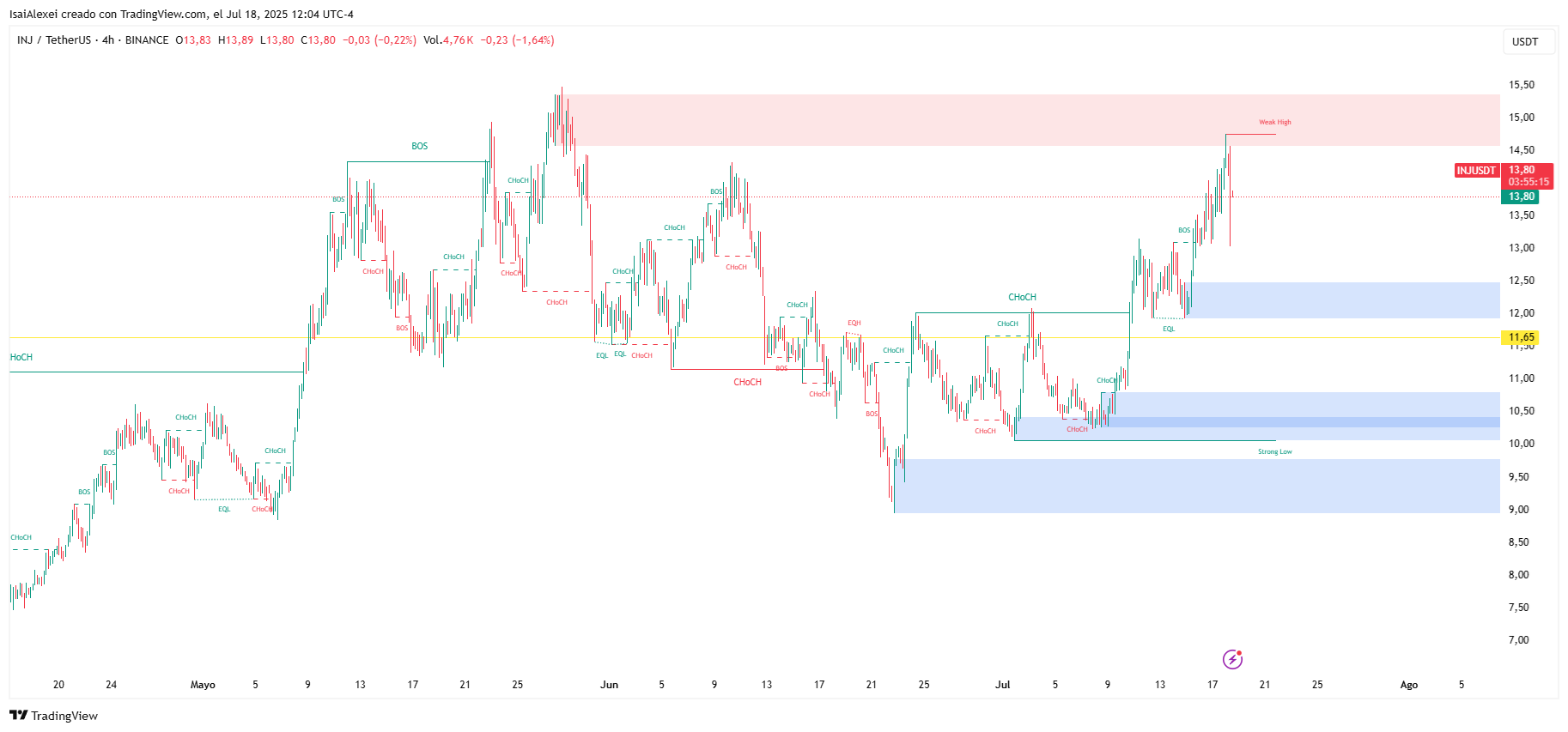
Injective (INJ) is trading at $13.82 USD, showing a +0.81% price increase over the last 24 hours. INJ has a 24-hour trading volume of $218.95 million, which represents 8.15% daily growth, suggesting renewed investor interest.
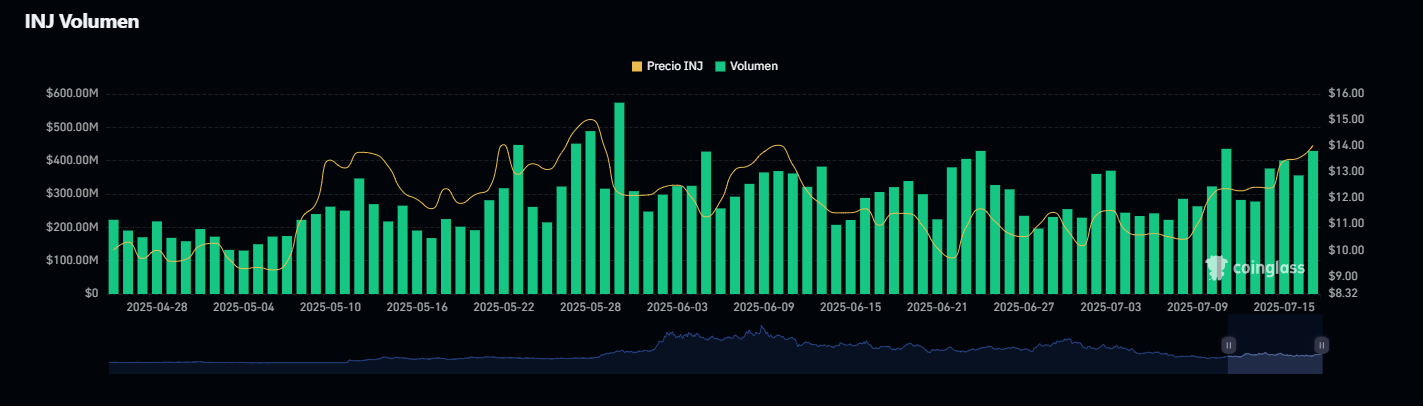
The circulating supply is 99.97 million INJ out of a total supply of 100 million, placing the fully diluted valuation (FDV) also at $1.38 billion.




