




- Concerns arise over pUSD’s dependence on Acala’s Honzon framework, recalling issues from the previous aUSD collapse event.
- Debates continue on whether Polkadot’s OpenGov or Acala should govern pUSD, with accountability central to market confidence.
Polkadot is preparing to introduce pUSD, a new stablecoin backed entirely by its native token DOT, as it seeks to strengthen its position in decentralized finance. The goal is to create a self-sustaining financial system on Polkadot, reducing reliance on external stablecoins like Tether (USDT) and USD Coin (USDC). The network aims to offer users a dollar-pegged asset rooted in its own infrastructure, promising over-collateralization to manage risk.
Red Flags Surface at Launch
However, pUSD’s launch has already drawn criticism and concern from analysts and users. Much of the skepticism centers around its dependence on Acala’s Honzon protocol, a framework that previously failed during the collapse of the aUSD stablecoin. Acala’s issues in handling aUSD resulted in a loss of confidence, unresolved user claims, and a lingering distrust that persists within the Polkadot user base.
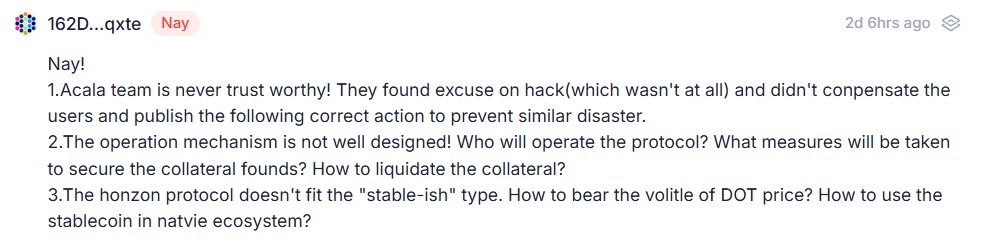
Another debate has emerged regarding governance. Some stakeholders argue that oversight should move to Polkadot’s OpenGov rather than Acala, in order to provide more transparency and accountability. The issue of clear responsibility remains central to whether the new stablecoin gains broader support or encounters resistance.
Khm…khm…
New Polkadot native stablecoin will be based on aUSD by Acala 🫳🎤Two days ago, @XiliangChen posted a funding request to the Polkadot Technical Fellowship to implement a Polkadot native stablecoin.
Here are the details
Ticker: PUSD 🐈⬛
Description: PUSD is… pic.twitter.com/x5fesbxWkJ— The Dots 🐂⭕️ (@TheDotsTalks) September 19, 2025
DOT-Only Collateral Raises Stability Questions
A second concern relates to pUSD’s single-asset collateral model. While over-collateralization adds a layer of security compared to models like Terra’s failed UST, relying solely on DOT introduces risk if the price of DOT falls sharply. In the event of a major price correction, the stablecoin could face liquidation cascades, creating sell pressure on DOT and threatening the peg.
Traders point out that previous projects, such as MakerDAO’s DAI, eventually diversified their collateral to include multiple assets and even real-world holdings to bolster resilience. Critics also mention that Polkadot has other native stablecoins, such as HOLLAR, with designs better suited for appchains.
For now, Tether and USDC remain dominant, with market capitalizations of $174 billion and $73 billion, respectively. pUSD enters a crowded market, and its long-term adoption will depend on how it manages risk, accountability, and user trust.
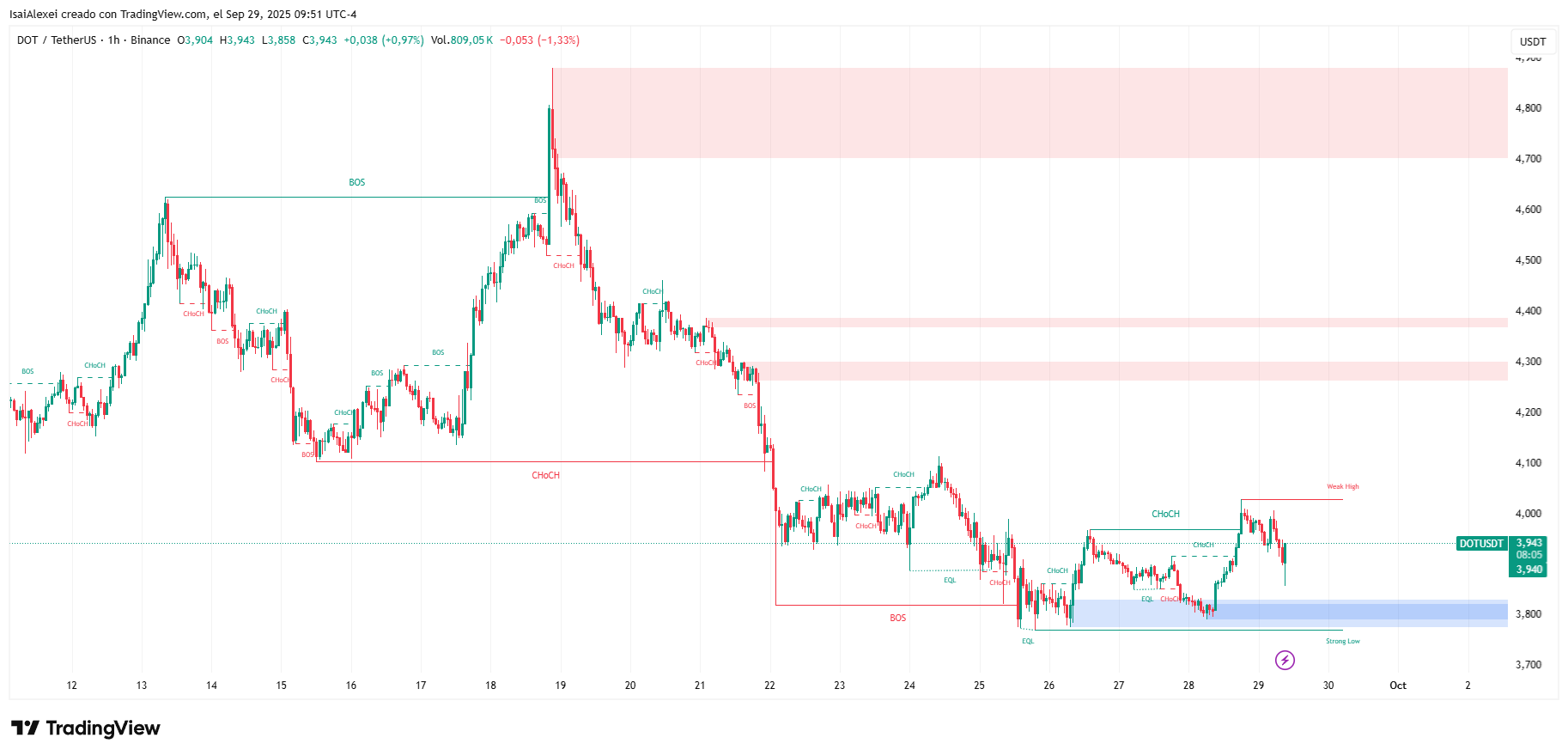
Polkadot (DOT) is trading at $3.88, down 2.75% in the past 24 hours. Over the last week, it has lost 8.75%, while showing a modest 3% monthly gain. On a six-month basis, DOT has fallen 6.7%, and year-to-date it is down 41.3%.
Over the past year, the token has declined 18.9%, keeping it far below its all-time high of $55.13. Its current market capitalization stands at $6.31 billion, with a daily trading volume of $256.2 million.
From a technical standpoint, DOT is consolidating near the $3.80–$4.00 zone, which traders see as key support. If the price holds, a short-term rebound toward $4.60–$4.80 is possible, where resistance is expected. However, a failure to maintain above $3.80 could trigger a pullback toward $3.40–$3.50, exposing the token to further downside.




