



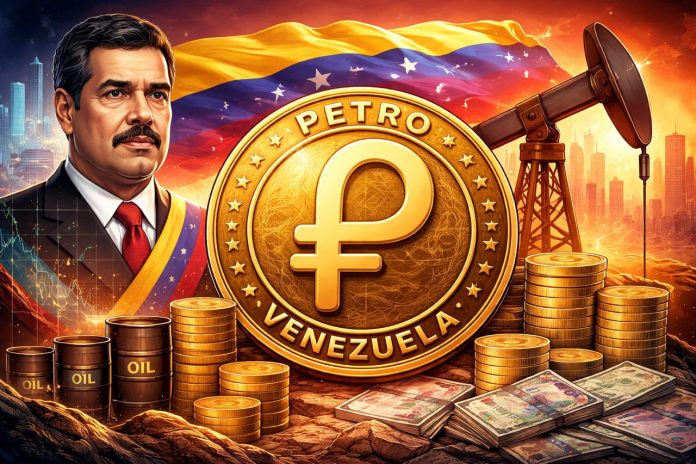

An analysis shared by WuBlockchain, originally written by Xiao Bing (TechFlow), revisits one of the most surreal experiments in crypto history: Venezuela’s Petro.
What began as the world’s first state-backed digital currency ended quietly in failure, mirroring the broader collapse of Venezuela’s political and economic institutions.
A Digital Currency Born From Crisis
When Venezuelan President Nicolás Maduro announced Petro’s launch in February 2018, the country was already spiraling through hyperinflation approaching 1,000,000%. The bolívar was collapsing, savings were being erased overnight, and U.S. sanctions had effectively sealed Venezuela off from global finance.
Petro was positioned as a technological escape hatch. It promised blockchain-based transactions that could bypass the U.S. dollar system, while claiming to be backed one-to-one by real oil reserves. One hundred million Petros were supposedly supported by $60 billion worth of crude.
By August 2018, Petro was elevated to official-currency status alongside the bolívar. Pensions, bonuses, and even military salaries were partially paid in Petro. Maduro personally airdropped tokens to retirees on national television, framing the project as economic salvation.

Grand Ambitions, Fragile Foundations
The government promoted Petro aggressively, both domestically and abroad. Russian advisors reportedly assisted with its design, while officials floated the idea of Petro-based oil settlement within OPEC. Exchanges were licensed, wallets launched, and official guides published, the state behaving more like a startup than a sovereign authority.
But beneath the spectacle, trust never materialized.
Venezuelans largely rejected Petro. Registration required intrusive identity verification, applications were routinely rejected without explanation, and the official “Fatherland Wallet” frequently malfunctioned. Payment failures were common, forcing the government to admit system defects and issue compensations.
Outside Venezuela, Petro faced immediate resistance. In March 2018, the U.S. government banned all Petro transactions by U.S. persons, declaring the token a sanctions-evasion mechanism. Financial institutions linked to Petro were sanctioned, effectively isolating it from any meaningful international adoption.
A Blockchain in Name Only
Petro’s most fatal flaw was structural.
Despite blockchain branding, Petro was fully centralized. Its supply, pricing, and rules were dictated by presidential decree. Its block explorer showed minimal activity, abnormal block times, and near-zero real usage. Claims of oil backing unraveled under scrutiny, with journalists finding no evidence of large-scale production in the supposed reserve regions.
Even Petro’s “white paper” proved malleable. When oil backing became inconvenient, the government quietly redefined Petro as partially backed by gold, iron, and diamonds, a move that would be unacceptable even by speculative crypto standards.
On the street, Petro traded far below its official price. While the government pegged it at $60, real-world value often fell under $10, if merchants accepted it at all.
Corruption Delivers the Final Blow
Petro’s collapse accelerated with Venezuela’s largest corruption scandal.
In March 2023, senior officials linked to the crypto regulator SUNACRIP were arrested. Investigators uncovered billions of dollars in missing oil revenues laundered through crypto channels. Funds were siphoned into private real estate, mining operations, and digital assets.
By 2024, SUNACRIP was shut down. Crypto mining was banned nationwide. Over 11,000 ASIC miners were seized, and authorized exchanges were closed. Petro trading ceased without announcement, ending the project not with outrage, but silence.
A Digital Mirror of National Failure
Petro did not fail because of U.S. sanctions alone. It failed because it was built on institutional decay.
Rather than addressing structural economic flaws, overreliance on oil exports, governance breakdown, and loss of public trust, the government attempted to mask collapse with technological spectacle. Petro became a digital illusion layered atop a failing state.
As Xiao Bing notes, digital currency cannot substitute credibility. When citizens no longer trust their government or its money, a blockchain wrapper cannot restore confidence.
Petro’s legacy is not innovation, but warning: technology cannot repair institutional failure, and crypto, stripped of decentralization and trust, becomes just another instrument of control.



