





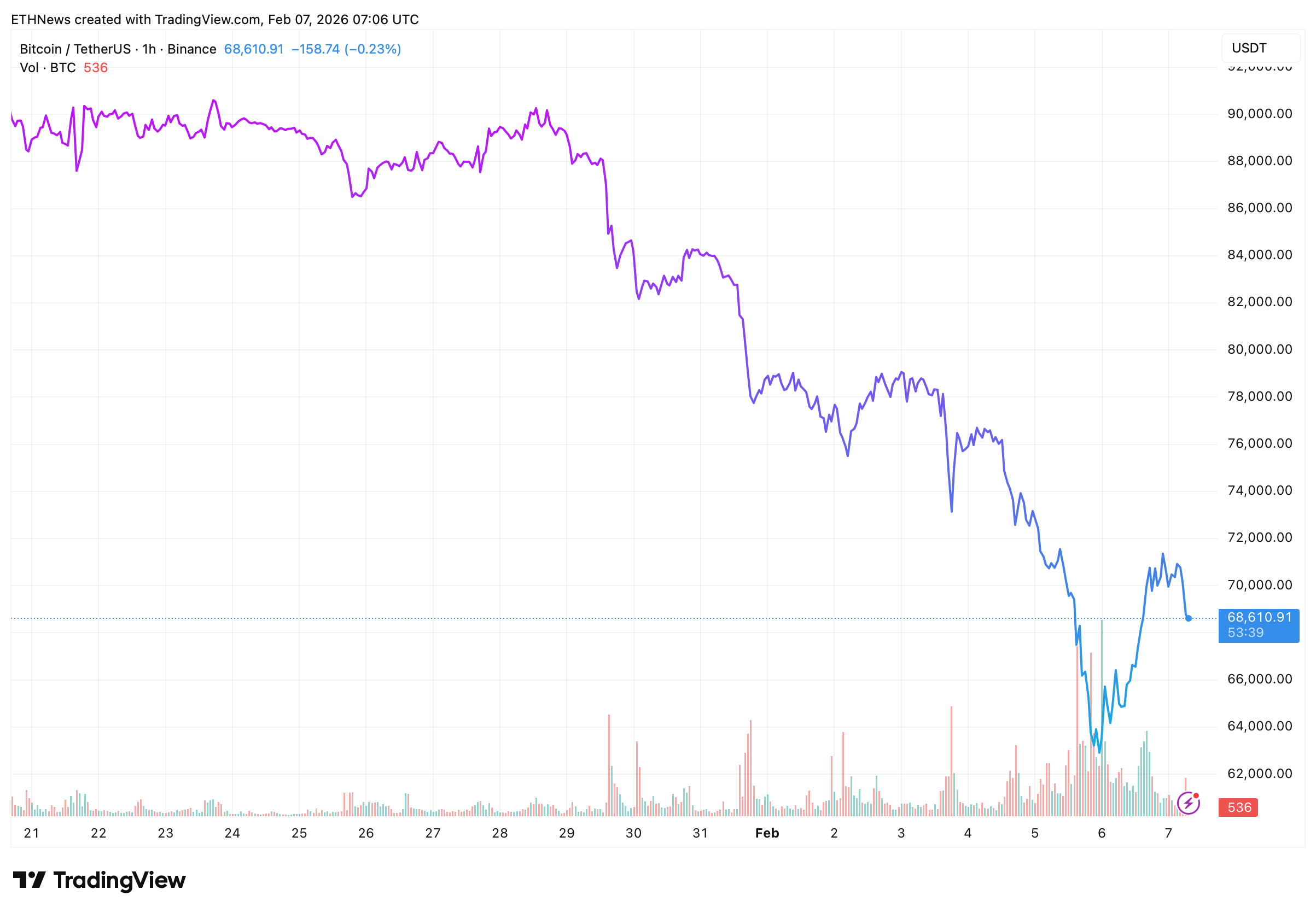
Bitcoin’s recent slide toward the low $60,000s has pushed price back into a part of the cycle where long-term structure, rather than momentum, starts to matter most, and veteran trader Peter Brandt argues the market may already be approaching its most important downside reference.
If historical bear-market behavior repeats, he sees $42,000 as the level where selling pressure has previously exhausted itself.
Why the “Banana Peel” Matters at This Stage
Brandt frames the current drawdown through a structural lens he refers to as the “Banana peel,” a pattern designed to capture abrupt, destabilizing declines that occur late in corrective phases. The model visualizes Bitcoin’s long-term logarithmic trend as a broad, parabolic curve, with the inner boundary acting as a gravity zone during deep retracements.
That inner curve has repeatedly coincided with cycle lows. In prior bear markets, 2011, 2015, 2018, and 2022, price ultimately gravitated toward this region before broader recovery phases began. In this framework, the $42,000 area represents not a random target, but the lower edge of a structure that has historically defined macro support.
Distance to the Floor Is Smaller Than It Looks
With Bitcoin recently trading as low as $60,001 on some venues, Brandt characterizes the remaining downside, in technical terms, as relatively compressed. From a structural perspective, the move required to test the $42,000 zone is far smaller than the percentage drawdowns seen earlier in previous cycles.
His view is not that downside risk has disappeared, but that if the market behaves consistently with past bear phases, any further decline would represent a final digestion of excess rather than the start of a new collapse. In that scenario, the $42,000 region acts less like a trapdoor and more like a basin where volatility historically stabilizes.
Context Within the Broader Bearish Signals
The pressure has not been isolated to Brandt’s framework alone. Bitcoin’s loss of higher-timeframe trend support earlier this month added weight to the bearish narrative, prompting other macro-focused analysts to flag deeper retracement risks. Some have pointed to $50,000 as a potential magnet if weakness persists.
Brandt’s view diverges by extending the lens further out. Instead of focusing on intermediate averages or tactical levels, his analysis centers on where long-duration cycles have consistently resolved, even during periods of extreme pessimism.
Structural Takeaway
Brandt’s $42,000 level is not a short-term call or a timing signal. It represents a historical boundary where Bitcoin’s deepest corrections have previously found acceptance. With price already much closer to that zone than headline numbers suggest, the coming phase is less about forecasting direction and more about observing whether long-term structure once again absorbs selling pressure, or whether this cycle breaks from its established pattern.



