

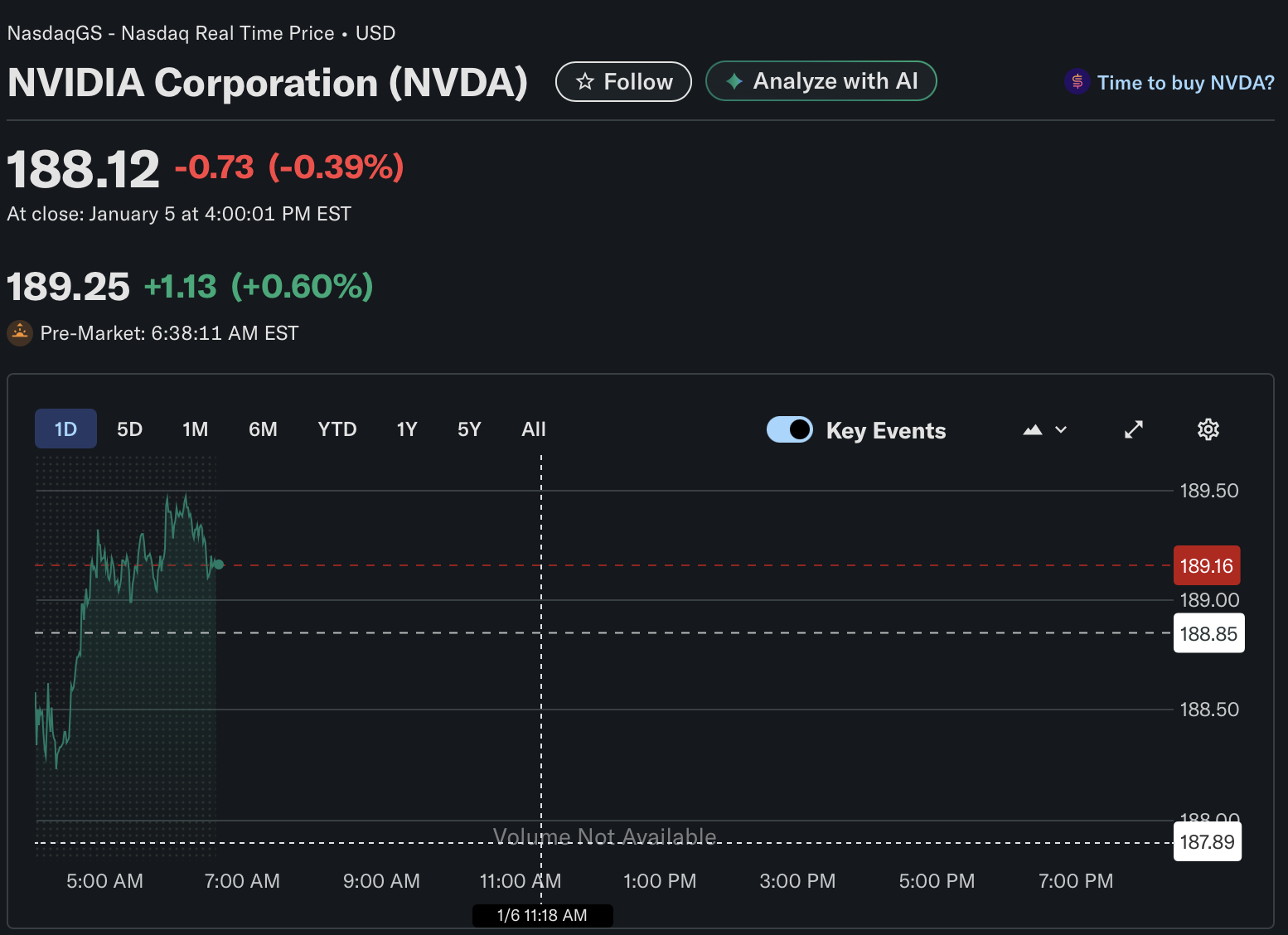
Nvidia (NVDA) shares closed slightly lower at around $188.11 on January 5, 2026, following the company’s unveiling of its next-generation Rubin AI platform at CES 2026. The muted market reaction suggests the announcement was largely priced in, as analysts had already anticipated the platform’s debut.
The Rubin platform represents a major step in Nvidia’s AI roadmap. It includes six advanced chips, highlighted by the Vera Rubin GPU and the Vera CPU, both designed to significantly enhance AI supercomputing performance.
According to Nvidia, the platform is expected to deliver a 10x reduction in inference token costs, a key metric for large-scale AI workloads and data center efficiency.
Despite the technological leap, Nvidia’s stock movement remained modest. Shares declined by just 0.39% in the latest trading session, reflecting limited surprise among investors. Products built on the Rubin platform are expected to become available through Nvidia’s hardware partners in the second half of 2026, meaning revenue impact is still several months away.
Wall Street sentiment toward Nvidia remains firmly positive. Analysts continue to hold a strong “Buy” consensus, with a median price target of approximately $264, indicating significant upside potential from current levels.
However, some caution persists around broader valuation concerns and ongoing insider selling, which have kept near-term price action relatively restrained.
While U.S. markets showed little immediate reaction, Asian semiconductor stocks responded more positively to the Rubin announcement, underscoring regional optimism around AI infrastructure spending.
Overall, Nvidia’s flat performance following CES reflects expectations rather than disappointment, with investors seemingly focused on execution and delivery timelines rather than headline innovation alone.