

Analyst forecasts for Nvidia in 2026 highlight sustained optimism around the company’s role at the center of the global artificial intelligence expansion.
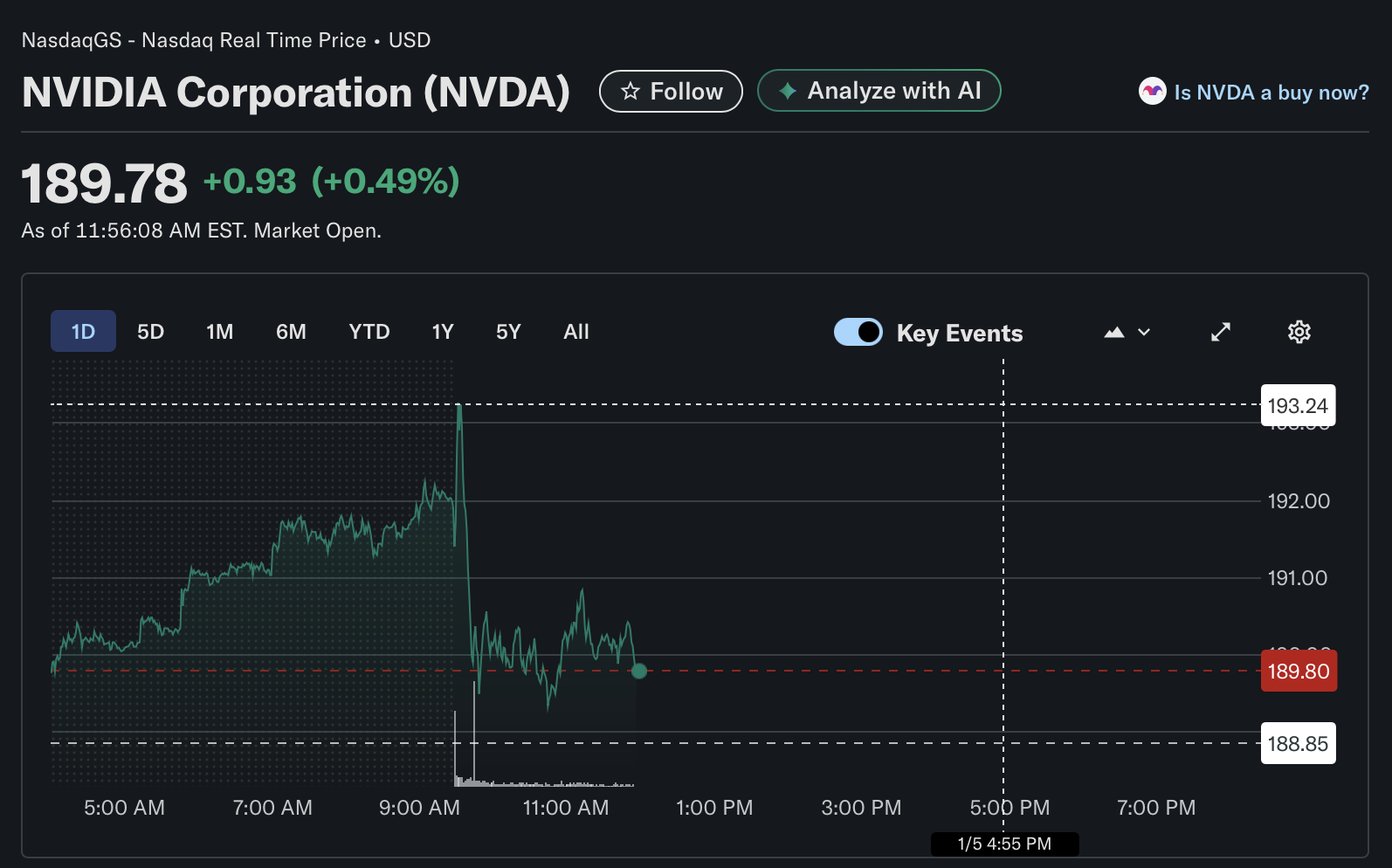
With the stock trading near $190 as of January 5, 2026, Wall Street price targets span a wide range, reflecting both strong growth expectations and ongoing valuation debates.
Breaking Down the Analyst Price Targets
The analyst target table shows a clear skew toward upside, even while acknowledging downside risk:
- Low target: $140
This scenario implies a –26.3% downside from current levels. It reflects a more conservative outlook where competition, margin pressure, or regulatory headwinds slow Nvidia’s momentum. - Average target: $207.13
The consensus average suggests a +8.9% upside, indicating analysts broadly expect Nvidia to grind higher rather than deliver explosive gains in the base case. - Median target: $253.02
The median forecast points to a +33.1% potential upside, showing that more than half of analysts see Nvidia extending its leadership and delivering stronger-than-average returns. - High target: $352
The most bullish projections imply a dramatic +85.1% upside, typically tied to scenarios where AI infrastructure spending accelerates faster than expected and Nvidia maintains pricing power and margin dominance.
The spread between the low and high targets underscores how sensitive Nvidia’s valuation is to execution, competition, and policy developments.
AI Leadership Remains the Core Thesis
Analysts remain confident in Nvidia’s dominant position in high-performance AI chips. The company continues to power data centers for major technology firms such as Microsoft, Amazon, and Meta Platforms. This entrenched role makes Nvidia a direct beneficiary of rising AI workloads, model training, and inference demand across cloud and enterprise environments.
Earnings Growth Supports Premium Valuation
Despite concerns that Nvidia trades at elevated multiples, analysts argue the valuation is supported by fundamentals. Earnings per share are projected to grow by more than 50% in fiscal year 2027, while gross margins remain near 70%. As earnings expand, forward price-to-earnings ratios are expected to compress, easing valuation pressure without requiring a sharp pullback in share price.
Risks That Could Shape the Range
The downside scenarios reflected in lower targets center on several key risks: intensifying competition from rivals such as AMD and Intel, potential supply chain constraints for next-generation chips, and geopolitical uncertainty, particularly U.S. export restrictions to China. Any combination of these factors could cap upside or introduce volatility.
Catalysts Investors Are Watching
Looking ahead, analysts highlight several potential catalysts that could push Nvidia toward the upper end of target ranges. These include clarity around a possible acquisition of Groq, announcements tied to the upcoming CES event, and further details on H200 chip exports to China.
Bottom Line
Analyst forecasts for Nvidia in 2026 suggest a stock with asymmetric potential: limited consensus upside in the base case, but significant optionality if AI demand and execution exceed expectations. The wide dispersion in price targets reflects not uncertainty about Nvidia’s relevance, but debate over just how large and durable the AI-driven opportunity ultimately becomes.