


According to Santiment, Ethereum’s official Proof-of-Stake deposit contract now holds 77.85 million ETH, worth just over $256 billion, representing 46.59% of Ethereum’s total supply.
The data shows that the balance of this wallet has grown by 38.4% over the past year, marking a sharp increase in long-term staking participation.
What This Wallet Actually Represents
The deposit contract, previously known as the Beacon Chain wallet, is not a traditional “whale” wallet. Its sole purpose is to hold ETH staked by validators securing the Ethereum network. Santiment notes that misinformation often spreads around this address, suggesting it could dump ETH onto exchanges.
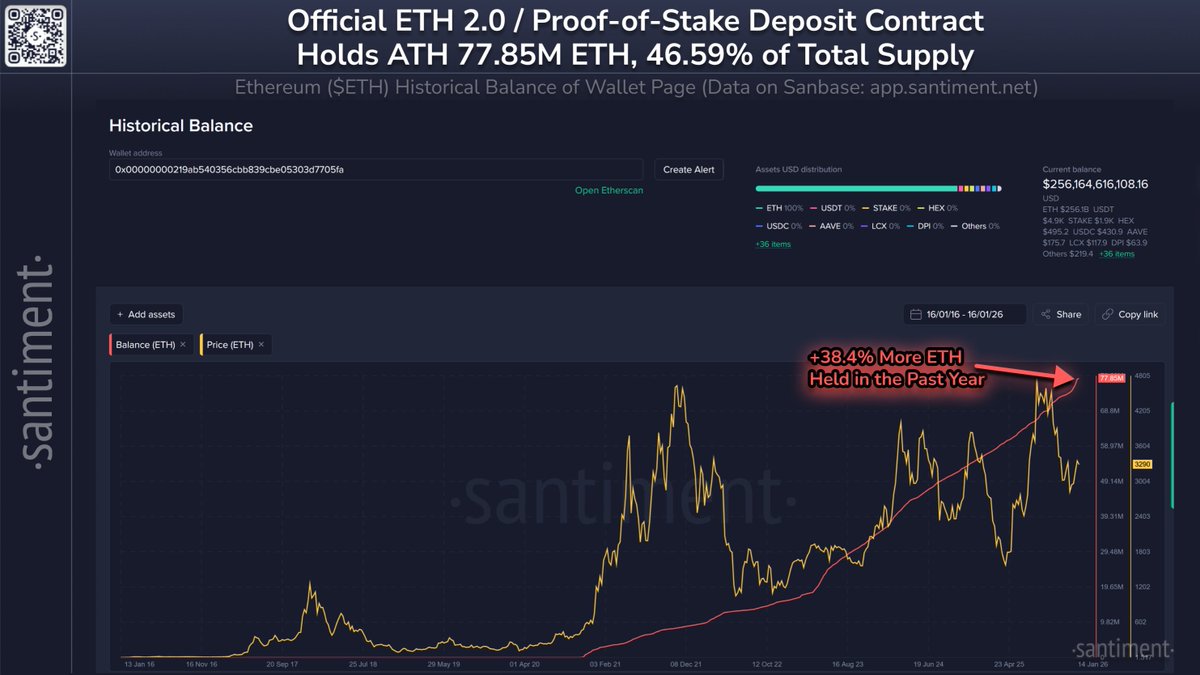
In reality, this wallet cannot freely move funds. ETH locked here can only be withdrawn through validator exits, which are strictly rate-limited by Ethereum’s protocol. Even in extreme scenarios, withdrawals occur gradually rather than all at once.
Why 46.59% of Supply in One Wallet Matters
At first glance, seeing nearly half of Ethereum’s supply concentrated in a single address may appear alarming. Santiment frames this as a reflection of strong long-term conviction among Ethereum participants, with a large portion of holders committing their ETH to staking rather than short-term liquidity.
This concentration generally signals growing trust in Ethereum’s long-term security model and validator economics.
The Bear Case: Liquidity and Exit Risk
Skeptics point to potential liquidity risks. If ETH’s price were to drop sharply and a large number of validators sought to exit staking simultaneously, withdrawal queues could slow how quickly ETH returns to circulation. Some argue that, over time, a large staked balance could amplify supply shocks if exits cluster.
Others also raise concerns that such a large portion of staked ETH could become influenced by a relatively small number of entities.
The Bull Case: Long-Term Commitment
The more optimistic interpretation is straightforward. Nearly half of ETH is locked by participants who believe in Ethereum’s long-term future. Rather than signaling imminent selling pressure, the data suggests reduced liquid supply and sustained validator confidence.
As Santiment’s data highlights, the deposit contract’s growing balance reflects a market increasingly aligned with long-term staking rather than short-term speculation.