





Monero continues to occupy a distinct position in the crypto ecosystem in 2025. While transparent blockchains and US dollar-backed stablecoins have become increasingly traceable and subject to compliance controls, Monero’s privacy-focused design keeps it relevant in high-risk and enforcement-sensitive environments.
Recent market data and new academic research provide a clearer picture of where Monero’s privacy remains strong, and where real-world network dynamics introduce additional complexity.
Usage Remains Resilient Despite Delistings
Monero transaction activity has remained stable and resilient, holding well above pre-2022 levels despite widespread delistings and mounting regulatory pressure.
Although monthly volumes fluctuate, overall usage has grown materially since 2020 and stabilized at a higher baseline. Transaction levels in 2024 and 2025 are significantly above those seen in 2020–2021, suggesting sustained demand rather than speculative spikes.
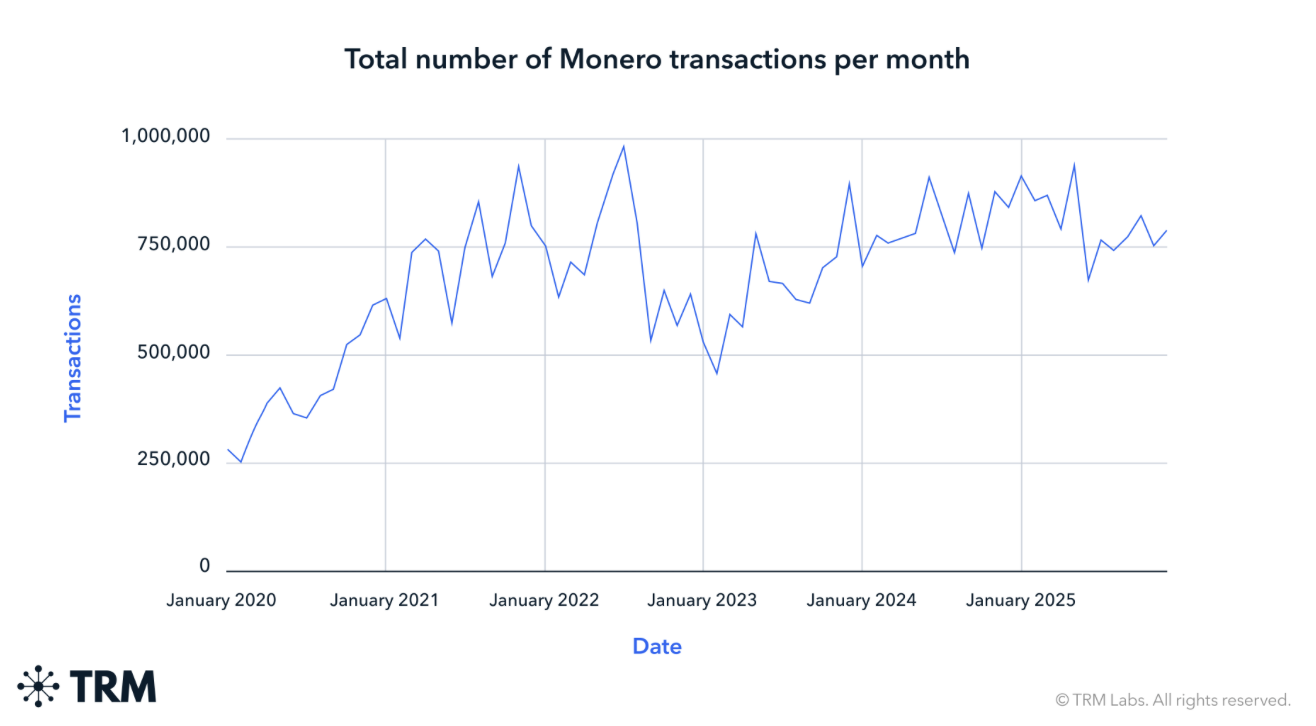
This resilience is notable given the scale of exchange de-risking. Many major centralized platforms, including Binance, Coinbase, Kraken, OKX, Huobi, and Bitstamp — have delisted or restricted Monero over compliance and traceability concerns. Reports indicate that dozens of exchanges removed support in 2025 alone.
Liquidity is now concentrated on a smaller set of venues, often offshore or lower-compliance exchanges. That constraint helps explain an ongoing tension in illicit finance:
- Ransomware actors frequently request Monero and sometimes offer discounts for XMR payments.
- However, the majority of real-world ransom payments are still made in bitcoin.
Bitcoin remains easier to acquire, move, and convert at scale, even if it is more traceable. In practice, usability and liquidity often outweigh pure privacy.
Monero’s thinner liquidity also shows up in price behavior. Over the past month, its realized volatility has been materially higher than that of bitcoin and ETH, reflecting a more fragmented market structure.
Despite exchange delistings and enforcement pressure, XMR activity on Monero remains above pre-2022 levels.
Key findings from our latest research:
🔺 48% of new darknet markets in 2025 are XMR-only
🔺 Most ransomware payments still occur in BTC — liquidity matters
🔺 14–15% of… pic.twitter.com/BYPJMrLaJN— TRM Labs (@trmlabs) February 16, 2026
Darknet Markets Shift Toward XMR-Only Models
Monero adoption within darknet markets (DNMs) has continued to rise.
In 2025, nearly half of newly launched darknet markets supported Monero exclusively — a significant increase from prior years. This trend is especially pronounced in Western-facing markets, where operators appear to be responding directly to improved tracing capabilities on Bitcoin and stablecoins.
While Monero represents a smaller share of overall crypto transaction activity compared to transparent networks, its specialized role remains intact. The combination of steady on-chain usage and increasing XMR-only marketplace adoption suggests that demand for privacy has not diminished as traceability across other assets has improved.
New Research Highlights Network-Layer Deviations
Beyond on-chain cryptography, new research has focused on Monero’s peer-to-peer (P2P) network behavior.
In collaboration with external academic researchers, analysts observed unexpected patterns in the Monero P2P layer. The findings indicate that approximately 14–15% of reachable peers exhibit non-standard behavior relative to protocol expectations.
These deviations include:
- Irregular handshake behavior
- Unusual message timing patterns
- Atypical peer list composition
- Infrastructure concentration in specific hosting environments
Importantly, “non-standard” does not automatically mean malicious. The analysis does not assign intent or attribute activity to specific operators. However, the persistence and concentration of these deviations make them notable.
Why Network Behavior Matters
Monero’s on-chain cryptography remains intact. Its privacy model still obscures transaction amounts, sender addresses, and receiver addresses at the blockchain level.
However, privacy assumptions often rely on the network layer behaving in a statistically uniform way. If a small set of nodes controls a disproportionate share of connections or relay visibility, they may gain structural insight into transaction propagation patterns over time.
Such effects do not represent a failure of Monero’s cryptography. Instead, they highlight how real-world network dynamics can diverge from theoretical models used in privacy analysis.
In peer-to-peer systems, infrastructure concentration can matter. Nodes that are widely connected or heavily advertised through peer lists may observe message timing and propagation behavior in ways that reduce uncertainty about origin patterns under certain threat models.
A Privacy Asset Facing Evolving Pressures
Monero’s role in 2025 reflects a dual reality:
- On-chain privacy remains strong and widely used in high-risk environments.
- Real-world network behavior introduces new analytical considerations.
Despite exchange delistings and liquidity constraints, usage has not meaningfully contracted. At the same time, evolving investigative tools and empirical research are shifting attention from purely cryptographic guarantees to network-layer realities.
Monero continues to fill a specific demand for privacy in a landscape where most digital asset activity is increasingly transparent. But as enforcement capabilities expand and network research deepens, privacy in practice is shaped not only by protocol design, but also by how the network operates day to day.



