





The latest breakdown of public Bitcoin treasury holdings shows how dominant corporate balance sheets have become in shaping Bitcoin’s supply.
According to the data presented, the top 100 publicly listed companies now collectively hold 1,127,981 BTC, placing a significant portion of total supply in long-term corporate custody rather than active market circulation.
Strategy’s Position Overshadows the Rest
At the top of the list, Strategy holds 709,715 BTC, accounting for approximately 63% of the Bitcoin held by the entire top 100 group. This level of concentration is unprecedented among public companies and highlights how unevenly corporate exposure to Bitcoin is distributed.
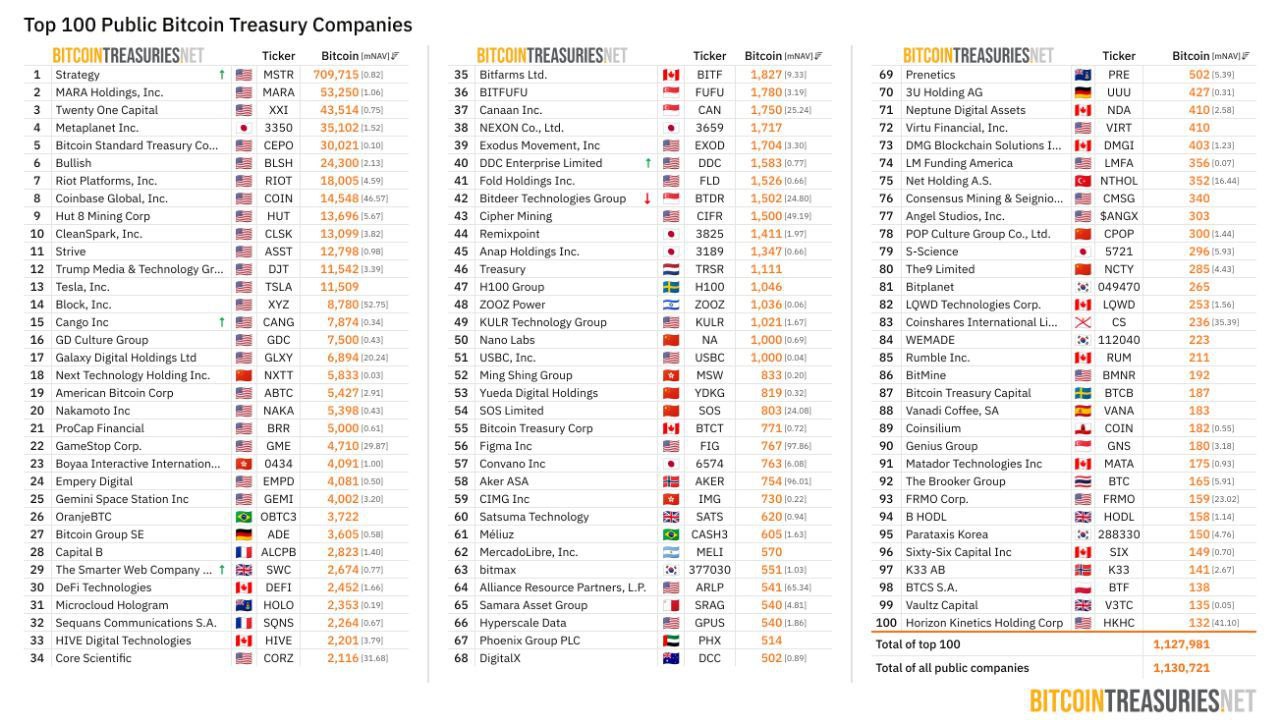
The next largest holders, MARA Holdings with 53,250 BTC and Twenty One Capital with 43,514 BTC, remain sizeable, yet they are dwarfed by the leading position. As the rankings move lower, holdings decline rapidly, with many companies holding only a few thousand or even a few hundred BTC.
What the Top 100 Aggregate Indicates
The combined 1.12 million BTC total underscores a structural shift in Bitcoin ownership. Public company treasuries typically operate with long-term mandates, meaning this Bitcoin is far less likely to be actively traded or liquidated during short-term market swings.
Rather than a broad, evenly distributed adoption curve, the data shows consolidation around a small number of high-conviction holders. The top end of the list carries disproportionate weight in defining how much Bitcoin is effectively removed from liquid supply.
Implications for Bitcoin’s Supply Dynamics
With more than one million BTC held by public companies, and the majority concentrated in a single balance sheet, market liquidity becomes increasingly dependent on marginal flows. This structure can amplify the impact of both inflows and outflows elsewhere in the ecosystem.
The list of the top 100 public Bitcoin treasury companies no longer just reflects participation. It now illustrates how corporate ownership has become a central pillar of Bitcoin’s long-term supply framework.




