



- Brazil leads Latin America in crypto adoption, ranked fifth globally, ahead of Venezuela, Argentina, Mexico, and Colombia respectively.
- Latin American adoption grew 63% year-on-year, fueled by retail demand, institutional entry, regulatory clarity, and cross-border payment use.
Chainalysis has published its 2025 Global Crypto Adoption Index, covering 151 countries, and the results reveal a shift in Latin America’s hierarchy. Brazil leads the region, positioned fifth worldwide, consolidating its role as the area’s strongest adopter of crypto assets.
Venezuela follows in eighteenth place, while Argentina climbs to twentieth, displacing Mexico, which now sits at twenty-third. Colombia completes the regional top five at twenty-ninth globally.
Compared with the 2024 ranking, the regional order changed considerably. Last year, Mexico and Argentina were ahead of each other in the global top twenty, while Peru was still listed at forty-second. The current reshuffle reflects both the rise of Argentina and the decline of Mexico in relative terms.
Despite these shifts, overall adoption in Latin America grew by 63% year-on-year. Analysts attribute the expansion to increased retail use, institutional entry, and clearer regulatory frameworks.
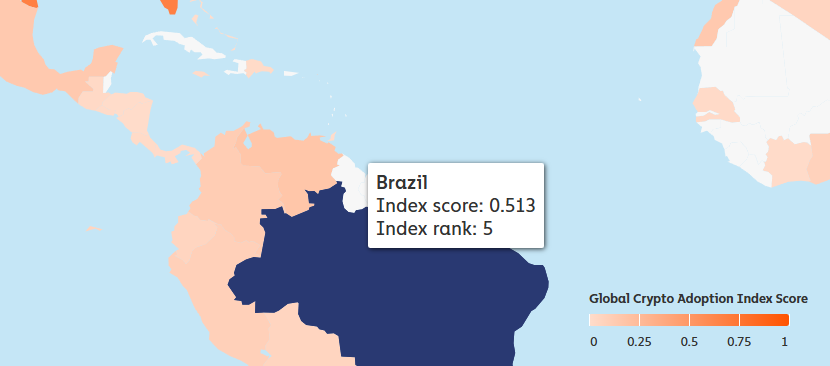
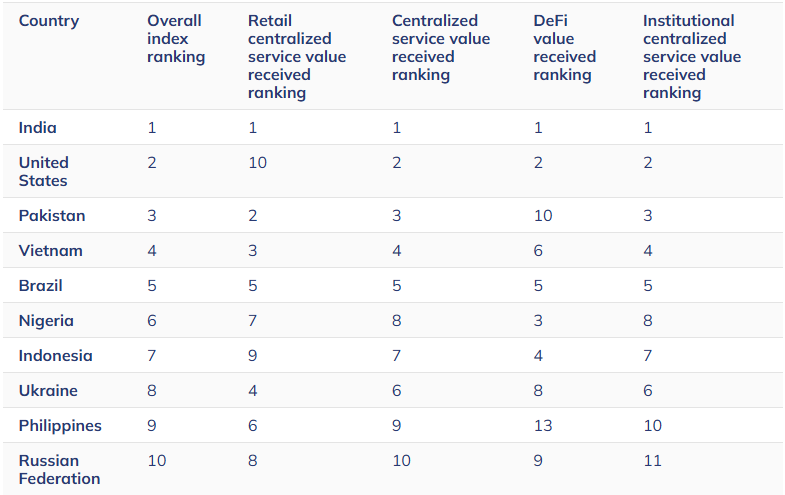
Brazil’s progress is especially evident. A year ago, it held the tenth global position; now it stands among the top five worldwide, behind only India, the United States, Pakistan, and Vietnam. This positions Latin America directly after Asia-Pacific and Africa as regions where crypto asset adoption has accelerated fastest.
The methodology behind the index considers on-chain activity adjusted by purchasing power, focusing on effective usage rather than raw transaction size. This sheds light on how populations with lower average income still integrate crypto for practical needs such as remittances and protection against inflation. Stablecoins dominate transactions in the region, representing almost ninety percent of the recorded volume.
Beyond speculation, exchanges have evolved into financial access points, facilitating savings, cross-border transfers, and payment flows. The Chainalysis report underlines that crypto assets now operate as a parallel financial network, increasingly embedded in Latin American economies, and reshaping their financial map for the years ahead.




