





The year-over-year growth rate of Bitcoin’s Short-Term Holder Realized Price has turned negative, currently reading negative 2.4%, a condition that has historically appeared during the most difficult phases of prior bear markets.
What This Metric Actually Measures
The Short-Term Holder Realized Price chart, shared by CryptoQuant, tracks the average cost basis of Bitcoin bought within the last 155 days. The year-over-year growth rate measures how that cost basis is changing relative to twelve months ago. When the reading is positive, newer buyers are paying more than they did a year ago, reflecting expanding demand and upward price momentum. When it turns negative, newer buyers are sitting on losses relative to the prior year’s entry prices, reflecting contracting demand and weakening momentum.
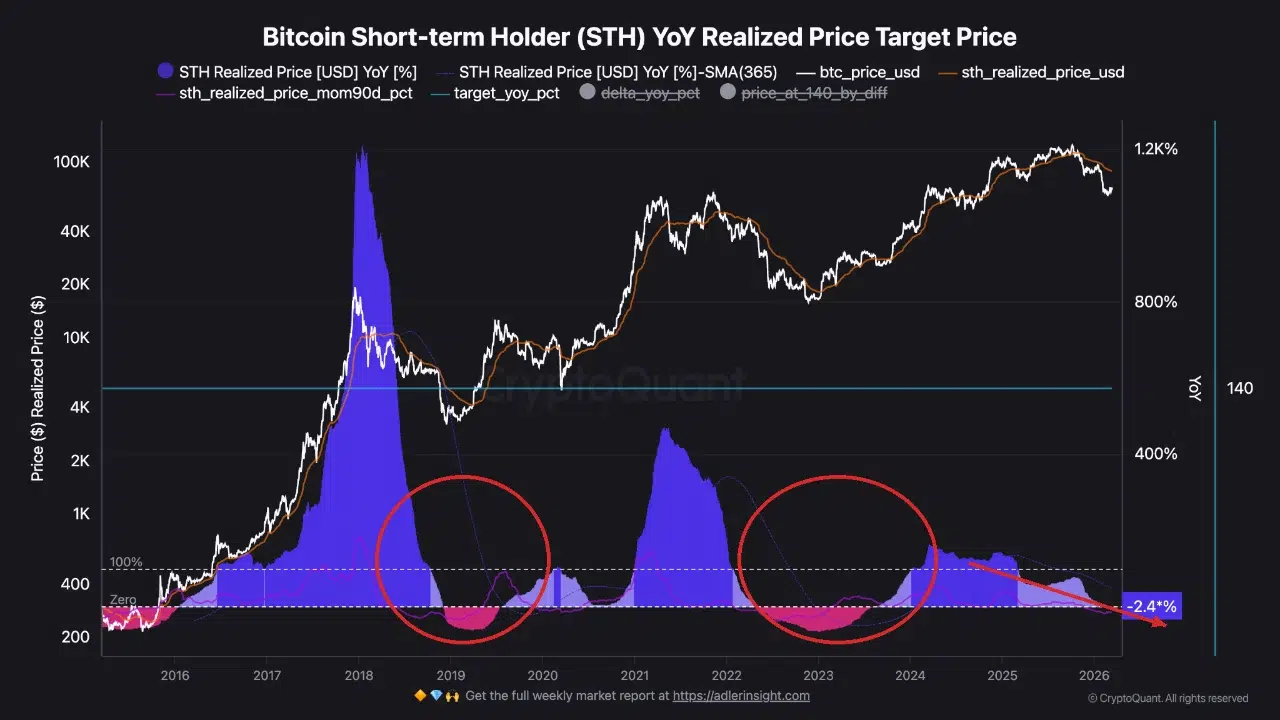
At negative 2.4%, the current reading means short-term holders are collectively underwater on a year-over-year basis. Their cost basis has declined rather than grown.
What the Chart Shows
The CryptoQuant chart covers 2015 through early 2026. The blue shaded area represents the STH Realized Price year-over-year percentage on the right axis. The white line tracks Bitcoin price on the left logarithmic axis. The orange line tracks the STH realized price level itself.
Two red circles are drawn on the chart by the analyst, marking the prior instances where the blue area compressed and the year-over-year reading turned deeply negative. The first circle sits around 2018 to 2019, coinciding with the prolonged bear market that followed Bitcoin’s $19,783 peak. The second circle covers 2022 to 2023, the period following the $69,000 cycle high when Bitcoin fell to $15,500.
The current reading at the far right of the chart shows the blue area compressing toward zero and now dipping below it, marked with the negative 2.4% label. The teal horizontal line at the 140% level represents a historical target zone. Current readings are nowhere near it.
Why the Historical Parallel Matters
Both prior instances where this metric turned negative, 2018 and 2022, preceded extended periods of price weakness before eventual recovery. The pattern is consistent: speculative participation fades, short-term buyers hold losing positions, momentum stalls, and the market enters a fragile structural phase until those positions either wash out or price recovers enough to restore positive momentum.
The current negative reading does not mean Bitcoin is about to collapse. It means the short-term demand structure has weakened to a degree last seen during confirmed bear market conditions. That is a different statement from a price prediction. It is a momentum observation.
What Would Need to Change
For this indicator to recover, short-term holders would need to accumulate at prices higher than current levels on a sustained basis, pushing the cost basis growth rate back above zero. That requires either price appreciation that brings new buyers in at higher prices, or the current cohort of underwater short-term holders exiting and being replaced by buyers at similar or higher levels.
Neither condition is present in the current data. The reading is negative and declining. Whether it stabilises or deepens depends on whether the broader market finds its footing in the weeks ahead.



