


Strategy’s shareholder landscape shifted sharply this month after new filings revealed that JPMorgan Chase & Co. reduced its position in the company by roughly 25%. The reduction came just days before MSCI officially announced that Bitcoin-focused companies would not be eligible for inclusion in its major global equity indexes. The timing immediately drew attention because Strategy is widely viewed as the closest publicly traded proxy for direct Bitcoin exposure.
What the Chart Shows
The chart in the post visualizes JPMorgan’s Strategy holdings across the past decade, alongside MSTR’s price action. For years, the bank held a modest stake, but its exposure grew meaningfully during Bitcoin’s major bull phases, especially as Strategy doubled down on its strategy of accumulating BTC.
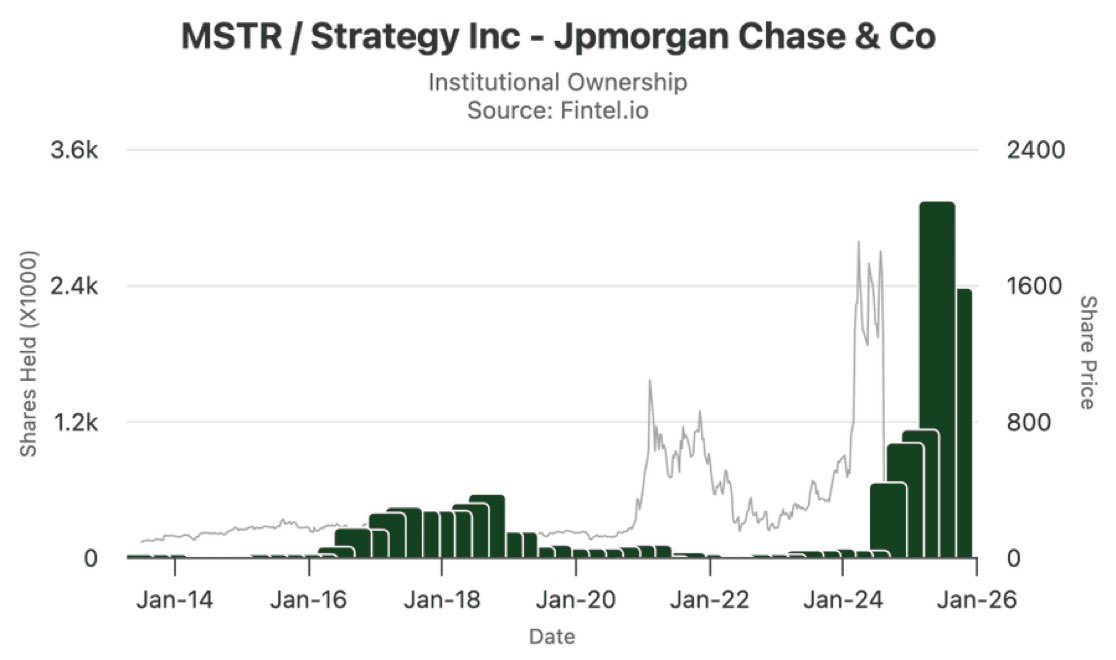
The dark green bars represent JPMorgan’s total shares held in different reporting periods, while the grey line shows the rapid climb in Strategy’s stock price, particularly from 2023 to 2025. The most recent bar on the far right reveals the sharp reduction: a large step down in shares held, even though MSTR’s price remained elevated. Because JPMorgan had been steadily increasing its position throughout the year, the sudden reversal stands out clearly on the chart.
The MSCI Decision and Why It Matters
JPMorgan’s reduction took place immediately before MSCI confirmed that Bitcoin-centric companies, including Strategy, would not be added to its flagship global indexes. This decision effectively removes a major inflow opportunity from passive index-tracking funds that could have generated sustained demand for MSTR stock.
For a company whose valuation now follows Bitcoin more closely than traditional software metrics, the ruling carries real market significance. Inclusion in MSCI’s global benchmarks would have opened the door to billions in long-term institutional exposure.
Coincidence, Risk Management, or Expectation?
Market analysts are now debating what the timing implies. One view is that JPMorgan was simply managing risk in a volatile environment. Bitcoin has experienced rapid drawdowns, ETF outflows have accelerated, and macro uncertainty has increased throughout November. From this angle, trimming a highly leveraged Bitcoin stock may look like a defensive move.
Another interpretation is that large institutions often have early insight into the direction of regulatory or index-related decisions. MSCI had been reviewing eligibility rules for months, and JPMorgan may have anticipated the outcome and adjusted its holdings accordingly. There is no indication of improper information sharing, but the closeness of the events has sparked speculation.
What Comes Next for Strategy?
Despite the cut, JPMorgan still retains a sizable position in Strategy, signaling continued interest in Bitcoin-linked equities rather than a full exit. Meanwhile, Strategy itself remains committed to expanding its Bitcoin treasury strategy, reinforcing its identity as the largest corporate BTC holder and a leveraged bet on long-term Bitcoin appreciation.
Attention now shifts to whether other institutions will reduce exposure or whether JPMorgan’s move was a unique portfolio adjustment. As Bitcoin volatility continues and regulatory clarity evolves, Strategy is likely to remain one of the most sensitive and reactive equities in the crypto-market ecosystem.