


Hyperliquid topped every blockchain in 24-hour fee revenue on March 20, generating over $2 million according to Artemis data, while a JPMorgan report published this week explained exactly why the platform has become the destination traders turn to when traditional markets are closed.
What the Fee Data Shows
New chart from Artemis ranks the top twenty chains by fees generated in the past 24 hours. Hyperliquid’s bar extends to just above $2 million, nearly double Tron’s second-place reading of approximately $1.1 million. EdgeX sits third at roughly $1 million. Solana follows at approximately $500,000. BNB Chain, Ethereum, and Bitcoin all register below $400,000 each, with the remaining fourteen chains generating fees that are barely visible on the chart relative to the top three.
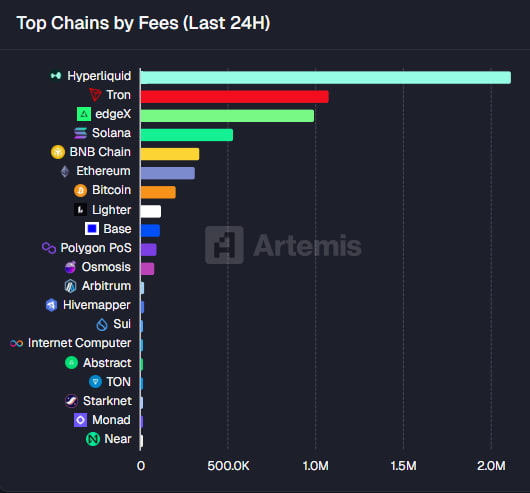
The gap between Hyperliquid and every other chain on the list is not marginal. It is structural. Ethereum, the chain that processes the majority of DeFi settlement globally, generated less than a fifth of Hyperliquid’s fee revenue on this particular day. Solana, which has positioned itself as the high-throughput chain for retail trading activity, sits at roughly a quarter of the total. Bitcoin, the largest asset by market cap, generates fees primarily from the base layer transaction load and sits below both.
Fee revenue is the most direct measure of how much economic activity a chain is processing in real time. It reflects actual trading demand rather than total value locked, market cap, or developer activity. What the Artemis chart shows is that more traders paid more to use Hyperliquid yesterday than any other blockchain on the list. By a significant margin.
Why JPMorgan’s Report Matters for This Context
The fee leadership does not exist in isolation. JPMorgan analysts led by Nikolaos Panigirtzoglou, published by The Block, identified the structural reason driving Hyperliquid’s adoption surge. When Iranian infrastructure strikes broke over a weekend earlier this month, CME traders could not react. Hyperliquid was open. Oil trading exploded on the platform during that window, with the CL-USDC perpetual crude oil contract reaching $1.7 billion in peak daily volume and climbing to approximately $300 million in open interest.
The CL-USDC contract is Hyperliquid’s crude oil perpetual futures product. CL is the standard ticker for West Texas Intermediate crude oil, settled in USDC rather than traditional dollars. It tracks oil prices continuously with no expiry date, giving anyone with a crypto wallet the same directional exposure as a CME oil futures contract without the exchange hours restriction. That product is now Hyperliquid’s third-largest by open interest after Bitcoin and Ethereum perpetuals.
JPMorgan’s analysts framed what they observed as a pivotal moment for decentralized finance filling a structural gap in traditional commodity markets. The bank flagged a surge in non-crypto investors specifically, traders who came to Hyperliquid not because of crypto ideology but because it was the only venue offering continuous crude oil price discovery on a Sunday night. The platform’s on-chain limit order book, sub-second execution finality, and up to 20x leverage gave those traders a product that functioned like the CME markets they were used to, without the closing time.
The Broader Implication
JPMorgan concluded that DEXs are taking market share from mid-tier centralized exchanges through 24-hour availability, speed, and self-custody, and that the trend will expand beyond commodities. The fee data from March 20 suggests that expansion is already happening faster than the report’s cautious framing implies.
Hyperliquid entering the global top ten by market cap this week, surpassing Cardano with approximately $9.97 billion, reflects the same dynamic from the valuation side. The fee leadership reflects it from the revenue side. A platform that generates more economic activity fees than Ethereum, Solana, and Bitcoin on a given day while simultaneously entering the top ten by market cap is not a niche derivatives venue anymore. It is becoming core infrastructure for a market that does not close.