
- Hoskinson says Chainlink quoted an absurd integration price, yet insists negotiations continue and a deal remains possible soon.
- Cardano weighs buying proven oracle infrastructure versus building in-house tools, balancing cash costs against delivery risk and complexity.
Cardano founder Charles Hoskinson acknowledged that integrating Chainlink will not be cheap. In a 22-second video clip shared on August 31 by the account @ARiHBARi, Hoskinson said Chainlink initially quoted an “absurd” price for integration, adding that the teams would “haggle” and “figure it out.” He also described Chainlink co-founder Sergey Nazarov as “extremely smart,” a strong negotiator who “knows what he’s worth.” The post logged over 100,000 views and a wave of replies from holders of both tokens.
🚨 @CARDANO FOUNDER @IOHK_CHARLES STATES THAT @CHAINLINK "GAVE THEM AN ABSURD NUMBER (PRICE) FOR INTEGRATION" & THAT @SERGEYNAZAROV "IS AN EXTREMELY SMART MAN THAT SEES THE FUTURE AND KNOWS HE'S SITTING ON A GOLDEN EGG"🚨$ADA IS WORKING ON INTEGRATING $LINK BUT IT TAKES TIME pic.twitter.com/sDP7xWWUs9
— LinkTOAD General HBARI (@ARiHBARi) August 31, 2025
At issue is Cardano’s access to trusted data feeds. Oracles allow on-chain applications to reference external prices and events. Without that link, many DeFi use cases do not function at scale.
Chainlink runs large oracle networks and sells integration, support, and custom services to base layers and applications. Therefore, a high initial quote is not unusual when the buyer wants enterprise-style coverage.
However, the public exchange highlights the trade-off that many base layers face: pay for proven data pipes or build and maintain a parallel stack. The former compresses timelines but raises cash costs; the latter preserves budget but adds delivery risk and complexity. For Cardano, Hoskinson’s comments suggest a preference to buy time and reliability if terms become acceptable.
Meanwhile, the thread’s replies reflected clear splits. Some users argued Cardano “needs” Chainlink and urged speed. Others questioned why internal tooling has not closed the gap already. A few noted that negotiations have surfaced before and asked for concrete timelines. That uncertainty kept the discussion centered on execution rather than marketing.
For market participants, the near-term read-through is straightforward. If a commercial deal lands, developers on Cardano gain easier access to battle-tested oracle rails, which can expand addressable use cases. If talks stall, the chain must lean harder on in-house or alternative providers, prolonging the current patchwork. Either path has costs.
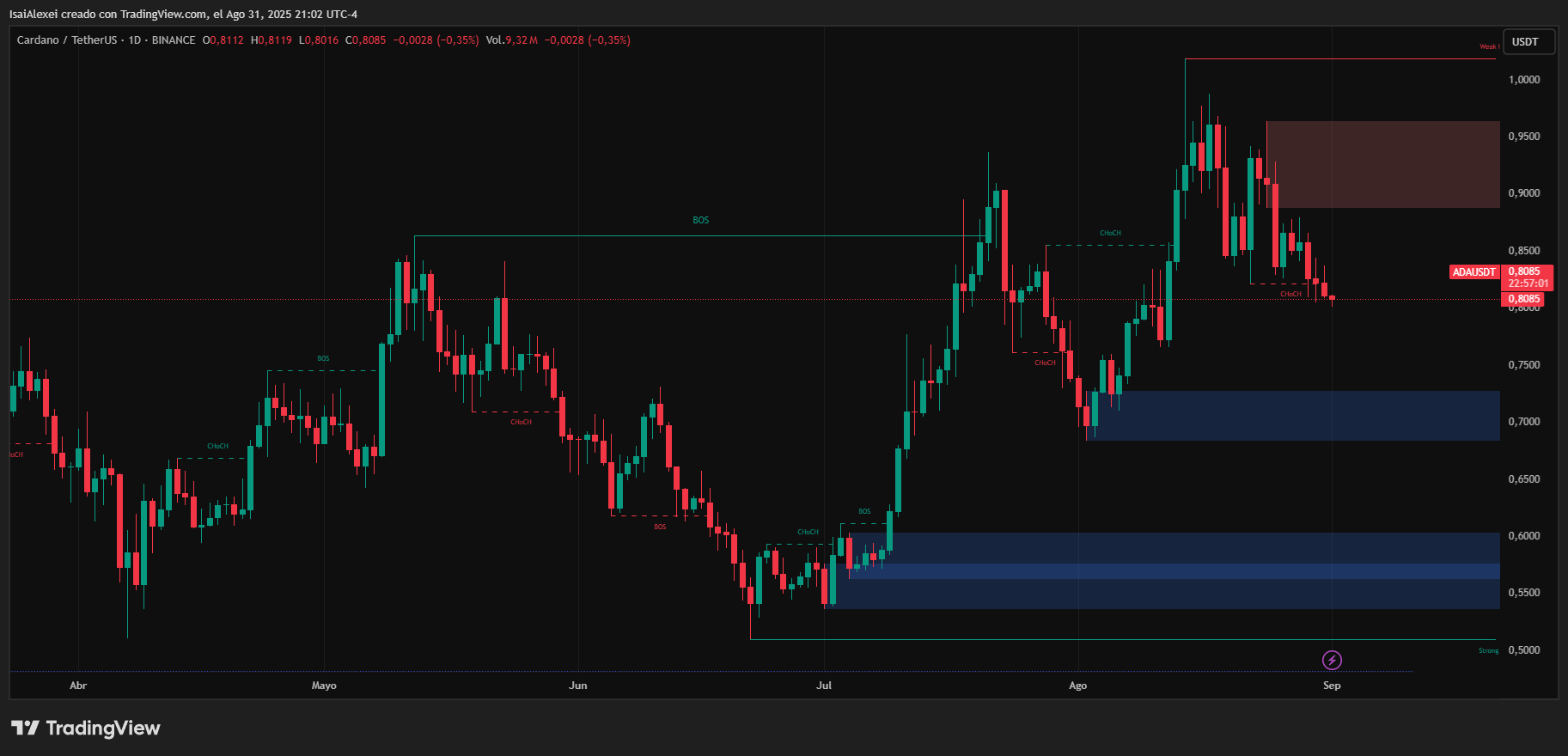
Cardano (ADA) is trading at $0.813 USD, reflecting a -1.12% decline in the last 24 hours and a -12.35% drop over the past 7 days. Its market capitalization is $29.69 billion, with a 24-hour trading volume of $956 million.
The circulating supply stands at 36.48 billion ADA, with a maximum of 45 billion tokens. ADA is currently 73.5% below its all-time high of $3.09, but still more than 4,100% above its historical low of $0.0192 USD.
The latest updates today include key developments. Cardano is preparing for its first ETF listing on Wall Street, with issuers such as Grayscale actively pushing proposals. If approved, this ETF could attract institutional flows and give ADA broader legitimacy in regulated markets.
At the same time, Cardano has faced recurring controversies, including claims of fund mismanagement in 2025, echoing earlier disputes seen in 2018 and 2023. These debates, however, have not derailed the network’s long-term roadmap.