


According to the CryptoQuant chart, recent price action reinforces a tightening link between Bitcoin and major U.S. equity benchmarks at a moment when global macro forces are turning less supportive for risk assets.
What the Chart Shows
The tracker compares Bitcoin’s price and short-term returns with those of the S&P 500, Nasdaq Composite, and Russell 2000.
Over the past week, all three U.S. indexes posted negative returns, and Bitcoin followed the same direction with deeper downside volatility. The clustering of negative daily and 7-day return bars highlights a period where correlations are tightening rather than breaking.
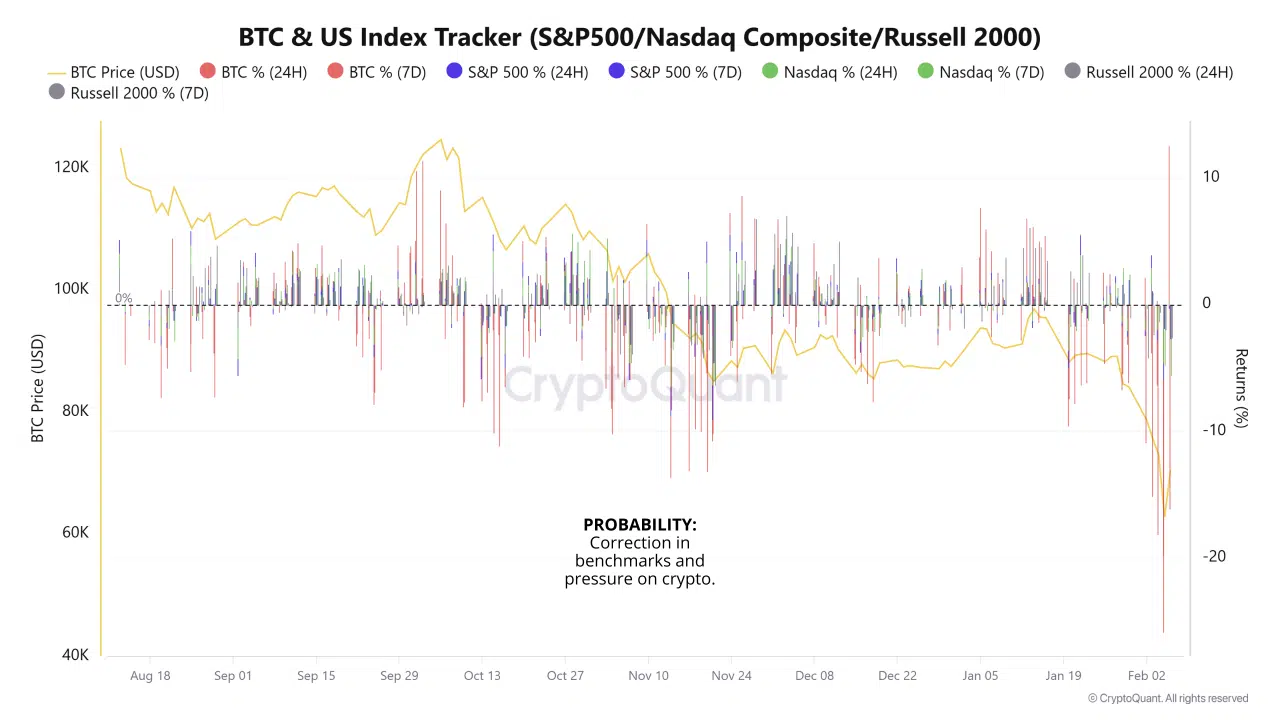
This matters because Bitcoin has not decoupled during the latest equity pullback. Instead, it has amplified the move, a typical pattern during risk-off phases.
Why Japan Matters Here
Sanae Takaichi’s election victory has accelerated expectations for aggressive fiscal stimulus in Japan, alongside yen weakness. That policy mix is already reshaping global capital flows:
- Capital allocation: Higher relative attractiveness of Japanese Government Bonds (JGBs) pulls capital away from U.S. equity exposure.
- U.S. indexes: As capital rotates, the Nasdaq, S&P 500, and Russell 2000 have all priced in downside over the past week.
- Dollar dynamics: A stronger dollar tightens financial conditions, historically a headwind for both equities and crypto.
Implications for Bitcoin
Because Bitcoin remains positively correlated with U.S. risk assets in this environment, pressure on equities translates into pressure on BTC. The chart explicitly points to a higher probability of continued correction in benchmarks, which raises the likelihood of additional short-term downside for Bitcoin, rather than immediate stabilization.
Bottom Line
The data does not suggest a Bitcoin-specific breakdown. Instead, it shows macro-driven spillover: Japan’s stimulus trade strengthens domestic markets while indirectly weighing on U.S. indexes, and Bitcoin is moving in step with that adjustment. As long as equity markets remain under pressure, Bitcoin’s path of least resistance remains tied to broader risk sentiment rather than crypto-native catalysts.