


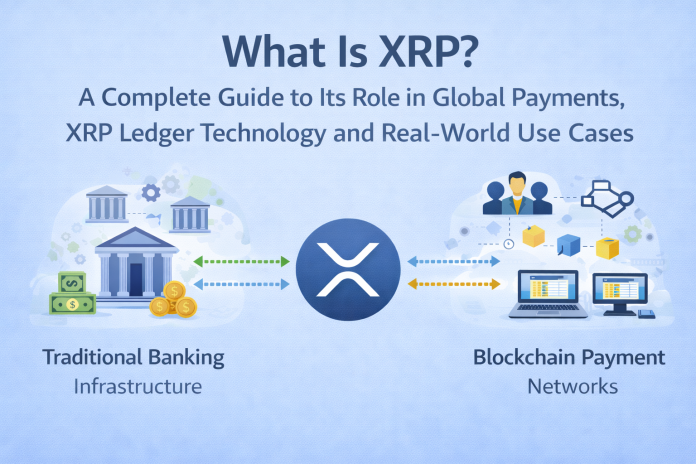

Why XRP Remains Relevant in a Rapidly Changing Crypto Market
More than a decade after its creation, XRP remains one of the most discussed and most misunderstood digital assets in the crypto market. While thousands of altcoins have emerged and faded through multiple market cycles, XRP has consistently remained among the largest cryptocurrencies by market capitalization. This persistence is not driven by hype, meme culture, or short-lived narratives. Instead, it reflects XRP’s focus on a core inefficiency that global finance has struggled with for decades: cross-border payments.
Recent technical developments saw XRP face a crucial monthly test as price interacted with the 21-month EMA, underscoring how key trend levels now influence short and long-term sentiment in the market.
Unlike many crypto assets designed to disrupt or replace the financial system outright, XRP was built with a more pragmatic objective. Its design assumes that traditional financial institutions, payment providers, and regulators will remain central to global money movement for the foreseeable future. Rather than attempting to bypass these actors, XRP was created to improve how value moves between them.
This positioning has earned XRP both supporters and critics. Financial institutions and payment companies have explored its infrastructure for efficiency gains, while crypto purists often criticize it for not aligning with maximal decentralization ideals. Yet regardless of ideological debate, XRP’s survival across multiple market cycles highlights an important reality: blockchain solutions that reduce real-world friction tend to outlast purely speculative experiments.
This evergreen guide explores what XRP is, how the XRP Ledger works, where XRP is used in practice, and why it continues to occupy a distinct role within the broader digital asset landscape.
What Is XRP and How the XRP Ledger Works
At its core, XRP is a digital asset designed to facilitate fast, low-cost transfers of value, particularly across borders. It operates on the XRP Ledger (XRPL), an open-source blockchain optimized specifically for payments and settlement rather than decentralized finance experimentation or complex smart contract ecosystems.
The XRPL was engineered with a narrow but demanding objective: move value quickly, reliably, and at scale. While many blockchains attempt to serve as general-purpose platforms, XRPL prioritizes efficiency, predictability and transaction finality, characteristics that are essential for payment systems.
Unlike Proof of Work networks, XRPL does not rely on mining. Unlike Proof of Stake networks, it does not require users to lock capital to secure the network. Instead, it uses a consensus process that enables rapid agreement among validators without sacrificing throughput or increasing energy consumption.
These architectural choices reflect XRP’s original mission. It was never intended to compete with programmable blockchains on flexibility. Instead, it focuses on doing one thing exceptionally well: settling value transfers quickly and cheaply across jurisdictions.
The technical design and consensus model behind this approach are detailed in the official XRP Ledger documentation, which outlines how fast finality is achieved without mining or staking.
XRP and Ripple: Clarifying the Relationship
One of the most persistent sources of confusion surrounding XRP is its association with Ripple. While the two are closely linked in public perception, they are not the same entity, and understanding the distinction is critical to evaluating XRP objectively.
The XRP Ledger was created before Ripple became a prominent company. XRPL exists as an independent, open-source blockchain maintained by a distributed network of validators. Ripple, as a company, builds software solutions that interact with XRPL and other payment infrastructure, but it does not own or control the ledger itself.
Confusion arises largely because Ripple has historically held a significant amount of XRP and has been a major contributor to XRPL development. This has led some observers to assume that XRP functions as equity or that Ripple directly controls the network. Neither assumption is accurate.
What complicates the narrative further is XRP’s early distribution model, which differs from mining-based assets. While this model remains controversial, it does not equate to centralized control over network consensus or transaction validation.
Key clarifications:
- XRP is not equity in Ripple
- XRP is not controlled by banks or payment providers
- The XRP Ledger operates independently of any single organization
Understanding this separation is essential for evaluating XRP’s risks, strengths, and long-term potential.
How the XRP Ledger Achieves Consensus
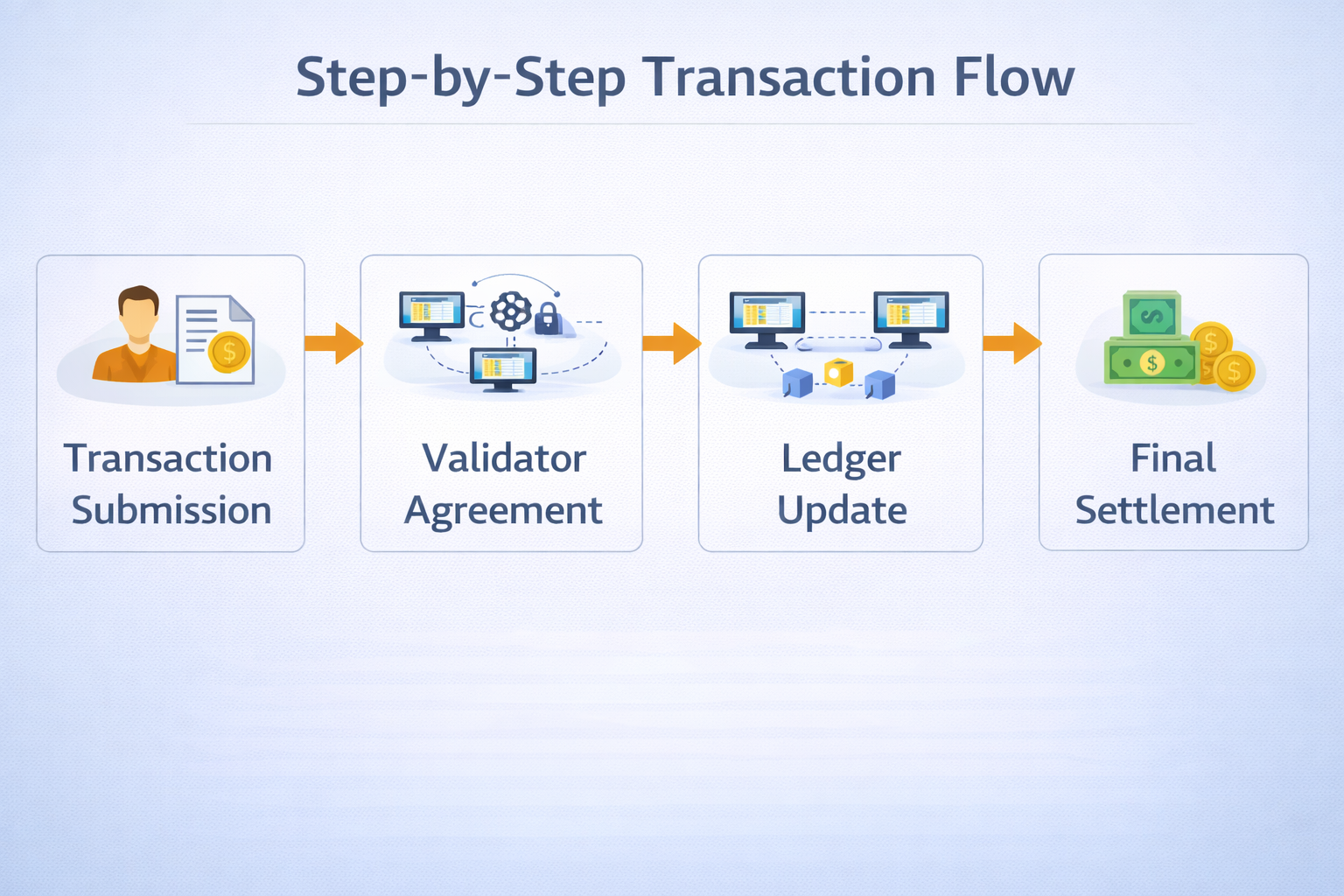 The XRP Ledger uses a consensus mechanism that differs fundamentally from both Proof of Work and Proof of Stake. Instead of miners or stakers competing for block rewards, XRPL validators collectively agree on the validity and order of transactions.
Validators are independent entities that participate in consensus by proposing transaction sets and voting on their validity. Once sufficient agreement is reached, transactions are finalized and added to the ledger. This process repeats every few seconds, enabling near-instant settlement.
One of the defining features of XRPL consensus is deterministic finality. Unlike probabilistic settlement models, where transactions become more secure over time, XRPL transactions are considered final once validated. This characteristic is particularly valuable for payments, where certainty matters more than flexibility.
Another important distinction is energy efficiency. Because XRPL does not rely on mining or capital-intensive staking, its energy consumption remains minimal. This efficiency is not a marketing afterthought, it is a direct consequence of designing the system around payments rather than incentive-driven security models.
Why XRP Was Created: The Cross-Border Payments Problem
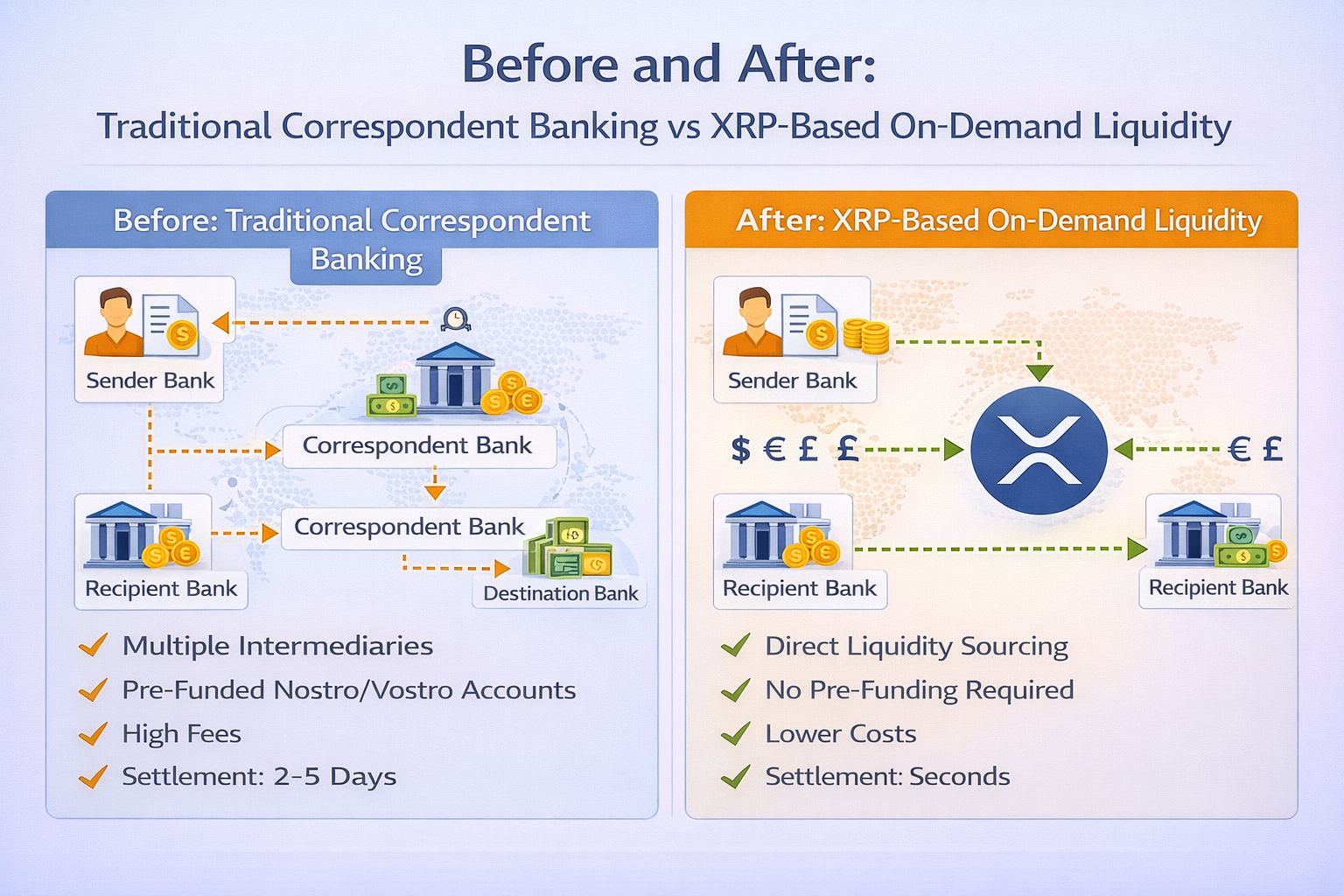
International payments remain one of the most inefficient components of the global financial system. Traditional cross-border transfers rely on correspondent banking networks, where funds pass through multiple intermediaries before reaching their destination.
This structure introduces several well-documented inefficiencies:
- Settlement times measured in days rather than seconds
- High fees driven by intermediaries and foreign exchange spreads
- Capital locked in pre-funded nostro and vostro accounts
- Limited transparency and tracking for senders and recipients
These inefficiencies persist not because of technical limitations, but because existing systems were built decades ago for a less interconnected world. Similar structural challenges are outlined in research from the Bank for International Settlements, which highlights delays, high costs, and fragmented liquidity as persistent issues in global payment rails.As global commerce and remittances expand, the friction becomes increasingly costly.
XRP was designed to function as a neutral liquidity bridge. One of the clearest real-world implementations of this concept is Ripple’s On-Demand Liquidity model, where XRP is used temporarily during cross-border settlement without requiring institutions to hold it long-term. Instead of pre-funding accounts across multiple currencies, institutions can source liquidity on demand using XRP, settle transactions quickly, and reduce capital inefficiency.
Real-World Use Cases of XRP
Cross-Border Payments
XRP’s primary real-world application is cross-border value transfer. By enabling rapid conversion between currencies, XRP can significantly reduce settlement times and operational complexity for payment providers.
Key advantages include:
- Near-instant settlement
- Reduced reliance on intermediaries
- Improved liquidity management
- Lower counterparty risk
On-Demand Liquidity (ODL)
One of the most notable implementations of XRP is the On-Demand Liquidity model. In this framework, XRP is used temporarily during a transaction without requiring institutions to hold it long-term.
A simplified ODL flow:
- Fiat currency A is converted into XRP
- XRP is transferred across the XRP Ledger
- XRP is converted into fiat currency B
This entire process typically completes in seconds, reducing exposure to volatility while eliminating the need for pre-funded accounts.
 XRP vs Bitcoin vs Ethereum: Different Assets, Different Purposes
Although XRP is often grouped alongside Bitcoin and Ethereum, the three assets were designed for fundamentally different roles within the digital asset ecosystem.
Bitcoin emphasizes censorship resistance and scarcity, positioning itself primarily as a store of value. Ethereum prioritizes programmability, enabling smart contracts and decentralized applications. XRP, by contrast, is optimized for payments, settlement, and liquidity transfer.
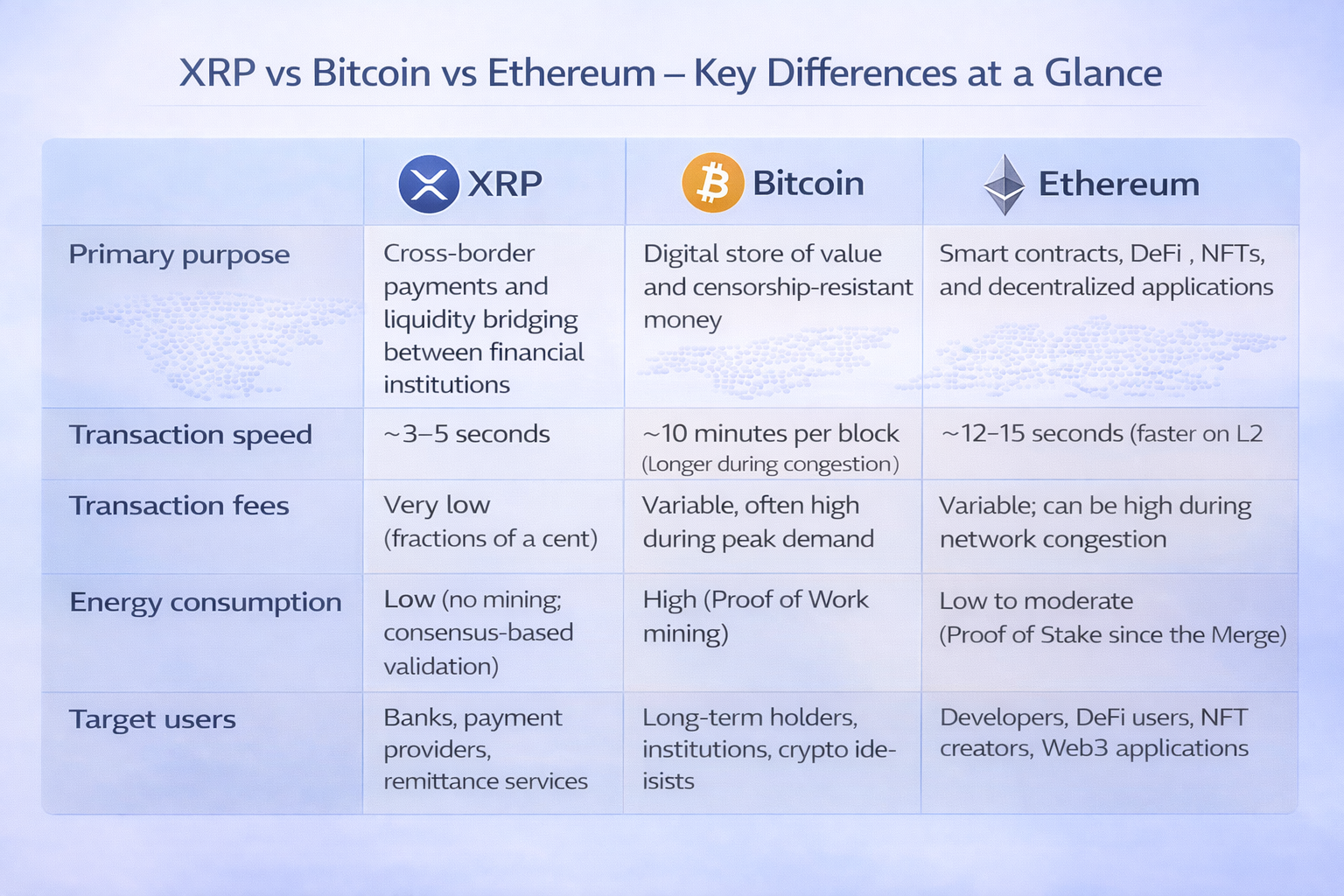 These differences are not value judgments, they reflect design trade-offs.Broader capital flows across crypto markets continue to influence how these trade-offs are priced, particularly as institutional products attract renewed attention, a trend ETHNews recently explored in its coverage of ETF-driven market shifts. XRP sacrifices some flexibility in exchange for speed, efficiency, and scalability, qualities that are critical in payment infrastructure.
XRP Supply, Tokenomics, and Distribution
XRP has a fixed maximum supply, all of which was created at the inception of the XRP Ledger. There is no mining and no ongoing issuance of new tokens. This model differs sharply from both inflationary and reward-based networks.
Transaction fees on XRPL are burned, gradually reducing total supply over time. While the burn rate is modest, it introduces a deflationary mechanism aligned with network usage.
A portion of XRP has historically been placed into escrow with time-based release schedules. This structure was designed to provide predictability around supply entering the market, though it has also been a source of controversy.
Understanding XRP’s tokenomics is essential for evaluating both its investment profile and its suitability as a liquidity asset rather than a speculative instrument.
Regulation and XRP’s Unique Position
Because XRP intersects directly with payment infrastructure, regulation has always played a central role in its narrative. Payments-focused digital assets face greater scrutiny than experimental DeFi protocols because they interact with existing financial systems.
This scrutiny presents challenges, but it also offers potential advantages. Regulatory clarity can enable broader institutional participation, reduce uncertainty, and accelerate integration with traditional finance.
For XRP, regulation is not a peripheral concern, it is a core determinant of adoption. The asset’s long-term relevance depends as much on legal frameworks as on technological capabilities.
Common Myths About XRP
“XRP Is Centralized”
One of the most persistent criticisms of XRP is the claim that it is centralized. This perception often arises because the XRP Ledger does not rely on mining (Proof of Work) or staking (Proof of Stake), which many market participants mistakenly equate with decentralization. In reality, decentralization is not defined by mining alone, but by who controls transaction validation, network rules and ledger state.
The XRP Ledger uses a consensus mechanism based on independent validators that collectively agree on transaction order and validity. These validators are operated by a diverse set of entities, including universities, infrastructure providers, exchanges, and independent node operators. No single validator or organization can unilaterally alter the ledger, censor transactions, or reverse finalized payments.
Critics often point to the concept of “trusted validator lists” as evidence of centralization. However, these lists are not enforced by the protocol itself. Any participant can choose which validators to trust, and the network continues to function as long as there is sufficient overlap among honest validators. Over time, validator diversity on the XRP Ledger has increased, reducing reliance on any single contributor.
In practice, XRP represents a different decentralization trade-off. It prioritizes fast finality, low costs, and operational reliability over adversarial mining competition. This model may differ from Bitcoin’s ideological approach, but difference does not equate to central control.
“Banks Own XRP”
Another common misconception is that banks or financial institutions “own” XRP. This misunderstanding stems from XRP’s association with payment software used by financial institutions and from the asset’s early distribution history. However, using infrastructure that interacts with XRP does not confer ownership or control over the asset itself.
Financial institutions that explore XRP-based solutions typically do so to improve settlement efficiency, not to accumulate or govern the asset. In many cases, XRP is used only momentarily during a transaction, converted from one fiat currency and into another within seconds. This model minimizes exposure to price volatility and does not require institutions to hold XRP on their balance sheets.
Ownership of XRP is distributed across a wide range of holders, including retail participants, exchanges, funds, and long-term investors. There is no mechanism by which banks can mint new XRP, alter its supply, or dictate how the ledger operates. XRP exists independently of any single user group, including institutional participants.
This distinction is important. XRP’s value proposition does not depend on banks owning it, but on liquidity and utility. Institutions can benefit from XRP’s functionality without controlling the asset itself, just as users benefit from the internet without owning the protocols that power it.
“XRP Has No Real Use Case”
The claim that XRP has no real use case is often made by comparing it to platforms that support decentralized applications, NFTs, or DeFi ecosystems. However, this comparison misunderstands XRP’s purpose. XRP was never designed to be a general-purpose computing platform. Its use case is deliberately narrow and that focus is precisely why it has endured.
XRP’s primary function is to act as a bridge asset for payments and liquidity. It enables value to move between currencies quickly and efficiently without requiring pre-funded accounts. This use case addresses a specific and well-documented problem in global finance: inefficient cross-border settlement.
Unlike speculative narratives that depend on future adoption of unproven applications, XRP’s use case aligns with an existing, trillion-dollar market global payments. While adoption is gradual and often invisible to retail users, infrastructure-level improvements rarely generate headlines despite their economic significance.
XRP’s utility may not appeal to every crypto participant, particularly those seeking yield, experimentation, or ideological decentralization. But utility does not need to be broad to be real. In XRP’s case, its role is clear, measurable, and tied to a concrete function within the financial system.
Risks and Considerations
Like all digital assets, XRP involves risks that may influence its adoption and long-term relevance. These risks arise from regulatory conditions, market structure, competitive dynamics, and the pace at which financial infrastructure evolves. Because XRP is positioned within payment and settlement systems, it operates in an environment shaped by established financial rules rather than purely experimental technology trends. As a result, its development and use must be evaluated within a broader institutional and regulatory context.
Regulatory frameworks governing payments, money transmission, and financial infrastructure vary across jurisdictions and may affect how XRP-related solutions are implemented. Changes in regulatory interpretation, licensing requirements, or supervisory expectations can influence adoption timelines and participation by market actors. While regulatory clarity in certain regions may support integration, uncertainty or fragmentation across jurisdictions can slow progress, particularly for cross-border use cases that depend on interoperability.
XRP also operates within a competitive landscape that includes stablecoins and central bank digital currencies, both of which are designed to improve payment efficiency. Stablecoins typically rely on underlying banking relationships and reserve structures, while central bank digital currencies are issued and governed by monetary authorities. These instruments may coexist with XRP in some contexts and compete with it in others, depending on regulatory frameworks, operational requirements, and market preferences.
Finally, market conditions and institutional adoption dynamics play an important role. Digital asset markets are subject to price fluctuations and variable liquidity, which can influence risk assessments and participation by entities with conservative operational requirements. In addition, XRP’s focus on payments means that adoption is closely tied to institutional integration, a process that typically progresses gradually due to testing, compliance, and system alignment. Together, these factors shape XRP’s long-term outlook without negating its underlying value proposition.
The Bigger Picture: XRP’s Role in Global Finance
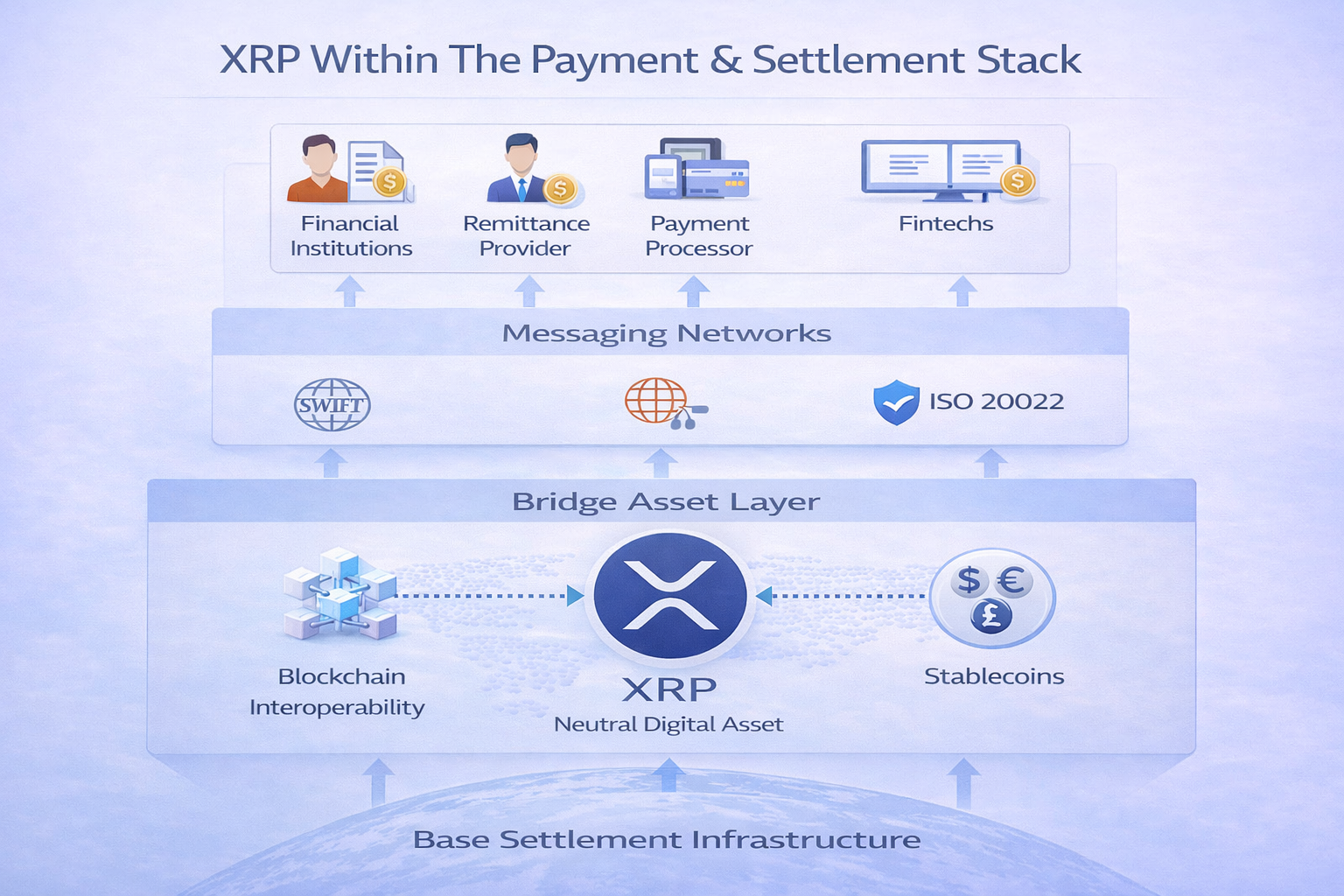 XRP occupies a distinct position within the digital asset ecosystem. It is neither a purely ideological experiment designed to challenge the financial system, nor a speculative novelty driven primarily by short-term market narratives. Instead, XRP represents an attempt to apply blockchain technology to a specific layer of global finance that has remained largely unchanged for decades: the infrastructure that enables money to move across borders.
This positioning places XRP closer to financial plumbing than to consumer-facing innovation. Its focus is not on user experience, programmability, or decentralized experimentation, but on improving settlement efficiency, liquidity management, and interoperability between different currencies and payment systems. As a result, its success is less visible to end users and more dependent on backend integration within existing financial networks.
Whether XRP ultimately becomes a dominant global settlement layer remains uncertain. The evolution of global payments is shaped by a combination of technological capability, regulatory alignment, institutional behavior, and geopolitical considerations. No single solution is guaranteed to prevail, and progress is often incremental rather than transformative. However, the underlying drivers for change cost reduction, speed, transparency, and efficiency, continue to exert pressure on legacy systems.
In this context, solutions that reduce friction while integrating with existing financial infrastructure are likely to remain relevant. Payment systems tend to evolve through adaptation rather than replacement and technologies that can operate alongside established frameworks may face fewer structural barriers to adoption.This gradual, infrastructure-led evolution is also reflected in analysis from the World Economic Forum, which argues that blockchain payment solutions are most likely to gain traction through integration with existing financial systems. XRP’s design reflects this reality, positioning it as a complementary tool rather than a disruptive force.
Ultimately, XRP’s long-term significance lies not in short-term price movements or market cycles, but in whether blockchain-based liquidity can meaningfully improve how value moves across borders. Its relevance will be determined by practical outcomes: reduced settlement times, improved capital efficiency, and increased interoperability. If these objectives continue to matter in global finance, XRP’s role, whatever its final scale, will remain part of the broader conversation about the future of payments.



