
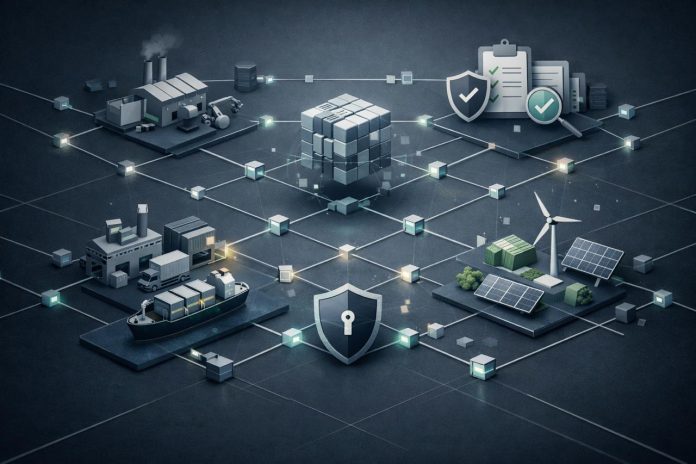

VeChain is not a general-purpose blockchain designed for open experimentation. It is an enterprise-oriented system built to solve a specific coordination problem: how businesses can share data, verify processes and prove outcomes across complex supply chains without relying on a single trusted intermediary.
What Is VeChain?
Rather than positioning itself as a competitor to public smart-contract platforms, VeChain focuses on operational trust. Its relevance comes from translating blockchain concepts: immutability, transparency and auditability into environments where regulation, compliance and efficiency matter more than permissionless experimentation.
Why VeChain Exists
Modern supply chains are fragmented by design. Products move across borders, vendors and regulatory regimes, often relying on siloed databases and manual verification. This fragmentation creates inefficiencies, increases costs and makes fraud difficult to detect.
VeChain exists to reduce these coordination failures. Its core premise is that shared, verifiable data can replace repeated audits, reconciliations and intermediaries. Instead of optimizing for decentralization at all costs, VeChain optimizes for reliability and real-world usability in enterprise contexts.
From Counterfeiting to Enterprise Coordination
VeChain’s earliest focus was product authenticity, particularly in luxury goods where counterfeiting erodes brand trust. That initial use case revealed a broader pattern: many industries struggle not because data is unavailable, but because it cannot be trusted across organizational boundaries.
Over time, VeChain expanded from anti-counterfeiting into logistics, food safety, automotive supply chains and sustainability reporting. This evolution reflects a shift from solving isolated problems to offering a shared infrastructure layer for enterprise coordination.
Leadership and Design Philosophy
VeChain was founded by Sunny Lu, whose background in luxury retail exposed the limits of traditional verification systems. Rather than approaching blockchain as a disruptive financial tool, VeChain’s leadership framed it as enterprise middleware, supporting existing processes instead of replacing them outright.
This philosophy continues to shape the network. VeChain prioritizes predictable costs, governance clarity and regulatory compatibility, even when those priorities require trade-offs compared to fully permissionless systems.
Proof of Authority as an Enterprise Trade-Off
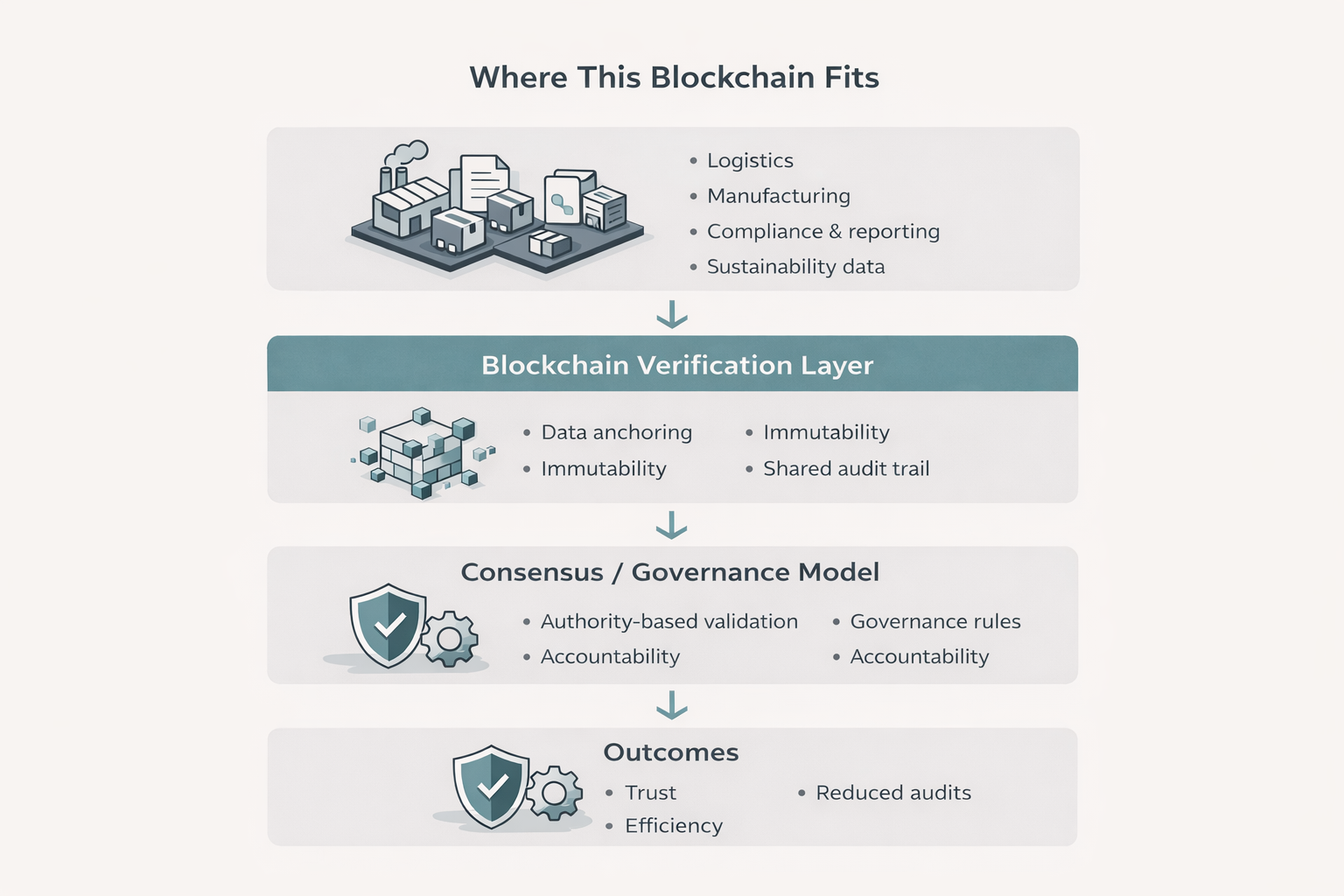
VeChain operates on a proof-of-authority consensus model. Instead of relying on anonymous validators, a limited set of identified nodes secures the network. This design choice emphasizes accountability and performance over maximal decentralization.
From an enterprise perspective, this model reduces uncertainty. Transactions settle quickly, governance is clearer and operational risks are easier to manage. Proof of authority, in this context, is less about ideology and more about aligning blockchain behavior with organizational realities.
Dual Tokens and Cost Predictability
 VeChain separates governance and usage through a dual-token structure. One token represents participation and long-term alignment, while another is consumed to pay for network activity.
This separation addresses a common enterprise concern: volatility. By isolating operational costs from speculative dynamics, VeChain allows businesses to plan usage without tying expenses directly to market fluctuations. Token economics function as a stability mechanism rather than an incentive for speculation.
Data Integrity Beyond Finance
VeChain’s value proposition extends beyond payments or smart contracts. The network is designed to anchor real-world data such as product origin, handling conditions, or emissions metrics into an immutable ledger.
This approach reframes blockchain as an auditing tool. Instead of trusting reports after the fact, stakeholders can verify processes continuously. In this sense, VeChain positions itself closer to infrastructure for accountability than to decentralized finance platforms.
Adoption Through Enterprise Integration
VeChain’s adoption strategy centers on integration rather than disruption. Enterprises use the network as an extension of existing systems, embedding blockchain verification into logistics, manufacturing and reporting workflows.
These integrations demonstrate a different path to blockchain adoption. Rather than attracting users through open participation, VeChain embeds itself where compliance, traceability and auditability already matter. Adoption follows operational necessity, not speculative interest.
Recent Developments: Sustainability as Infrastructure
Recent development within the VeChain ecosystem has emphasized sustainability and environmental reporting. As regulatory and social pressure around emissions grows, the ability to verify environmental data has become a structural requirement rather than a public-relations exercise.
VeChain’s tooling increasingly positions the network as infrastructure for environmental accountability. This shift reflects a broader trend: blockchains gaining relevance not through financial abstraction, but through measurable real-world impact.
What VeChain Represents in the Crypto Landscape
VeChain represents a pragmatic interpretation of blockchain’s role in the economy. It suggests that decentralization is not binary and that some systems derive value from constrained governance and identifiable participants.
Rather than challenging existing institutions, VeChain integrates with them. Its trajectory highlights a parallel future for blockchain – one where distributed ledgers function as shared operational infrastructure, enabling trust between organizations that would otherwise rely on opaque processes.
Further Reading
Readers interested in the broader context around VeChain may explore What Is Ethereum to understand the smart-contract foundations enterprise platforms build upon and What Is Distributed Ledger Technology (DLT)? for a systems-level view of how shared ledgers support coordination.
For insight into how blockchain increasingly intersects with regulation and sustainability, Real-World Assets (RWA) in Crypto: How Tokenization Is Bringing Traditional Finance On-Chain provides additional perspective on enterprise-driven adoption models.