

What Is Solana and How Does It Work?
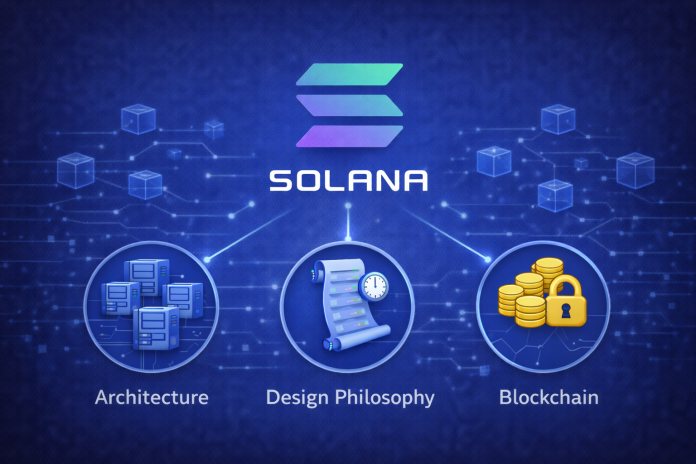
Solana is a high-performance layer-1 blockchain designed to support fast, low-cost transactions and scalable decentralized applications. In simple terms, it aims to make blockchain applications feel responsive enough for everyday use, without users needing to think about delays, congestion, or fluctuating fees.
Early blockchains prioritized security and decentralization above all else. While this foundation was essential, it also introduced limitations in speed, cost, and usability. As blockchain adoption expanded beyond simple value transfers into finance, gaming, and consumer applications, these constraints became increasingly apparent.
Within the broader blockchain ecosystem, Solana occupies a distinct position. It is a performance-oriented layer-1 that attempts to solve scalability directly at the base layer, rather than relying heavily on secondary networks or off-chain execution. This choice places Solana at one end of the blockchain design spectrum, emphasizing execution efficiency and developer simplicity while consciously accepting architectural tradeoffs.
Why Was Solana Created: The Problem It Aims to Solve
As blockchain usage increased, the scalability limits of early designs became more pronounced. Many networks could process only a small number of transactions per second, leading to congestion, slow confirmations, and unpredictable transaction fees during periods of high demand.
Several core issues emerged as adoption grew:
- Limited throughput, forcing transactions to be processed sequentially
- Network congestion during peak usage
- Rising and volatile transaction fees
- Poor user experience for interactive or real-time applications
Low throughput and high latency made many consumer-facing applications impractical, while competition for scarce block space undermined affordability. Solana approached these challenges not as incremental optimizations, but as a systems-level redesign. The central question was whether a single, highly optimized base layer could support global-scale applications without fragmenting execution across multiple environments.
Who Created Solana?
Solana was founded by Anatoly Yakovenko, an engineer with a background in distributed systems and network optimization. His experience working on performance-sensitive systems shaped his perspective on blockchain inefficiencies.
Yakovenko identified the lack of a shared, reliable notion of time as a fundamental bottleneck in many blockchains. Without an internal clock, networks must repeatedly communicate to agree on transaction order, creating coordination overhead that limits performance. Solana’s architecture emerged from the idea that this bottleneck could be reduced by embedding a cryptographic notion of time directly into the protocol.
This perspective led Solana to be designed less as a financial protocol and more as a high-performance distributed system. Rather than assuming limited throughput as an inherent constraint of decentralization, the network treats coordination costs as an engineering problem to be minimized. By reducing how often participants need to communicate to establish order, Solana attempts to unlock higher efficiency while preserving a shared, verifiable state, an approach that sets it apart from blockchains built primarily around economic minimalism or modular execution.
Core Design Philosophy of Solana
Solana follows a performance-first design philosophy, which is described in detail in the official Solana architecture documentation. Instead of minimizing the base layer and shifting complexity to external systems, it optimizes execution directly at the protocol level. This approach treats the blockchain not merely as a settlement layer, but as an execution environment capable of supporting continuous, high-frequency activity.
This philosophy is reflected in several deliberate design choices:
- Vertical scaling by leveraging increasingly powerful hardware
- A single global state that preserves composability and shared liquidity
- Tight integration of consensus, execution, and data propagation
- Reduced reliance on secondary execution layers
Together, these choices aim to minimize coordination overhead and maximize throughput within a unified system. By keeping execution on the base layer, Solana avoids fragmenting liquidity and application logic across multiple environments, which can simplify development and enable more complex interactions between protocols. Developers operate within a shared state space, allowing applications to interoperate without relying on bridges or asynchronous messaging between layers.
At the same time, this approach shifts complexity inward. Higher performance requires more capable validator infrastructure, more sophisticated networking, and tighter coupling between protocol components. These factors influence who can realistically participate in validation and how decentralization manifests in practice. Rather than treating these outcomes as flaws, Solana’s design frames them as explicit tradeoffs, prioritizing execution efficiency and developer simplicity while accepting increased operational demands and architectural complexity as part of the cost of performance.
How Solana Works
Understanding how Solana functions is essential to understanding its role in the blockchain ecosystem.
 Proof of History: Ordering Time on a Blockchain
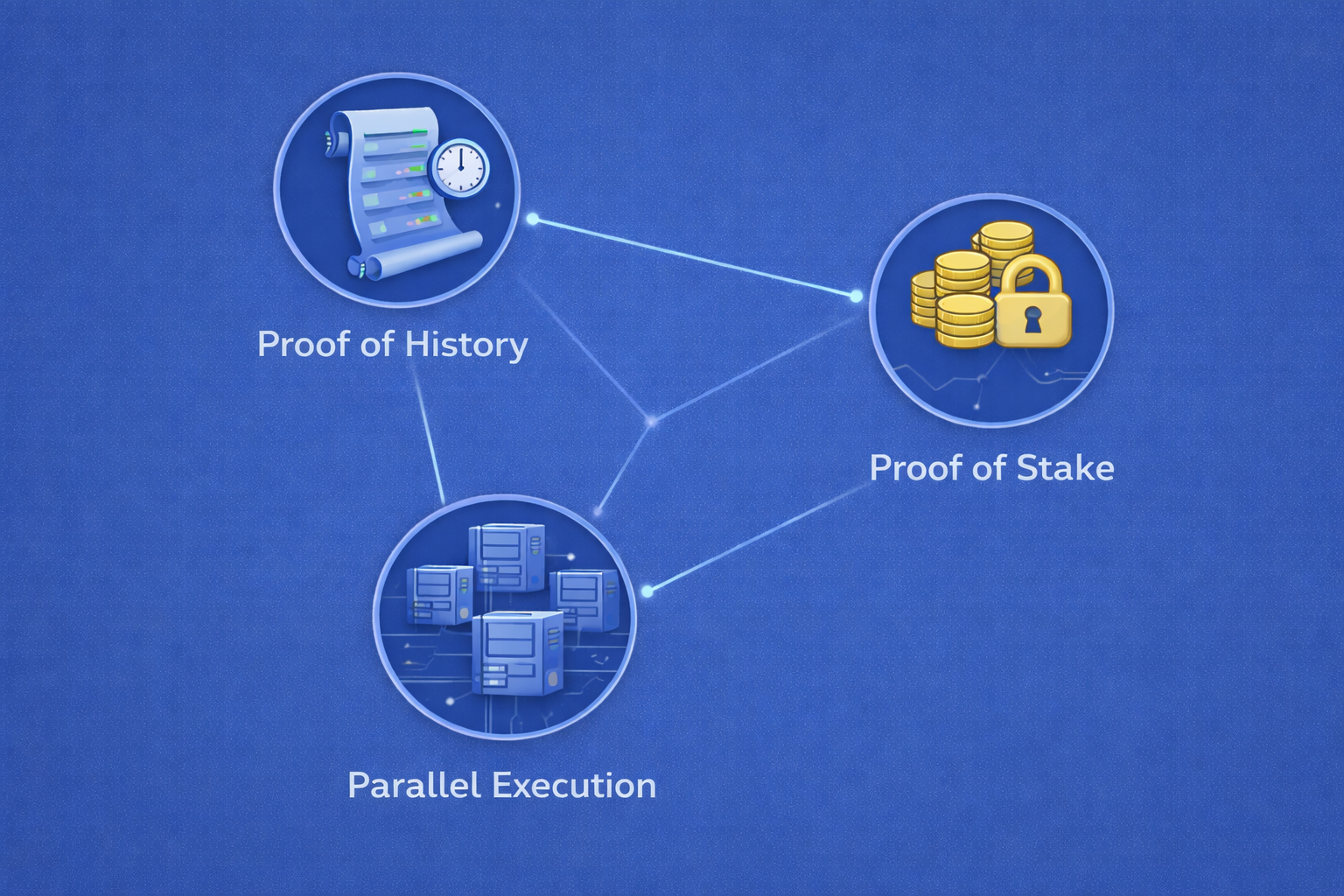
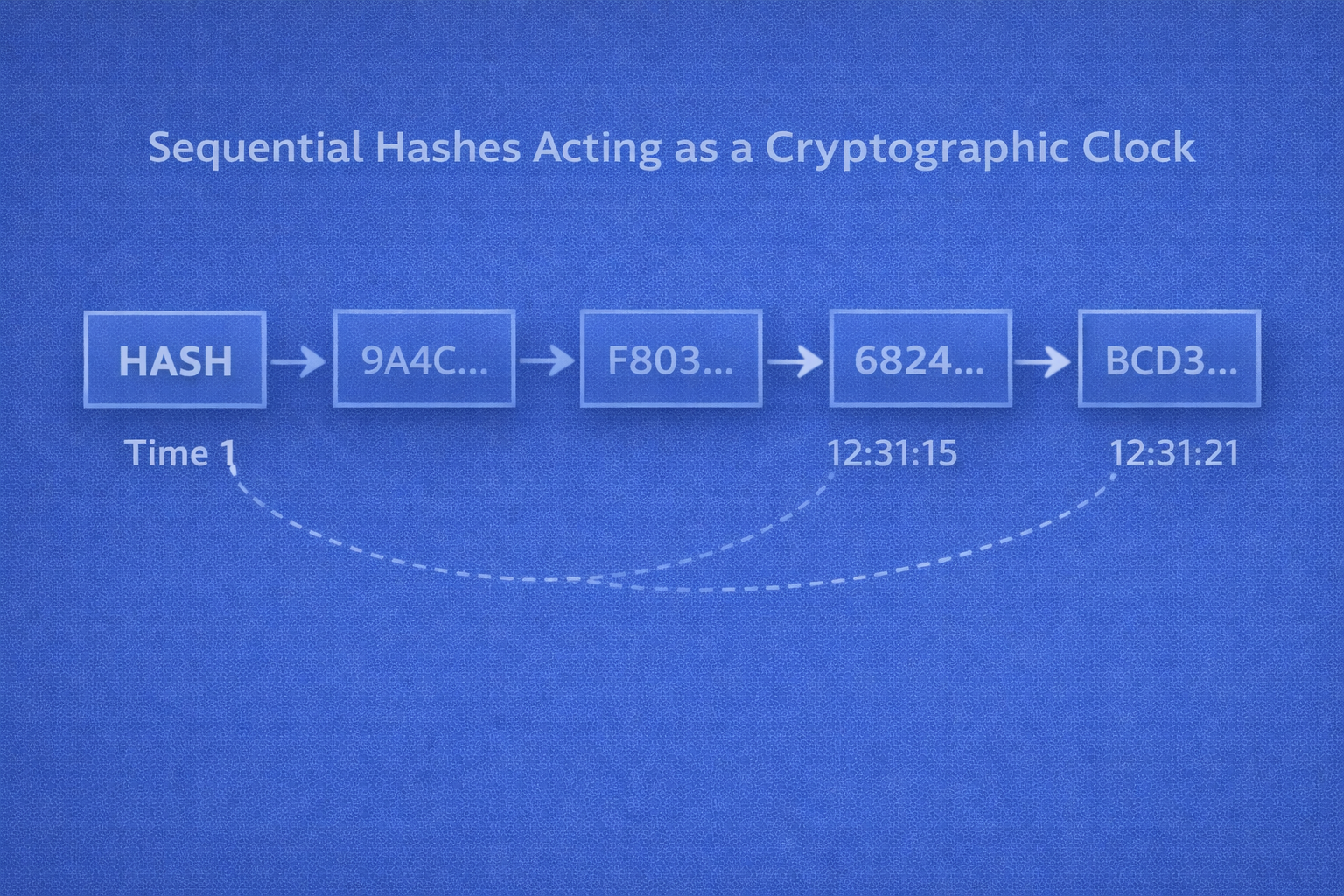
Proof of History is a cryptographic technique that establishes a verifiable sequence of events over time, as defined in Solana’s official Proof of History documentation. It works by continuously hashing data in a way that proves how much time has passed between each step, creating a tamper-resistant timeline.
Instead of requiring validators to repeatedly communicate to agree on transaction order, Proof of History provides a pre-ordered sequence that participants can independently verify. This reduces coordination overhead and allows validators to focus on executing transactions rather than negotiating their placement.
Proof of History does not replace consensus. It functions as a cryptographic clock that improves efficiency within Solana’s broader Proof-of-Stake system.
 Consensus Mechanism: Proof of Stake Enhanced by Proof of History
Solana uses a Proof-of-Stake consensus model in which validators stake SOL to participate in block production and network security, following the rules outlined in Solana’s consensus documentation. Proof of History enhances this process by streamlining how validators agree on transaction order.
This structure enables:
- Continuous block production
- Reduced coordination overhead
- Faster confirmations
- Economic accountability through staking and penalties
Validators rotate leadership roles, produce blocks, and verify one another’s output, while Proof of History minimizes the need for constant coordination.
Architecture and Parallel Execution
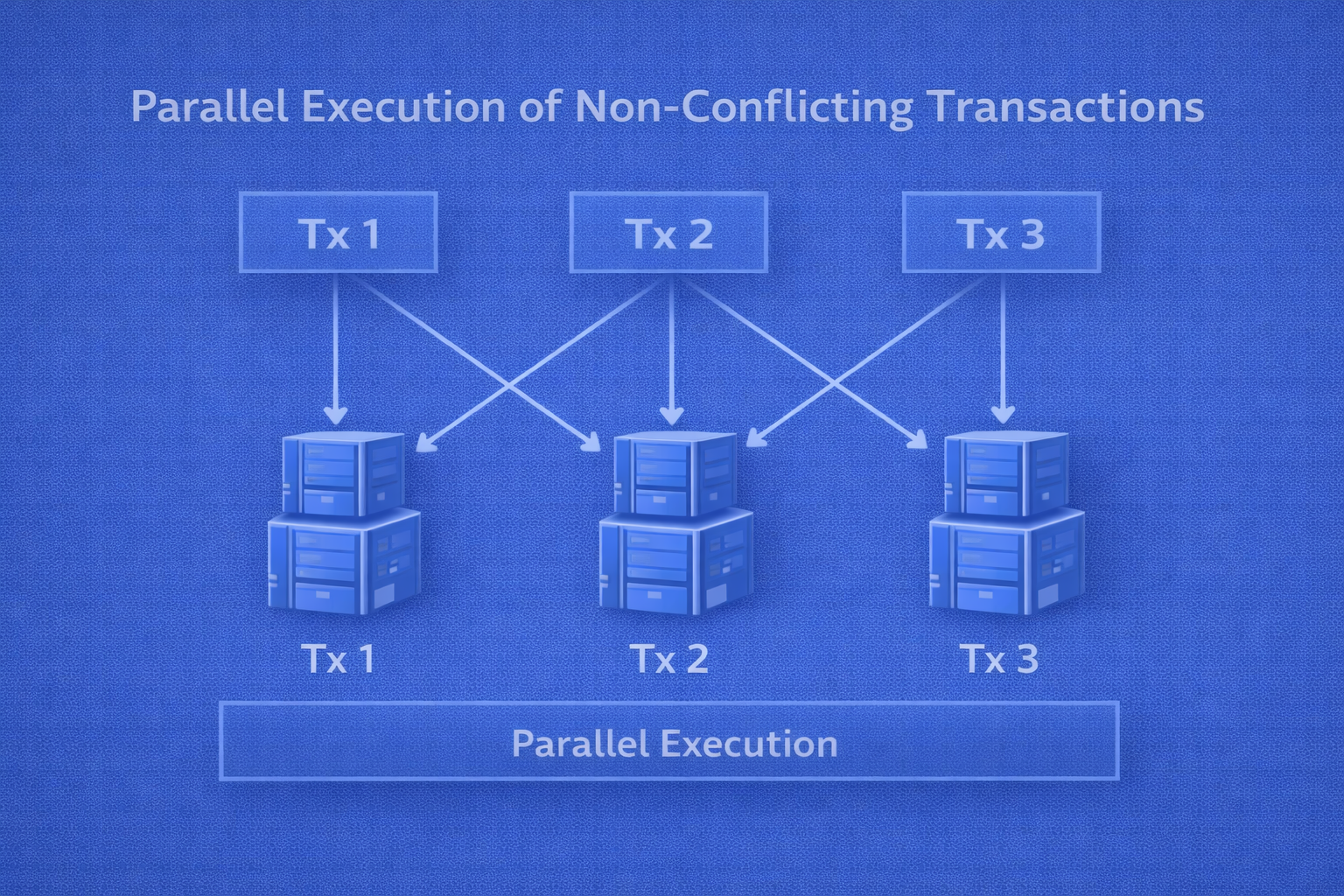 Solana operates on a single global state, meaning all smart contracts interact with the same ledger. To scale this model, the network supports parallel execution of transactions that do not conflict with one another.
Transactions affecting unrelated accounts can be processed simultaneously rather than sequentially. This allows Solana to utilize modern multicore hardware efficiently while preserving composability across applications.
SOL Token: What It Is and What It Does
SOL is the native asset of the Solana network and plays a central role in its operation, requiring users to manage keys and balances securely, as outlined in ETHNews’ crypto wallets guide. It is used to pay transaction fees, compensate validators, and enable participation in consensus through staking.
Because Solana is designed for high throughput and frequent execution, SOL’s utility is closely tied to network activity rather than scarcity-driven fee pressure. Staking SOL aligns economic incentives between users, validators, and the long-term health of the network.
What Can Be Built on Solana?
Solana is well suited for applications that require speed, low latency, and predictable costs, including:
- Decentralized finance platforms with frequent state updates
- NFT marketplaces supporting large-scale minting
- Real-time blockchain games
- Consumer payment applications requiring fast confirmations
These use cases are difficult to implement effectively on slower networks, positioning Solana as an execution-focused environment for real-time applications.
Solana vs Ethereum: A Conceptual Comparison
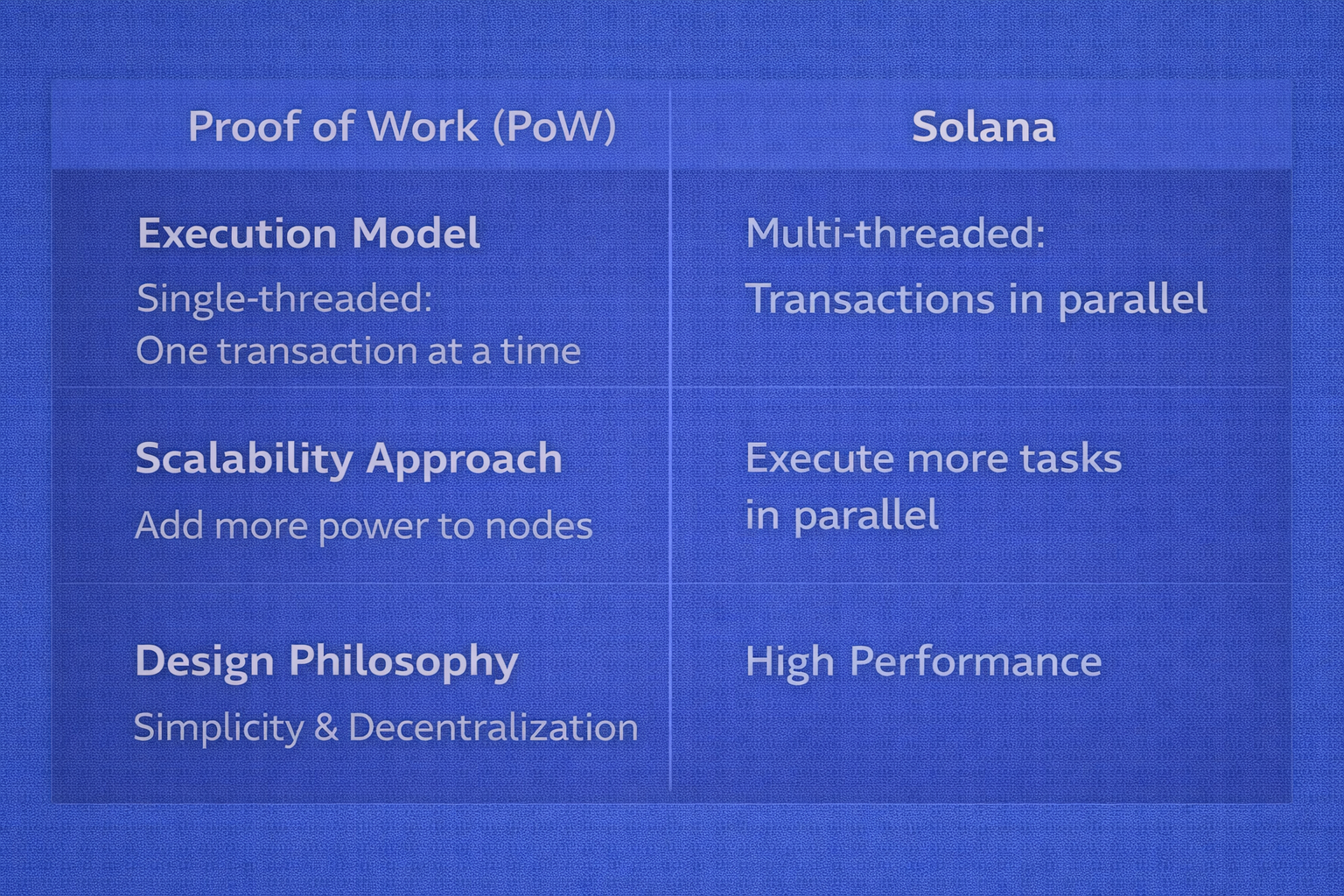
Solana and Ethereum reflect different approaches to blockchain scalability. Ethereum emphasizes minimalism and modularity at the base layer, relying heavily on layer-2 solutions for execution. Solana integrates execution directly into the base layer and prioritizes performance and low latency.
These approaches are best viewed as complementary rather than competitive. Different applications benefit from different tradeoffs.
 Benefits of Solana
Taken together, Solana’s benefits reflect its core goal: enabling fast execution without fragmenting the developer experience. Rather than distributing activity across multiple layers or environments, Solana concentrates execution within a single, high-capacity base layer designed to handle continuous activity at scale.
Key advantages include:
- High throughput through parallel execution, allowing the network to process many non-conflicting transactions simultaneously rather than sequentially
- Low latency suitable for real-time applications, enabling faster feedback loops and more responsive user experiences
- Low and predictable transaction costs, supported by high capacity that reduces fee volatility during periods of increased demand
- A unified execution environment that preserves composability, allowing applications to interact seamlessly without relying on bridges or asynchronous messaging
Together, these characteristics allow Solana to function as an active execution layer rather than merely a settlement network. Applications can operate continuously and interact directly within a shared state, supporting use cases that depend on speed, frequent updates, and tight integration, capabilities that are difficult to achieve on networks optimized primarily for periodic settlement.
Risks and Limitations
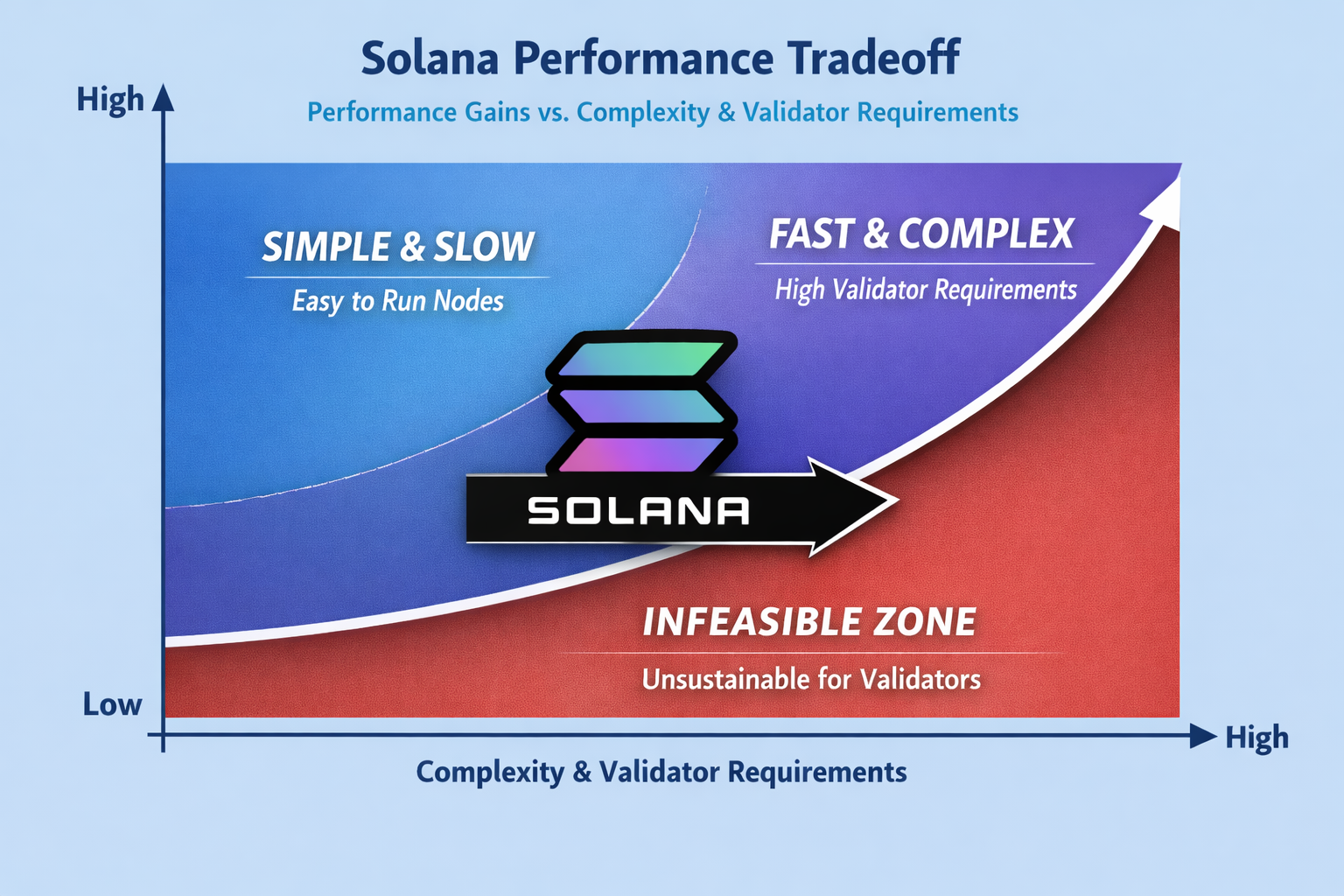
Solana’s performance-oriented design enables high throughput and low latency, but it also introduces tradeoffs that affect how the network operates in practice. These tradeoffs are not accidental; they are the direct result of prioritizing execution efficiency and tight protocol integration at the base layer.
Key limitations include:
- Higher validator hardware requirements, which increase the cost of participation and raise the technical barrier to entry compared with lighter-weight networks, as detailed in Solana’s official validator hardware requirements.
- Increased protocol complexity, as tightly integrated components require more sophisticated engineering and make upgrades and maintenance more demanding
- Greater operational demands on validators, including networking, monitoring, and rapid response to edge cases or performance issues
- Potential centralization pressures related to infrastructure costs, particularly in environments where access to reliable hardware and bandwidth is uneven
Together, these factors shape the type of decentralization and resilience the network can realistically sustain. Rather than distributing responsibility across many minimally provisioned participants, Solana concentrates execution efficiency within a smaller number of highly capable operators. This model can deliver strong performance, but it also places greater emphasis on coordination, tooling, and governance to maintain stability under stress.
Evaluating Solana therefore requires viewing performance, decentralization, and security as interdependent variables rather than isolated metrics. Its architecture illustrates how scaling decisions inevitably shift constraints rather than eliminate them, offering a clear example of how different design priorities lead to different risk profiles across blockchain networks.
 Decentralization and Validator Participation
Solana is permissionless, meaning anyone can technically run a validator. In practice, participation depends on access to hardware, bandwidth and operational expertise, as well as the ability to acquire and stake assets, a process explained in ETHNews’ guide to buying cryptocurrencies.
Decentralization on Solana is best understood as a spectrum rather than a binary condition. This dynamic is not unique to Solana but is more visible in performance-oriented networks where infrastructure demands are higher.
Over time, factors such as improvements in tooling, changes in hardware costs, and shifts in staking economics can influence how participation evolves. Validator distribution, stake concentration, and operational accessibility are not fixed characteristics but variables that change as the network matures. As a result, decentralization on Solana is best evaluated as an ongoing process shaped by technical design, economic incentives, and real-world constraints rather than a static property defined at launch.
Common Misconceptions About Solana
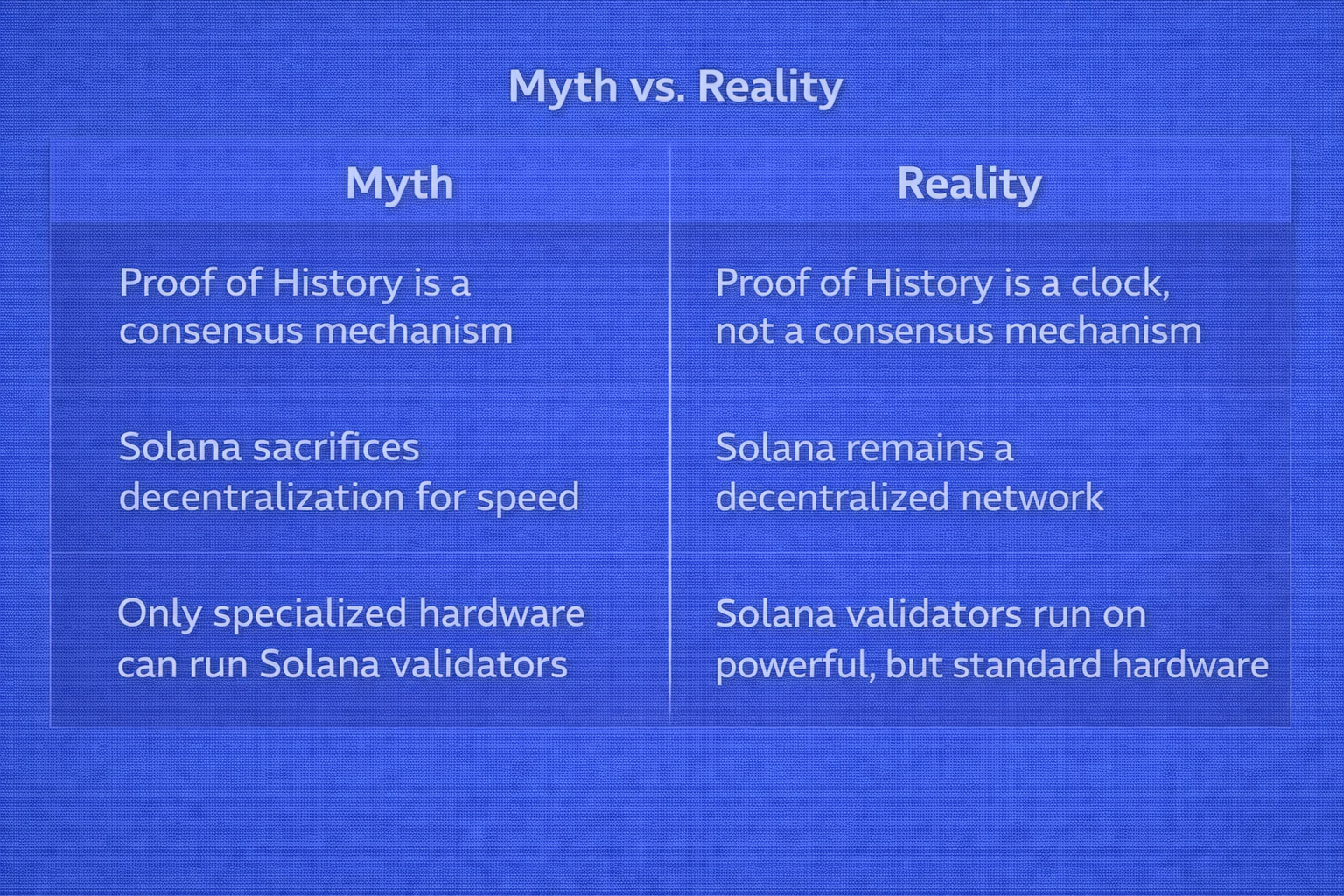 Solana is often discussed in oversimplified terms, leading to recurring misconceptions such as:
- “Solana is centralized by design”
- “Proof of History replaces consensus”
- “High speed automatically means low security”
These claims typically arise from comparing Solana to blockchains built around different assumptions rather than from examining how its components function together. In reality, Proof of History serves as a timing mechanism that improves coordination efficiency, while Proof of Stake remains responsible for security, validation, and economic finality. Performance in this context reflects an architectural choice to reduce coordination overhead, not a rejection of decentralized consensus.
More broadly, high throughput and low latency do not inherently negate decentralization or security. Instead, they shift where tradeoffs appear. Solana’s design places greater emphasis on infrastructure capabilities and operational coordination, which influences who can participate in validation and how decentralization manifests in practice. Understanding these dynamics requires moving beyond slogans and examining how design priorities translate into real-world behavior.
Solana in the Broader Blockchain Ecosystem
The blockchain ecosystem is increasingly diverse, with performance-focused chains, modular architectures, and settlement-oriented networks coexisting, a dynamic increasingly influenced by broader market forces discussed in ETHNews’ analysis of crypto’s growing correlation with traditional markets. Rather than converging on a single optimal design, the industry has evolved toward specialization, where different networks emphasize different tradeoffs depending on their goals. This diversity allows developers to select infrastructure based on application requirements such as latency, throughput, composability, and security assumptions, rather than forcing all use cases onto a single architectural model.
Within this landscape, Solana represents one end of the design spectrum by demonstrating what is possible when performance is prioritized at the base layer. Its architecture shows how reducing coordination overhead and integrating execution directly into the protocol can enable new classes of applications that are difficult to support elsewhere. At the same time, Solana’s position highlights the broader reality that no single approach can serve all needs equally. Instead, its design contributes to a more pluralistic ecosystem, where different blockchain architectures coexist, compete, and inform one another as the technology continues to mature.
Solana and the Future of High-Performance Blockchains
As demand grows for real-time applications such as payments, gaming, and on-chain markets, performance constraints become more visible, particularly during quieter accumulation phases explored in ETHNews’ analysis of long-term network participation trends. Solana offers insight into how decentralized systems can approach these demands without fully abandoning shared state or composability.
This experimentation highlights a broader shift in blockchain design, where different networks explore distinct points along the spectrum between performance, decentralization, and complexity. Solana’s tightly integrated approach contrasts with more modular architectures, demonstrating that scalability can be addressed through multiple strategies rather than a single dominant model. Rather than serving as a definitive blueprint, Solana functions as an ongoing experiment whose outcomes continue to influence protocol design across the industry, shaping how future systems balance execution efficiency with coordination and resilience.
Solana’s Ongoing Role in the Evolution of Blockchains
Solana is best understood not as “a faster blockchain,” but as a distinct architectural response to the problem of scalability. By prioritizing performance at the base layer, it expands the range of applications that blockchains can realistically support, particularly those that depend on continuous execution, low latency, and predictable costs. This approach challenges the assumption that high throughput must always be achieved by fragmenting execution across multiple layers or environments.
At the same time, Solana illustrates that scalability is not a single-dimensional problem with a universal solution. Improving execution speed and capacity introduces new considerations around validator requirements, network complexity, and operational resilience. These factors shape the network’s decentralization profile and influence how security and participation are distributed in practice. Rather than eliminating tradeoffs, Solana makes them more explicit, offering a clear example of how different design priorities lead to different outcomes.
Taken together, Solana’s strengths and limitations provide valuable lessons for the broader ecosystem. Its architecture demonstrates how coordination costs can be reduced through protocol-level design, while also highlighting the challenges of maintaining robustness in tightly integrated systems. Regardless of future market cycles, Solana will remain an important reference point in discussions around execution, coordination, and decentralized infrastructure design, not as a definitive model, but as a meaningful experiment that continues to inform how blockchains evolve.