



IOTA is not a general-purpose blockchain and not a financial-first crypto network. It is a distributed ledger system designed specifically to support the Internet of Things (IoT), where machines exchange data and value autonomously at high frequency and low cost.
What Is IOTA?
Instead of using blocks and miners, IOTA is built on a different data structure known as the Tangle. This architecture was created to support environments where transaction fees, latency and scalability constraints make traditional blockchains impractical. In IOTA’s design, value transfer and data integrity are treated as infrastructure requirements rather than financial products.
The MIOTA token exists to support this system, enabling coordination and incentives within a network optimized for machine-to-machine interaction.
Why IOTA Exists
IoT ecosystems introduce coordination problems that blockchains were not designed to solve. Devices generate vast numbers of small transactions and data events, often with minimal economic value individually but significant impact collectively. Transaction fees, congestion and reliance on miners make many blockchain systems unsuitable for this environment.
IOTA exists to address these limitations. Its core premise is that machines should be able to transact without fees, validate each other’s activity and scale naturally as usage grows. Rather than optimizing for financial settlement, IOTA optimizes for data integrity, automation and scalability in machine-driven systems.
In this sense, IOTA positions itself as digital infrastructure for connected devices rather than as a payment network.
Origins and Institutional Focus
IOTA was initiated in 2015 and is maintained by the IOTA Foundation, a non-profit organization based in Germany. The foundation’s mandate has consistently emphasized research, standardization and real-world adoption over speculative growth.
The project was co-founded by David Sønstebø, Dominik Schiener, Sergey Ivancheglo and Sergey Popov. While the founding team has evolved, the foundation continues to operate with a research-driven, standards-oriented approach.
This institutional structure distinguishes IOTA from many community-led blockchain projects.
The Tangle: A Non-Blockchain Ledger
IOTA does not use a blockchain. Instead, it relies on a Directed Acyclic Graph (DAG) structure known as the Tangle. In this model, each new transaction validates two previous transactions, creating a continuously growing web of confirmations.
There are no blocks and no miners. Validation is performed by network participants themselves, meaning that activity contributes directly to network security. As more transactions occur, validation capacity increases, allowing the system to scale organically.
From an architectural standpoint, the Tangle reframes consensus as a collaborative process rather than a competitive one.
Feeless Transactions as a Design Requirement
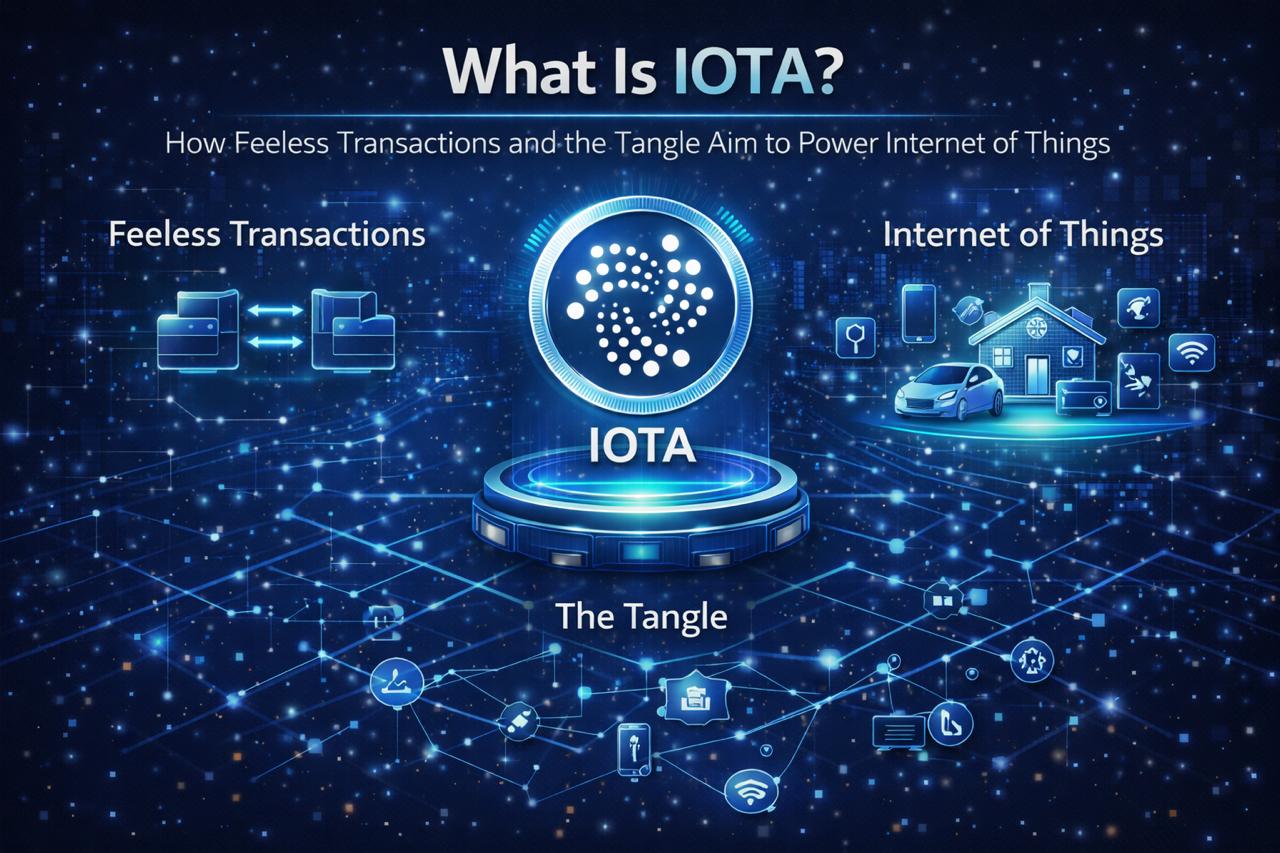 One of IOTA’s defining features is the absence of transaction fees. This is not an incentive mechanism, but a functional requirement. In IoT environments, devices may need to exchange value or data continuously, often in micro or nano amounts.
By removing fees entirely, IOTA enables use cases such as sensor data markets, automated energy trading and machine-based service payments that would be uneconomical on fee-based networks. Feelessness, in this context, is essential infrastructure rather than a user benefit.
Coordicide and the Path to Full Decentralization
To support network stability during early stages, IOTA historically relied on a central component known as the Coordinator. The long-term roadmap includes its removal through a protocol upgrade known as Coordicide.
Coordicide is designed to transition the network to full decentralization while maintaining security and performance. This effort represents one of IOTA’s most significant ongoing developments, as it shifts the network from protected operation to open participation.
Rather than rushing this transition, the project has emphasized formal verification, testing and staged deployment.
Real-World Focus and Industry Collaboration
IOTA’s adoption strategy centers on industrial and institutional collaboration rather than retail usage. The network has worked with automotive manufacturers such as Volkswagen and Jaguar Land Rover on use cases involving vehicle data, automated payments and sustainability tracking.
In smart city initiatives, projects like CityXChange explore decentralized energy markets and urban infrastructure optimization. Supply chain collaborations with companies such as Zebra Technologies focus on traceability and data integrity.
IOTA also participates in standardization bodies including INATBA and Object Management Group, reinforcing its role in shaping global IoT standards.
Expanding the Developer Ecosystem
To support experimentation and application development, IOTA introduced additional networks such as Shimmer and Assembly. These environments allow developers to test new features, deploy smart contracts and explore decentralized applications built on DAG-based infrastructure.
Rather than competing directly with smart-contract platforms, these initiatives extend IOTA’s capabilities while preserving its core focus on data and machine coordination.
Recent Developments: From Research to Operational Readiness
Recent developments around IOTA have centered on transitioning the network from a research-driven system to production-ready infrastructure. The primary focus remains the gradual implementation of Coordicide, with ongoing testing and validation aimed at safely removing the Coordinator while preserving security and performance.
Parallel to this, activity on Shimmer has accelerated, serving as a proving ground for new protocol features, governance mechanisms and economic models before they reach the main IOTA network. This staged approach reflects IOTA’s emphasis on correctness and resilience over rapid deployment.
The Assembly smart contract initiative has also broadened IOTA’s scope, enabling developers to experiment with decentralized applications while maintaining compatibility with the Tangle’s core design principles. Together, these efforts indicate a maturation phase, where IOTA is refining its architecture to support real-world IoT and data-driven use cases at scale rather than pursuing speculative expansion.
What IOTA Represents in the Crypto Landscape
IOTA represents an alternative interpretation of distributed ledger technology. It suggests that not all decentralized systems need to be optimized for finance and that some derive value from removing economic friction entirely.
By prioritizing feeless transactions, scalability and industrial integration, IOTA positions itself as infrastructure for connected systems rather than as a speculative asset. Its long-term relevance depends less on market cycles and more on whether IoT ecosystems require neutral, scalable coordination layers.
Readers interested in alternative infrastructure-focused ledger designs may explore What Is Algorand (ALGO)? or What Is Chainlink? to understand how off-chain data feeds integrate with decentralized systems.
For broader context on infrastructure-focused crypto projects, examining enterprise and IoT-driven adoption models can provide additional perspective.



