



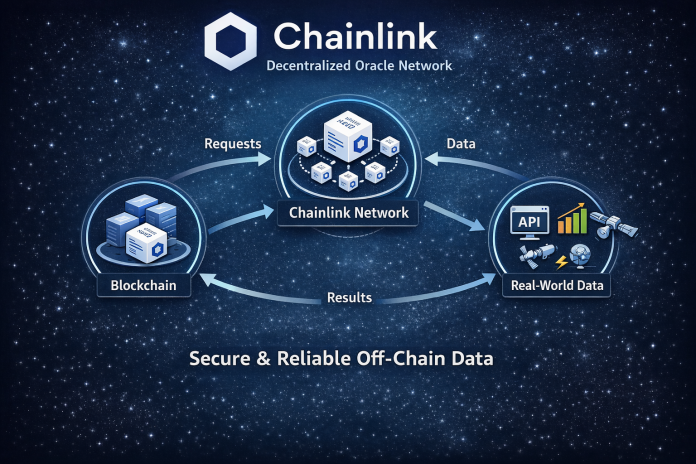

Blockchains are designed to be deterministic systems. Every node must reach the same conclusion given the same inputs. While this property ensures security and immutability, it also creates a limitation: blockchains cannot natively access information that exists outside their own networks.
Why Blockchains Need Oracles
This constraint becomes critical when smart contracts are expected to respond to real-world events – prices, weather conditions, interest rates, or the outcome of external processes. Without reliable access to off-chain data, smart contracts remain isolated and functionally incomplete.
Chainlink was created to address this limitation. Its role is not to execute smart contracts, but to supply them with trustworthy external data, enabling blockchains to interact meaningfully with the real world.
Origins: Solving a Structural Limitation
Chainlink was founded by Sergey Nazarov and Steve Ellis, with a clear focus on one problem: how to connect blockchains to external systems without reintroducing centralized points of failure.
Rather than modifying existing blockchains, Chainlink was designed as a separate network that interfaces with them. This decision allowed it to remain blockchain-agnostic, supporting multiple ecosystems without being tied to the governance or constraints of any single chain.
From the outset, Chainlink positioned itself as middleware, infrastructure that enables functionality rather than competing for user attention.
Oracles as Infrastructure, Not Consensus
 Chainlink does not produce blocks, validate transactions, or compete at the base-layer level. Its function is orthogonal to consensus mechanisms such as Proof of Work or Proof of Stake.
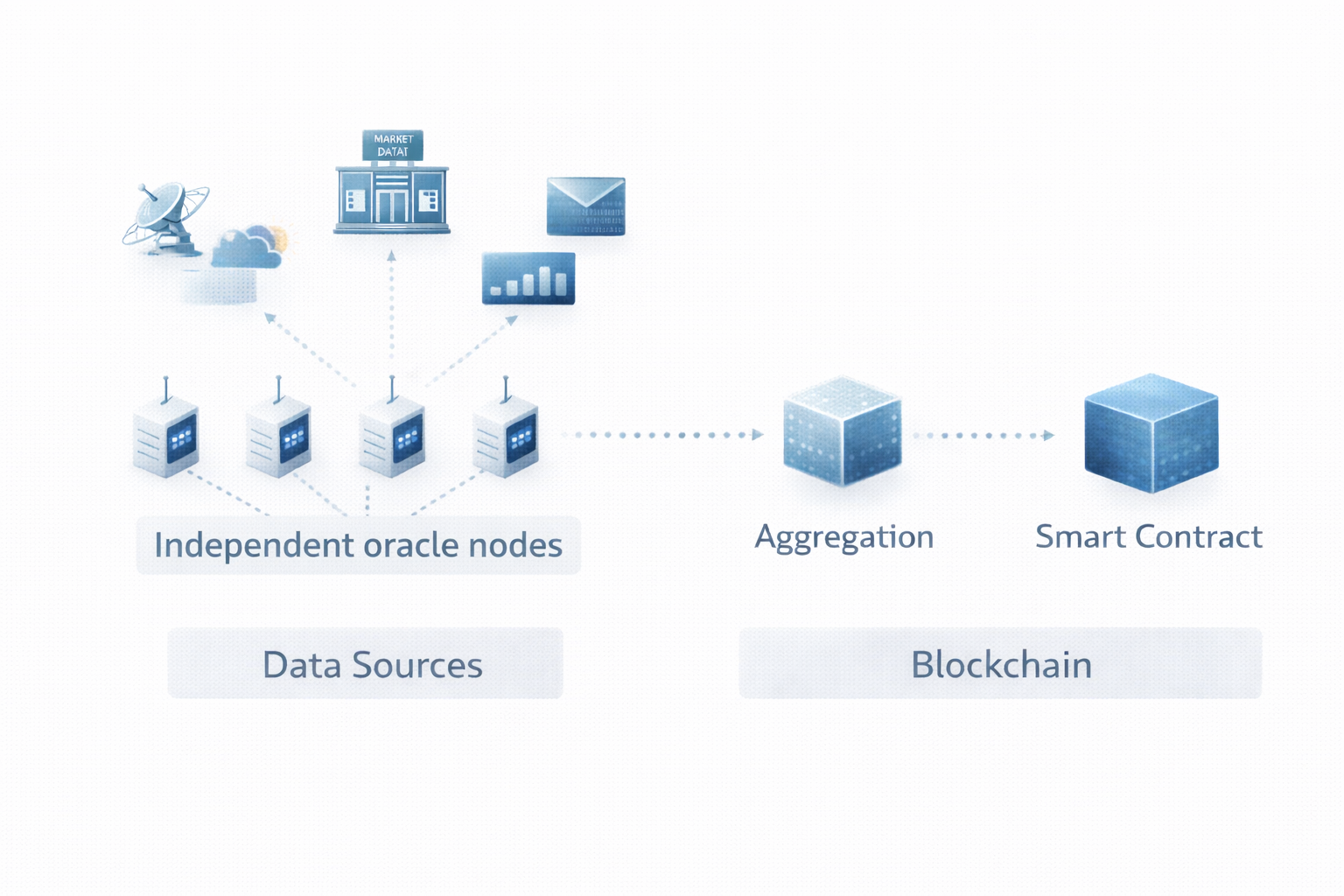
Instead, Chainlink operates through decentralized oracle networks composed of independent node operators. These nodes retrieve data from off-chain sources, aggregate it and deliver it to smart contracts in a way that minimizes manipulation and single points of failure.
The key insight is redundancy. Multiple oracles perform the same task and the network aggregates their responses. This structure shifts trust away from individual data providers and toward collective verification.
Incentives, Staking and Data Integrity
The LINK token underpins Chainlink’s incentive model. Node operators are compensated in LINK for providing oracle services, while staking mechanisms require them to lock tokens as collateral.
This design aligns economic incentives with data accuracy. Nodes that deliver reliable information are rewarded, while those that act dishonestly risk financial penalties. Rather than relying on reputation alone, Chainlink embeds accountability directly into its economic structure.
There is no mining in the Chainlink ecosystem. Security is achieved through incentives, decentralization and economic risk rather than computational expenditure.
Why Chainlink Became Core DeFi Infrastructure
Chainlink’s earliest large-scale adoption occurred within decentralized finance. Protocols such as Aave, Synthetix and Compound rely on Chainlink price feeds to function correctly.
Accurate pricing is not a convenience in DeFi, it is a security requirement. Incorrect or manipulated data can trigger liquidations, arbitrage exploits, or systemic failures. Chainlink’s role in providing resilient price feeds has made it a foundational component rather than an optional integration.
This dependence illustrates Chainlink’s significance: when oracles fail, entire financial systems fail with them.
Beyond DeFi: Enterprise and Real-World Integration
Chainlink’s use cases extend beyond blockchain-native applications. Its architecture allows smart contracts to interact with APIs, enterprise systems and traditional data providers.
Collaborations with organizations such as Google Cloud have demonstrated how decentralized oracles can bridge blockchain systems with existing IT infrastructure. In sectors such as insurance, Chainlink-powered oracles enable parametric contracts that execute automatically based on real-world events like weather conditions.
Supply chain tracking, gaming randomness and data verification represent additional domains where trust-minimized data delivery is essential.
Recent Developments: Interoperability and Network Evolution
One of Chainlink’s most significant recent developments is the introduction of the Cross-Chain Interoperability Protocol (CCIP). Rather than treating cross-chain communication as a secondary feature, CCIP positions Chainlink as a coordination layer for secure data and asset transfer across blockchains.
This evolution reflects a broader shift. Chainlink is no longer only about feeding data into smart contracts. It is increasingly about enabling secure communication between distinct blockchain environments.
At the same time, ongoing improvements to staking and oracle configuration signal a move toward greater economic security and decentralization as usage scales.
Sustainability by Design
Chainlink’s model avoids the energy-intensive processes associated with mining-based systems. By relying on distributed nodes and economic incentives, it achieves security without large computational overhead.
This structure makes Chainlink environmentally efficient by default, a byproduct of its architectural role rather than a separate design objective.
What Chainlink Represents in the Blockchain Stack
Chainlink occupies a layer that is often overlooked in discussions about blockchains. It does not store value, execute transactions, or define monetary policy. Instead, it enables blockchains to interact with reality.
Its importance lies in abstraction. By standardizing how external data enters decentralized systems, Chainlink reduces complexity for developers while increasing reliability for users.
As smart contracts expand into finance, insurance, governance and enterprise use cases, the need for trustworthy data becomes systemic. Chainlink’s continued relevance depends on that need and so far, the trajectory of the industry suggests it is only increasing.
Further Reading
For readers exploring how different infrastructure layers interact within crypto ecosystems, related guides on What is XRP, What is Stellar and What is USD Coin provide additional context on settlement, liquidity and real-world integration.



