


Bitcoin is a decentralized digital currency that allows people to send and receive value directly over the internet without relying on banks, governments, or other intermediaries. It operates on a public, distributed ledger known as the blockchain, which records every transaction in a transparent and verifiable way.
“Bitcoin is a remarkable cryptographic achievement, and the ability to create something that is not duplicable in the digital world has enormous value” – Eric Schmidt, former CEO of Google.
Unlike traditional money, Bitcoin is not issued or controlled by a central authority. Instead, it is maintained by a global network of independent computers that follow a shared set of rules. These rules define how new Bitcoin are created, how transactions are validated, and how the system remains secure.
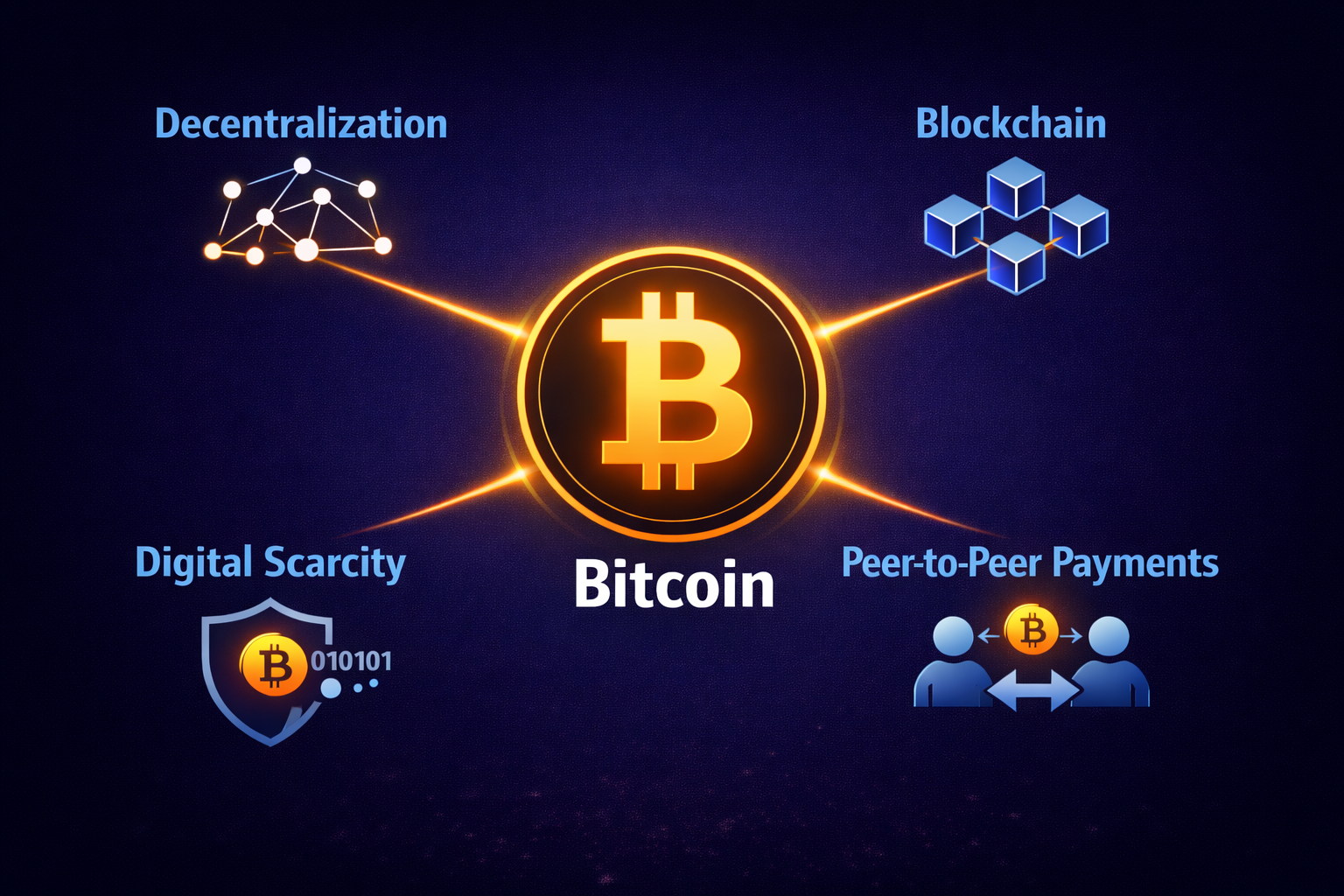
At its core, Bitcoin represents a fundamentally different approach to money, one based on cryptography, mathematics, and decentralized consensus rather than institutional trust.
Why Bitcoin matters extends beyond price movements or market cycles. It touches on deeper questions of monetary policy, financial sovereignty, censorship resistance, and how value can exist and move in a fully digital world.
Why Bitcoin Was Created: The Problem It Aims to Solve
To understand Bitcoin, it is essential to understand the limitations of the systems that came before it.
The Limits of Traditional Money
Modern financial systems depend on centralized intermediaries such as banks, payment processors, and clearing institutions. While this structure enables large-scale economic coordination, it also introduces systemic vulnerabilities:
- Trust dependency: Users must rely on institutions to safeguard and transfer their money correctly.
- Centralized control: Monetary policy, account access, and transaction approval are controlled by authorities.
- Inflation risk: Fiat money supplies can be expanded, reducing purchasing power over time.
- Restricted access: Large parts of the global population remain underbanked or excluded.
- Censorship: Transactions can be delayed, reversed, or blocked.
The global financial crisis of 2008 exposed these weaknesses clearly. Extraordinary interventions, bailouts, and monetary expansion raised fundamental questions about who controls money and under what rules.
Bitcoin’s Core Idea
Bitcoin was designed as a response to these structural issues. Its purpose was not simply to create a digital currency, but to create a monetary system that functions without requiring trust in any single entity.
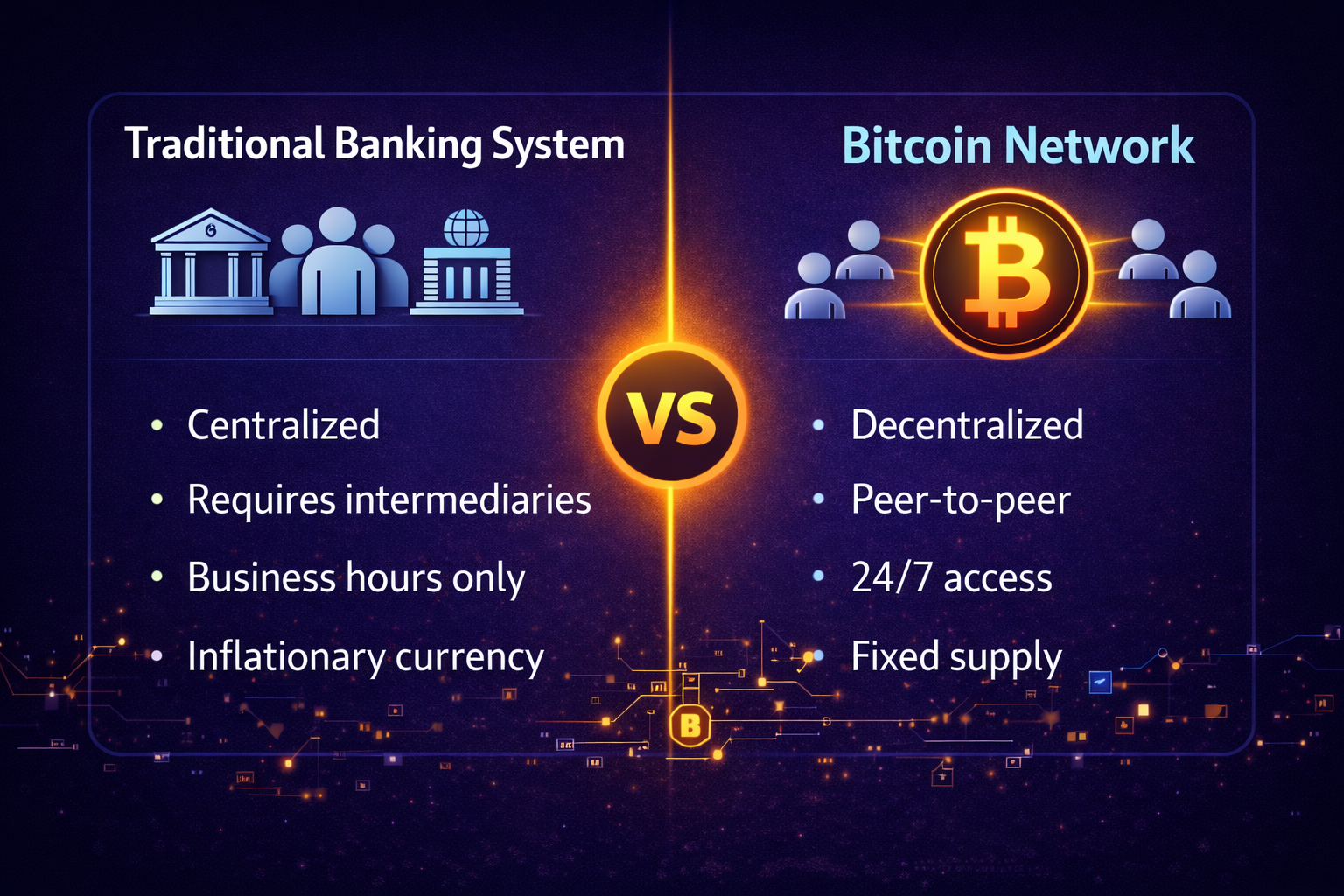
Instead of relying on financial institutions or centralized authorities, Bitcoin operates through a combination of cryptography, open-source software, and decentralized network participation. Cryptography secures ownership by ensuring that only the holder of a private key can authorize transactions, removing the need for trusted intermediaries. Open-source software defines and enforces the system’s rules transparently, allowing anyone to verify how the network operates and ensuring that no hidden changes can be imposed. These rules are upheld by a decentralized network of independent participants who validate transactions collectively, making Bitcoin resilient to censorship, manipulation, and single points of failure.
This architecture allows Bitcoin to operate as a trust-minimized system, where verification replaces reliance on authority.
Who Created Bitcoin?
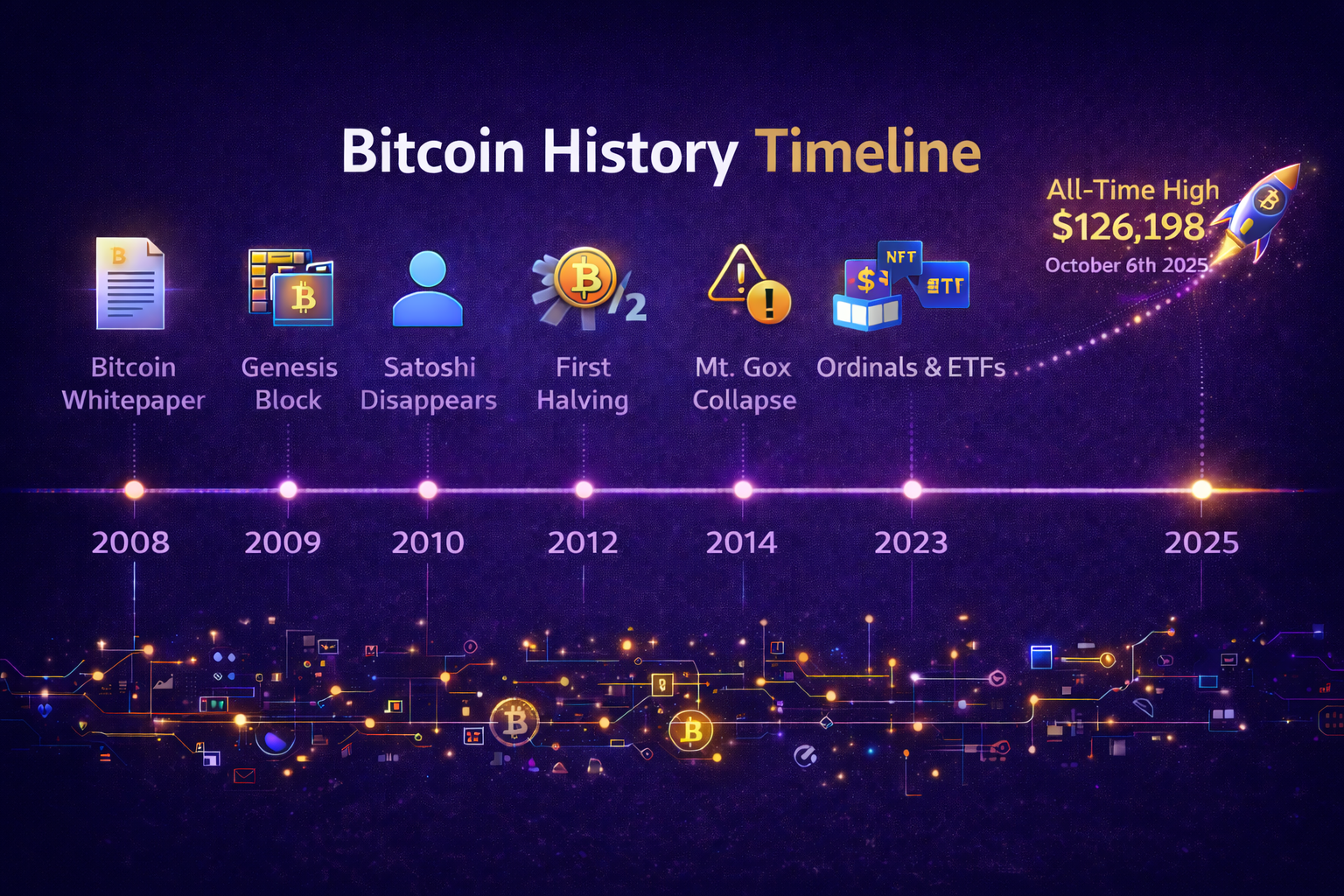
Bitcoin was introduced in 2008 by an individual or group using the pseudonym Satoshi Nakamoto, who published the whitepaper “:Bitcoin A Peer-to-Peer Electronic Cash System”. The paper outlined a method for transferring digital value without a central intermediary.
In January 2009, the Bitcoin network launched with the mining of the genesis block, the first block in the blockchain.
Embedded within it was a now-famous message:
“The Times 03/Jan/2009 Chancellor on brink of second bailout for banks”
This message is widely interpreted as contextual commentary on the fragility of the traditional financial system and the motivation behind Bitcoin’s creation.
Why Satoshi’s Identity Matters Less Than the Code
Satoshi withdrew from public communication in 2010. Since then, Bitcoin has continued to operate and evolve without its creator.
This absence reinforces a core principle at the heart of Bitcoin’s design: the network does not depend on a founder and no individual or organization exercises control over the protocol. Instead, Bitcoin is governed through decentralized consensus, where changes to the system emerge only through broad agreement among its participants rather than through authority or decree. As a result, Bitcoin’s resilience does not stem from trust in a person or institution, but from its open architecture and the distributed nature of its network, which allows it to function independently of any central figure.
How Bitcoin Works: The Core Mechanics
Understanding Bitcoin requires examining how several independent components work together to create a secure and decentralized monetary system.
Blockchain Explained
The blockchain is a public, append-only ledger that records every Bitcoin transaction.
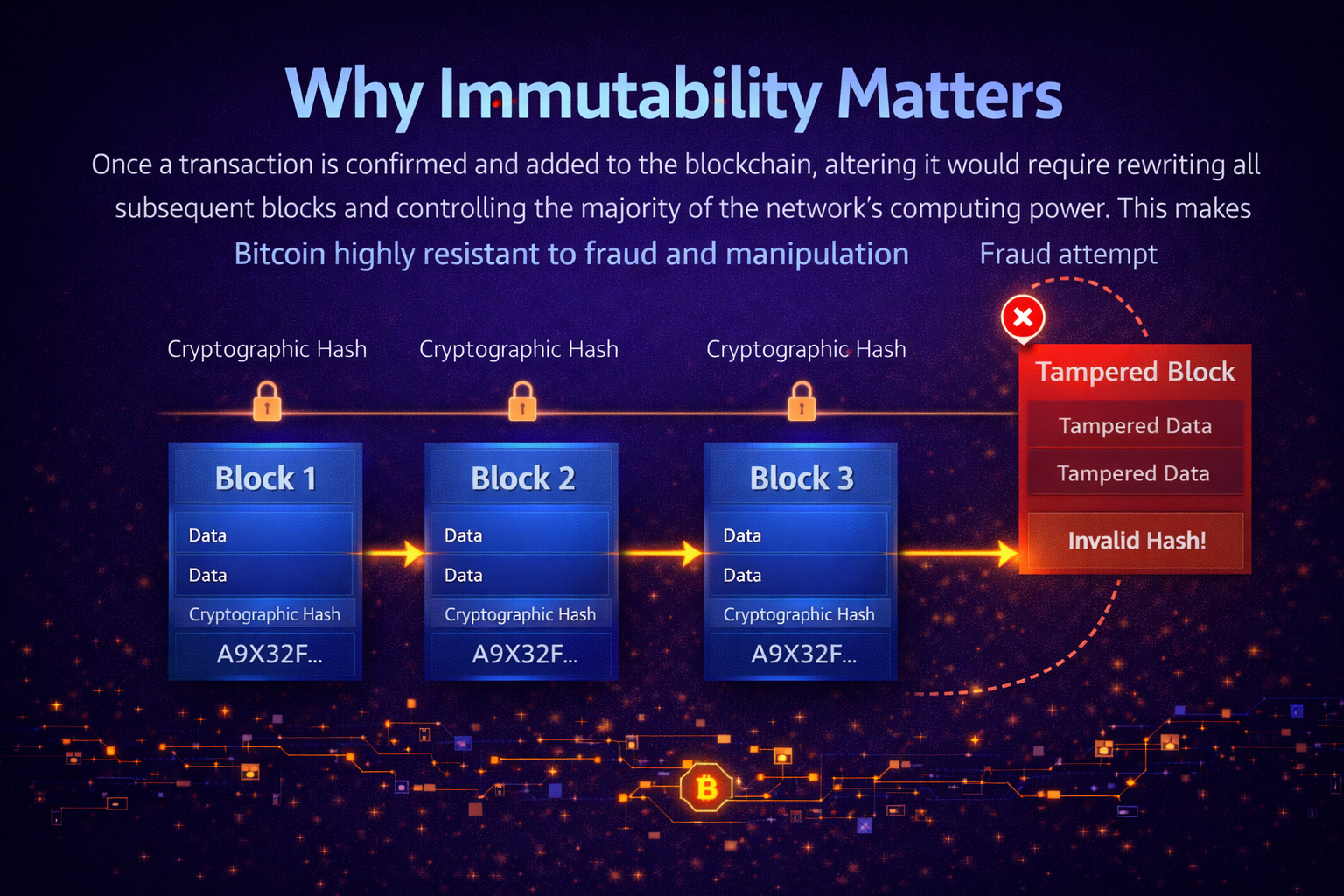
Rather than being stored in a central database, Bitcoin’s ledger is distributed across thousands of independent nodes around the world. Each participant maintains a copy of the blockchain, and all copies are synchronized through shared consensus rules. This decentralized structure removes single points of failure and makes the system highly resistant to censorship or manipulation, as no single entity controls the record of transactions.
Each block added to the blockchain contains a batch of validated transactions, along with a cryptographic reference (hash) to the previous block and a timestamp. By linking blocks together in this way, Bitcoin creates a chronological chain of data that becomes increasingly difficult to alter as new blocks are added. This growing resistance to modification, known as immutability, is a core element of Bitcoin’s security and underpins trust in the integrity of the network.
Bitcoin Transactions: How Value Moves
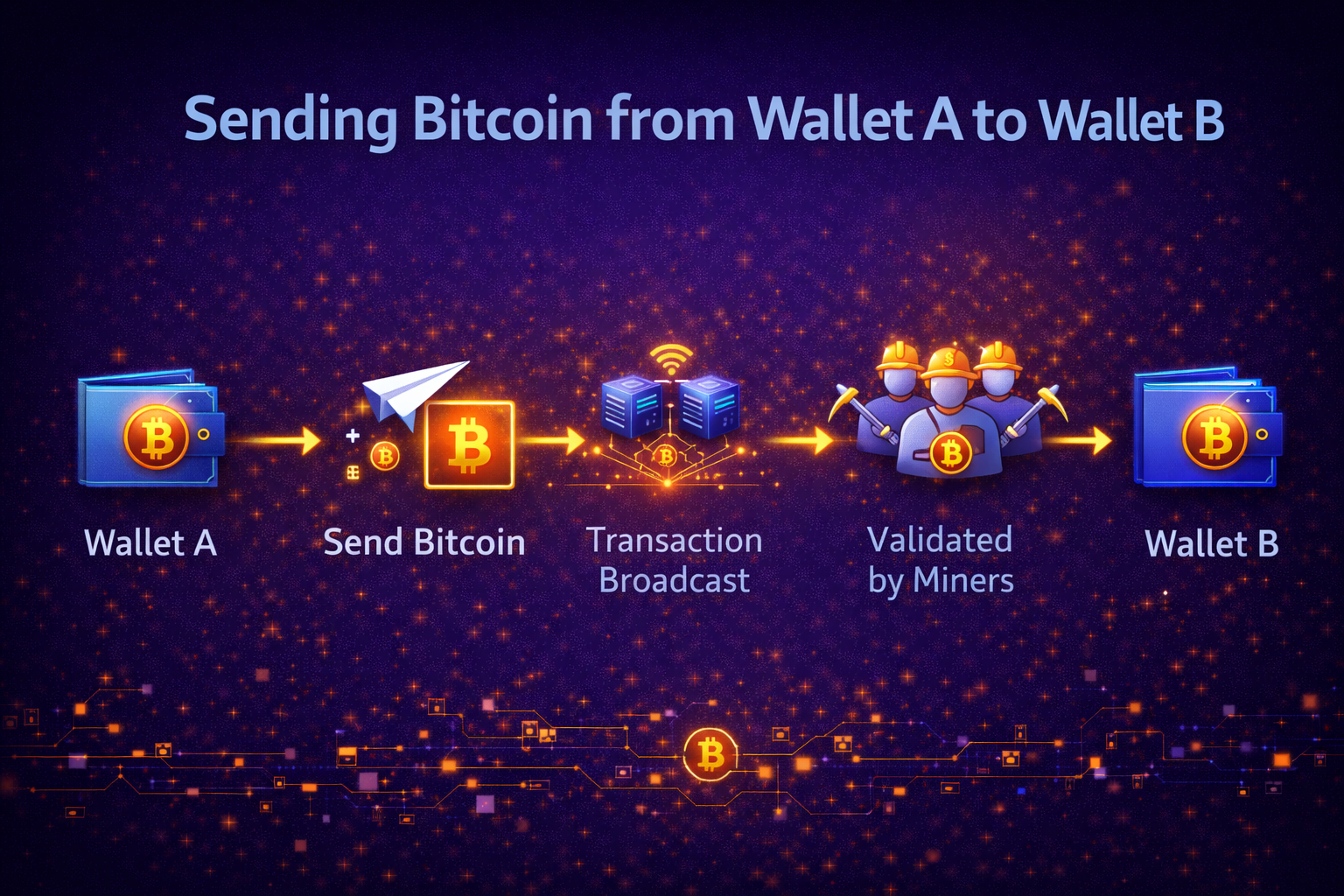
Bitcoin transactions rely on cryptographic key pairs rather than accounts.
- A public key (address) is used to receive Bitcoin.
- A private key proves ownership and authorizes spending.
When a Bitcoin transaction is created, the sender first signs it using a private key, proving ownership of the funds without revealing sensitive information. The transaction is then broadcast to the network, where independent nodes verify that it follows the system’s rules, such as ensuring the sender has sufficient balance and has not attempted to double-spend. Once verified, miners include the transaction in a block, adding it permanently to the blockchain.
Bitcoin transactions are transparent, meaning they are visible on the public ledger and can be independently verified by anyone. At the same time, they are pseudonymous, as transactions are linked to cryptographic addresses rather than real-world identities. Crucially, Bitcoin transactions are also final: once confirmed, they cannot be reversed. This finality distinguishes Bitcoin from traditional payment systems, which rely on intermediaries, reversibility, and trust-based dispute resolution mechanisms.
Bitcoin Mining and Proof-of-Work
Bitcoin uses a consensus mechanism called Proof-of-Work to secure the network.
What Mining Does
Mining serves three critical functions:
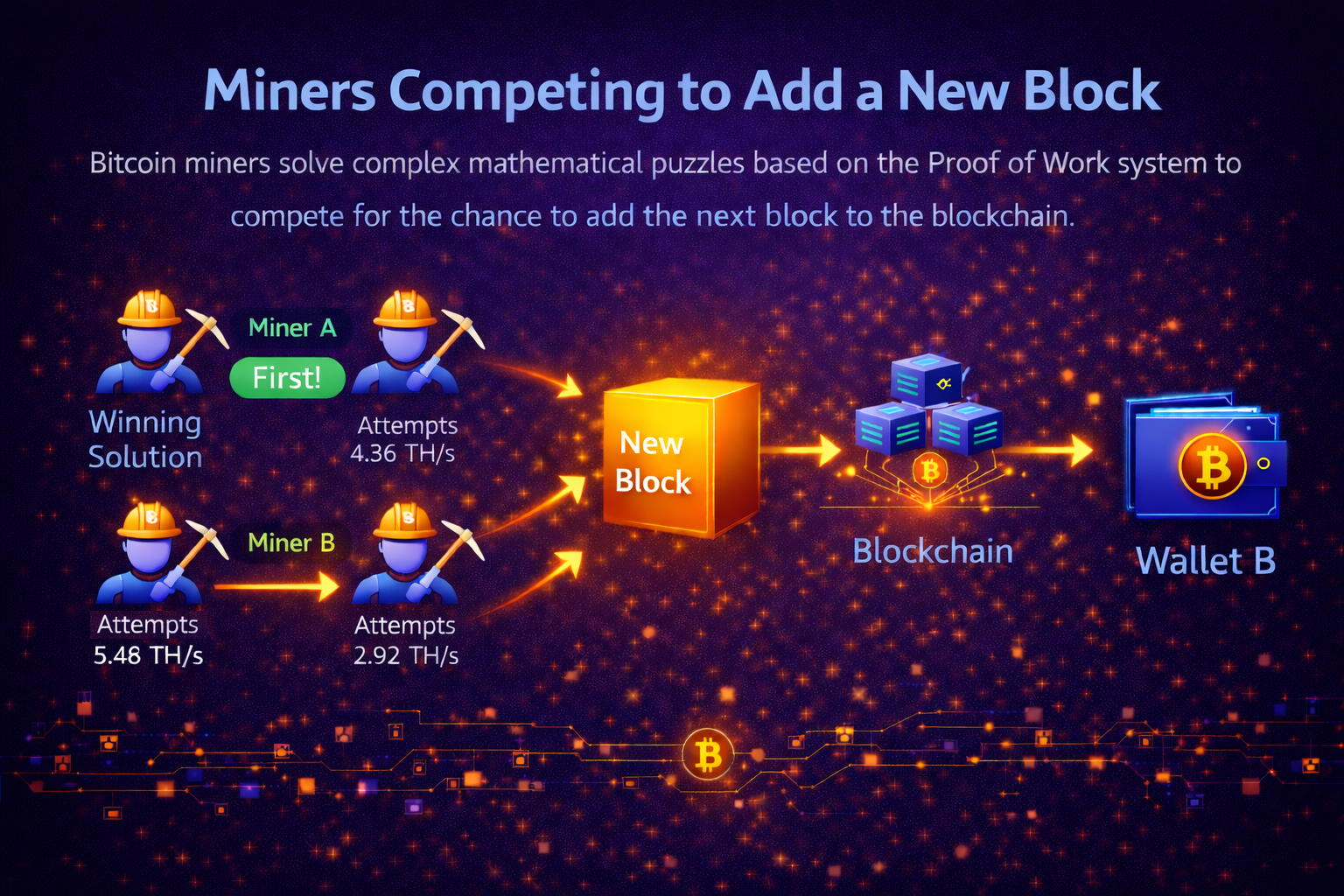
- Validates transactions
- Secures the blockchain against attacks
- Introduces new Bitcoin into circulation
Miners compete to solve cryptographic puzzles. The first to succeed earns the right to add a new block and receives a block reward.
Why Proof-of-Work Is Necessary
Proof-of-Work makes attacking the network economically costly. To alter transaction history, an attacker would need to control a majority of the network’s computational power, an increasingly impractical task as the network grows.
The energy cost of mining is not incidental, it is what anchors Bitcoin’s digital ledger to real-world physical constraints.
Fixed Supply: The 21 Million Bitcoin Limit
Bitcoin’s monetary policy is predefined and transparent.
- Maximum supply: 21 million Bitcoin
- New issuance occurs through mining
- The issuance rate decreases approximately every four years through Bitcoin halving events
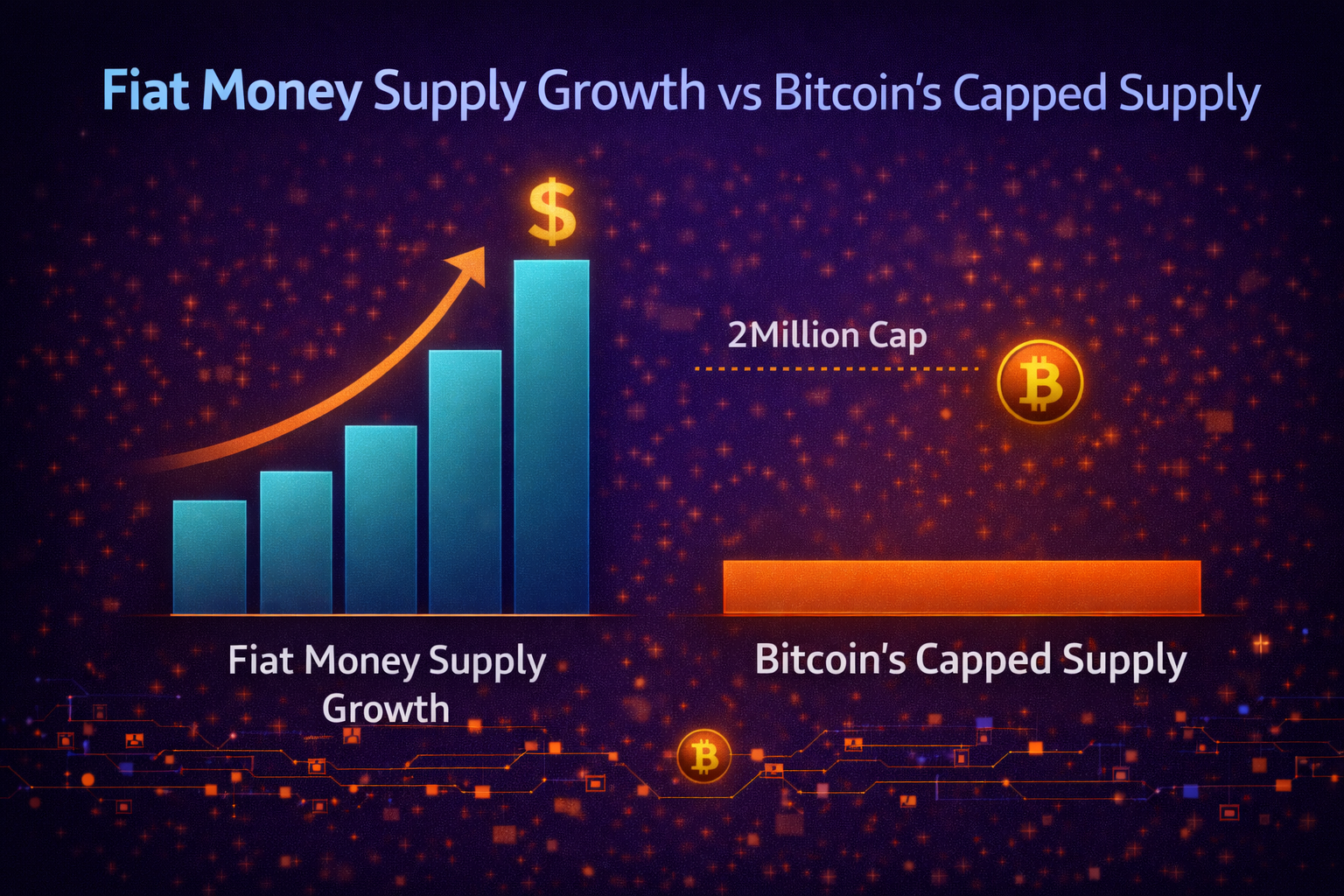
This predictable supply schedule contrasts with fiat systems, where monetary expansion is discretionary. Over time, Bitcoin’s issuance approaches zero, reinforcing its digital scarcity.
The halving mechanism also aligns incentives between miners and the long-term security of the network.
What Makes Bitcoin Different From Traditional Money
Bitcoin introduces a monetary model that differs fundamentally from state-issued currencies.
Centralization vs Decentralization
Traditional money systems rely on centralized authorities to issue currency, manage supply, and approve transactions. Yet despite this structural difference, Bitcoin’s market behavior can still reflect broader financial conditions, as explored in Bitcoin–Nasdaq Correlation Surges. Bitcoin distributes these functions across a global network, making unilateral control impossible.
Inflation vs Digital Scarcity
Fiat currencies can be expanded to meet policy goals. Bitcoin’s supply is capped and enforced by code, not by institutions. This introduces a form of scarcity that is verifiable and predictable.
Key Benefits of Bitcoin
Bitcoin’s design results in a set of interrelated advantages that distinguish it from previous forms of money. Because the network is decentralized, it has no single point of control or failure, making it more resilient to disruption. Transactions are inherently resistant to censorship, as no central authority can easily block or reverse them. Bitcoin also enables borderless value transfer, allowing participants to send and receive funds globally without relying on traditional financial infrastructure. At the same time, the system is transparent, with a public ledger that anyone can audit, and it operates under predictable monetary rules that are consistent and known in advance.
Together, these properties distinguish Bitcoin from previous forms of money. They emerge directly from its decentralized architecture rather than from policy decisions or institutional guarantees. As a result, Bitcoin operates under a set of rules that apply equally to all participants, regardless of location or status.
Risks and Limitations of Bitcoin
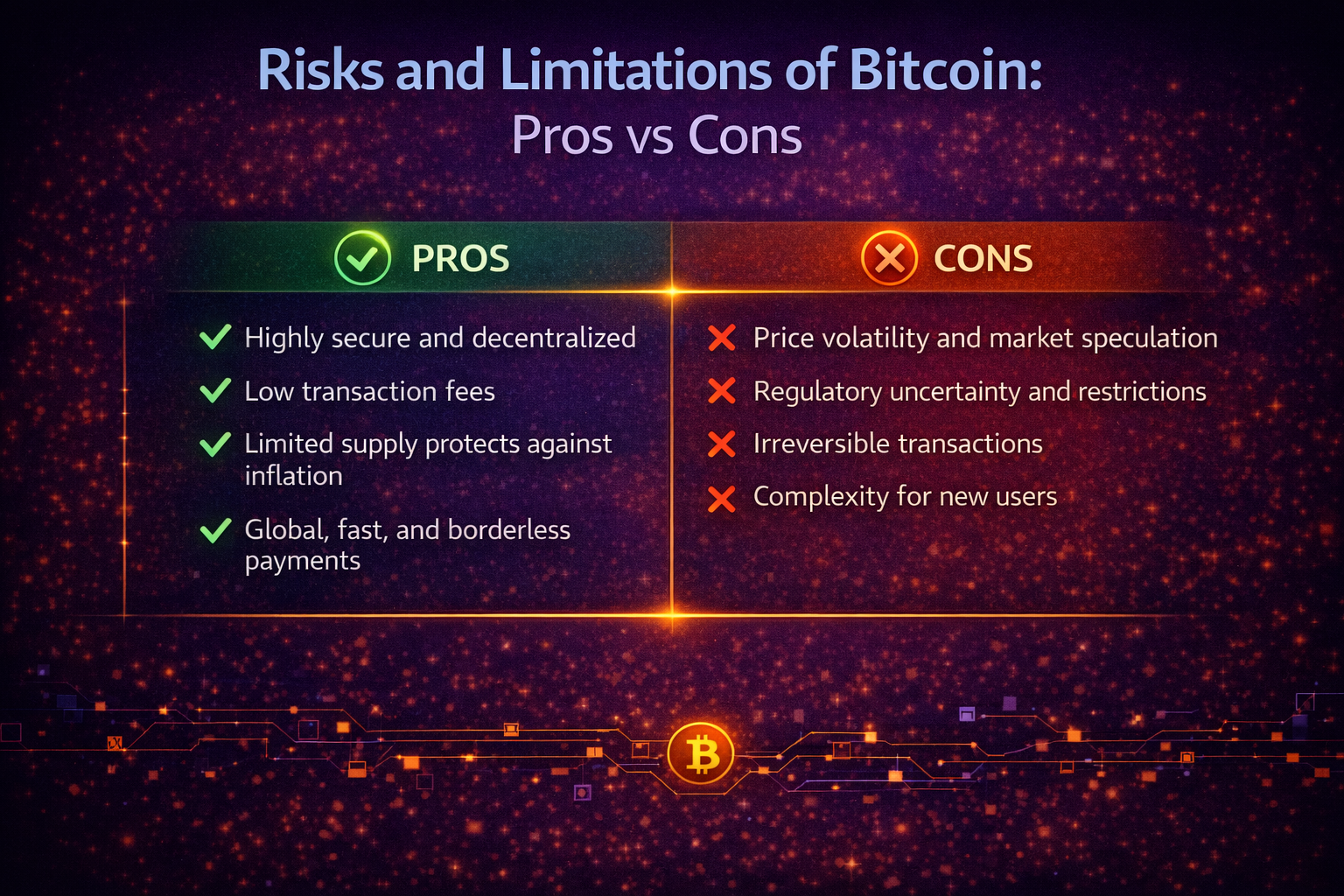
A balanced understanding requires acknowledging Bitcoin’s limitations.
- Price volatility: Market value can fluctuate significantly
- Scalability constraints: Transaction throughput is limited
- Energy usage: Proof-of-Work requires substantial electricity
- Regulatory uncertainty: Legal frameworks differ globally
- User responsibility: Self-custody places security on the individual
Bitcoin offers autonomy, but that autonomy comes with tradeoffs. Many of these risks are the direct result of removing intermediaries and centralized safeguards, shifting responsibility to the user and the network itself. Understanding these limitations is essential for evaluating Bitcoin realistically, not as a perfect system, but as a distinct monetary model with clear strengths and measurable constraints.
How Bitcoin Is Used Today
Bitcoin serves different functions depending on the context in which it is used. For some users, it functions as a store of value, offering a long-term savings asset with predictable monetary rules. It can also be used for peer-to-peer payments, enabling direct transfers without relying on financial intermediaries. In the context of remittances, Bitcoin provides an alternative to traditional cross-border services that are often slow or expensive. More broadly, Bitcoin can support financial sovereignty by giving individuals access to money that operates outside conventional financial systems. These use cases emphasize Bitcoin’s practical utility rather than short-term speculation.
Real-time network behavior is also shaping how people use Bitcoin, for example Bitcoin Faces a Moment of Uncertainty,outlines current divergences in usage indicators.
Even critics of Bitcoin have acknowledged this shift in how value can be stored and transferred. Former U.S. President Barack Obama once described Bitcoin as “a Swiss bank account in your pocket”, highlighting its ability to provide individuals with direct access to financial tools outside traditional banking systems.
In practice, Bitcoin is used differently across regions and user groups, shaped by local economic conditions and access to financial infrastructure. In developed markets, it is often treated as a long-term store of value, while in emerging economies it can function as a practical tool for payments, savings, and capital preservation.
Rather than serving a single purpose, Bitcoin’s flexibility allows it to operate as a monetary network that adapts to real-world needs. This versatility helps explain why adoption continues even during periods of market volatility, as users engage with the network for reasons that extend beyond price movements alone.
Common Misconceptions About Bitcoin
- “Bitcoin is anonymous” – It is pseudonymous, not anonymous
- “Bitcoin has no real value” – Value arises from scarcity, utility, and network adoption
- “Bitcoin is only used for crime” – Illicit use represents a small portion
- “Bitcoin is just digital gold” – It shares scarcity traits but remains natively digital and transferable
Bitcoin is often misunderstood due to oversimplified narratives. It is not anonymous but pseudonymous, with transactions recorded on a transparent public ledger. Its value is derived from enforced scarcity, real-world utility, and growing network adoption, not speculation alone. While sometimes compared to digital gold, Bitcoin’s true distinction lies in being a natively digital, transferable, and globally accessible monetary system.
Bitcoin vs Other Cryptocurrencies
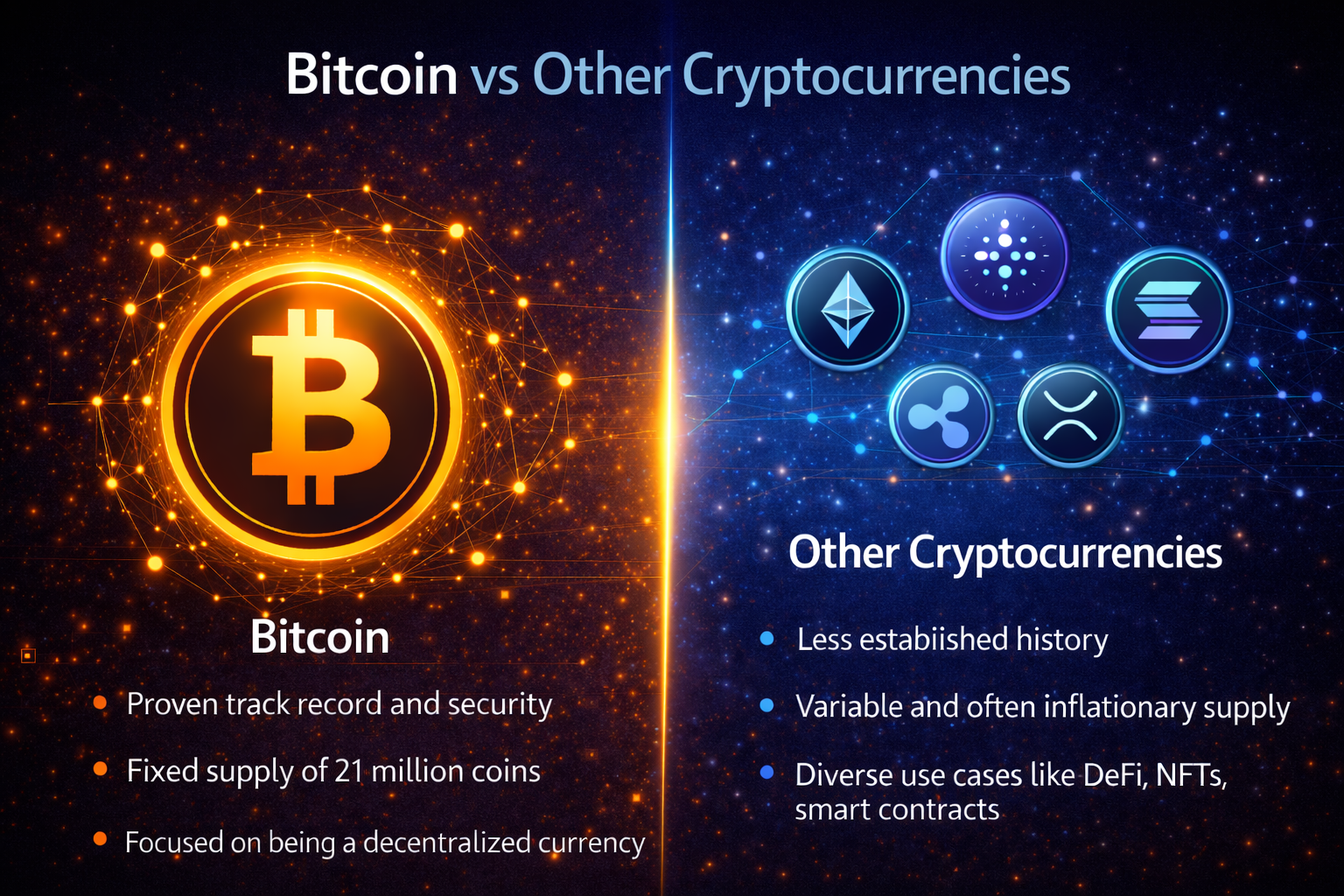
Bitcoin occupies a distinct role within the broader cryptocurrency ecosystem. It was designed first and foremost as a decentralized monetary system, with an emphasis on security, predictability, and long-term reliability rather than rapid innovation.
Unlike many other cryptocurrencies that focus on expanding functionality or supporting complex applications, Bitcoin prioritizes monetary soundness. Its development is intentionally conservative, with changes adopted slowly and only when they strengthen the network’s core properties. This approach reflects the requirements of money, where stability and trust outweigh experimentation.
Bitcoin also functions as neutral infrastructure. Its rules apply equally to all participants, without discretionary governance or special privileges. This neutrality, combined with a fixed supply and decentralized validation, reinforces its role as a base monetary layer rather than an application platform.
While other cryptocurrencies explore a wide range of use cases, Bitcoin’s primary objective remains consistent: to operate as a secure, decentralized, and censorship-resistant form of digital money. Its strength lies not in the number of features it adds, but in the reliability of the system it preserves over time.
Bitcoin and Blockchain: Not the Same Thing
Bitcoin uses blockchain technology, but blockchain itself is a broader concept that extends beyond any single network or use case. In Bitcoin, the blockchain functions as a public, immutable ledger that secures a decentralized monetary system and enforces its rules without central oversight.
More generally, a blockchain is a type of data structure that can be used to record, verify, and synchronize information across distributed systems. While Bitcoin applies this structure specifically to money, other implementations may use it for record-keeping, coordination, or digital ownership.
Understanding this distinction helps clarify a common misconception: Bitcoin is not synonymous with blockchain and blockchain applications do not necessarily share Bitcoin’s monetary properties, security assumptions, or decentralization model. Recognizing this difference provides clearer insight into how Bitcoin fits within the broader crypto ecosystem and why it is often evaluated by different standards.
Why Bitcoin Still Matters
Bitcoin represents the first successful implementation of decentralized digital money, but its importance extends beyond its function as a currency. More than a decade after its launch, it continues to operate without centralized oversight, censorship, or institutional control, something unprecedented in monetary history.
Even during periods of subdued market activity, on-chain behavior suggests continued participation rather than exit, a dynamic examined in Bitcoin’s Quiet Selling.
Bitcoin introduces a system where value can move without intermediaries, where monetary rules are transparent and predictable, and where access is global and permissionless. These properties challenge long-standing assumptions about how money must function.
Perhaps Bitcoin’s most lasting contribution is conceptual. It has forced a re-examination of trust, authority, and the role of institutions in financial systems. Even for those who never use it directly, Bitcoin has reshaped discussions around monetary design and digital value.
Regardless of how it evolves, Bitcoin has already demonstrated that a decentralized, non-sovereign monetary system can exist and function at global scale. In doing so, it has permanently changed how money is understood in the digital age,not by replacing existing systems overnight, but by proving that another model is possible.