



Bitcoin trading has evolved from a niche activity into a global financial practice involving millions of participants. As the market matured, centralized exchanges emerged as the primary gateways for accessing liquidity, tools and execution. Among them, Binance has become one of the most widely used platforms for trading Bitcoin, largely due to its deep liquidity, broad market access and feature-rich interface.
Why Binance Is One of the Most Popular Places to Trade Bitcoin
This guide is designed to be evergreen. It does not assume hype-driven conditions or short-term market narratives. Instead, it focuses on mechanics, structure and disciplined execution, skills that remain relevant across bull and bear markets. Whether you are placing your first trade or refining your approach, understanding how Bitcoin trading works on Binance is more important than predicting price direction.
Trading Bitcoin is not the same as simply buying and holding it. Trading implies active decision-making, risk management and execution within defined time horizons. This article walks through that process step by step, starting from account setup and ending with long-term habits that separate consistent traders from reactive ones.
In this guide, you’ll learn:
- What trading Bitcoin on Binance actually involves and what it doesn’t
- How to place, manage and review Bitcoin trades step by step
- Why execution and risk management matter more than prediction
- Which mistakes most new traders make when using Binance
- How to approach Bitcoin trading as a skill, not a gamble
What You Need Before Trading Bitcoin on Binance
Before placing a single trade, there are several foundational steps that shape both your access and your risk profile. Skipping these steps often leads to avoidable mistakes later.
Creating and Verifying a Binance Account
To trade Bitcoin on Binance, you first need an account. Account creation is straightforward, but identity verification (KYC) is a critical step. Verification unlocks higher withdrawal limits, access to fiat on-ramps and full trading functionality. More importantly, it ensures smoother account operation during periods of high market activity.
While KYC may feel like a formality, it directly affects your ability to move funds efficiently, something that matters when markets are volatile.
Funding Your Account
Binance allows users to fund accounts either through fiat deposits or by transferring cryptocurrency from another wallet or exchange. Each method has trade-offs.
Fiat deposits are convenient for beginners but may involve banking delays or fees depending on jurisdiction. Crypto deposits are faster if you already hold digital assets, but require careful attention to network selection and addresses.
Regardless of method, the goal is simple: ensure you have sufficient balance in the asset you plan to trade against Bitcoin, most commonly a stablecoin.If you’re using USDT or USDC as your quote asset, it helps to understand how stablecoins work and what risks they carry, since “stable” refers to price behavior, not guaranteed safety.
Securing Your Account
Security is not optional when trading Bitcoin. At a minimum, enable two-factor authentication and withdrawal protections. Trading platforms concentrate both funds and activity, making them natural targets during periods of heightened market interest. Strong security habits reduce operational risk and mental distraction.
Understanding the Binance Trading Interface
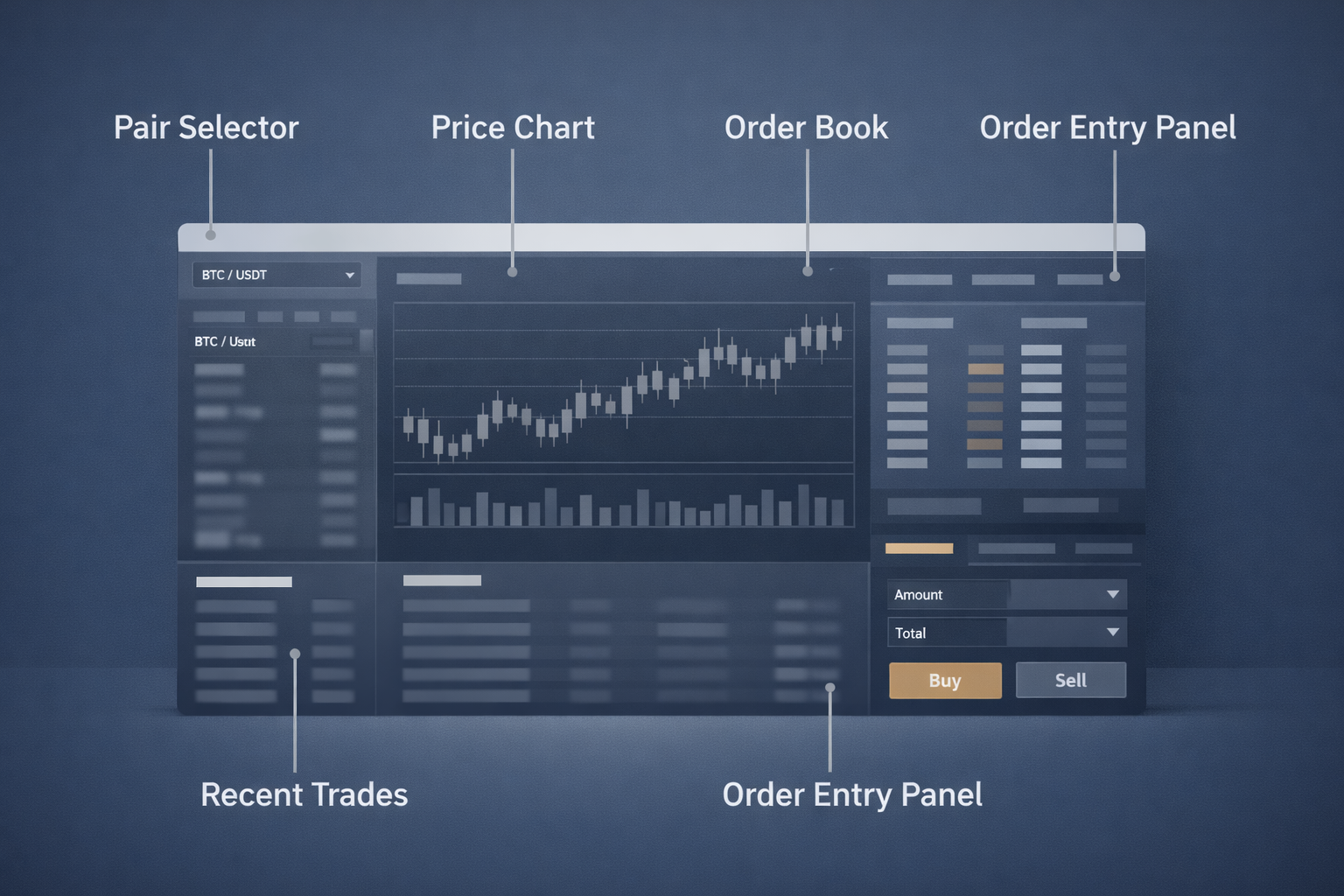 For new users, the Binance interface can feel overwhelming. Charts, numbers and flashing prices create noise that often leads to rushed decisions. Understanding the layout turns that noise into usable information.
The core elements of the trading interface include the price chart, order book, recent trades and order entry panel. Each serves a distinct function. The chart shows price history and context. The order book displays current buy and sell interest. The trade feed shows real-time execution. The order panel is where decisions become actions.
Many new traders misread the Binance interface by treating activity as opportunity. Rapid price movement, flashing numbers and a constantly updating trade feed can create the illusion that action is required at all times. In reality, most of what the interface displays is noise rather than signal. Reacting impulsively to short-term fluctuations often leads to poor execution, unnecessary fees and emotional decisions that undermine long-term consistency.
A more effective approach is to treat the interface as a filtering tool rather than a stimulus. Experienced traders focus on a small subset of information market structure, liquidity conditions and their predefined levels, while ignoring most of the visual clutter. The goal is not constant engagement, but clarity. Fewer decisions, made deliberately, often lead to better outcomes than frequent interaction driven by urgency.
Binance allows users to switch between simplified and advanced views. Beginners benefit from starting with a cleaner layout, then gradually incorporating more tools as familiarity grows. The goal is not to use every feature, but to understand the ones that directly affect execution.
Bitcoin Markets on Binance: Choosing the Right Trading Pair
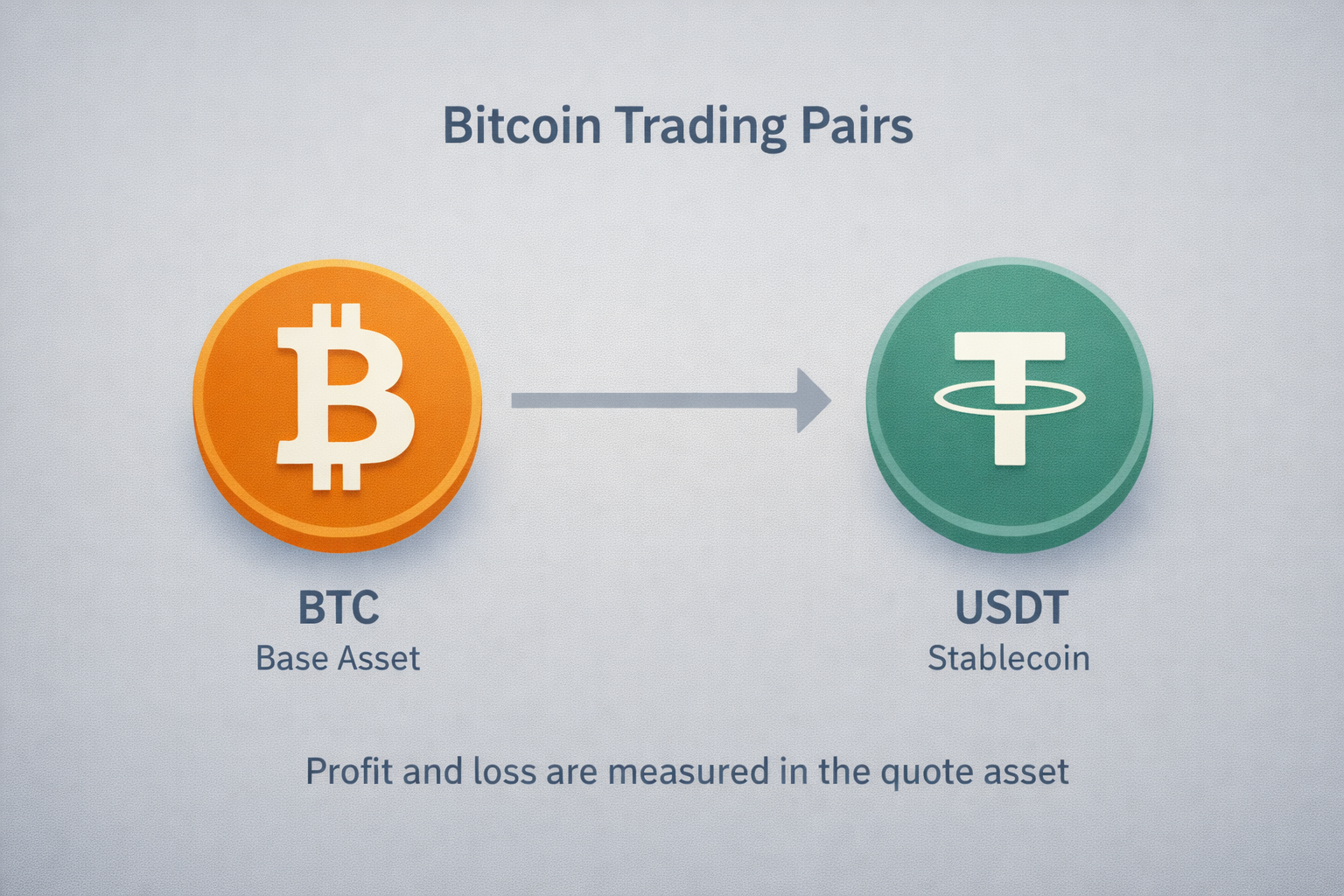 Bitcoin does not trade in isolation. On Binance, it trades against multiple quote assets, most commonly stablecoins. Understanding trading pairs is essential because your profit and loss are always measured relative to the quote asset.
- Bitcoin is the base asset in the trading pair
- The stablecoin is the quote asset
- Profit and loss are always measured in the quote asset
- Bitcoin–stablecoin pairs typically offer the highest liquidity
- Higher liquidity usually means tighter spreads and better execution
Pairs such as BTC/USDT or BTC/USDC dominate volume because they combine Bitcoin’s volatility with a stable unit of account. This allows traders to measure performance in stable terms rather than constantly converting back to fiat. This relationship between volatile assets and stable settlement units is central to why volatility and stability coexist in digital finance.
Liquidity matters. Higher liquidity generally means tighter spreads, lower slippage and more reliable execution. For most traders, the most liquid Bitcoin-stablecoin pair is the most practical choice, especially during fast-moving markets.
How Spot Trading Bitcoin on Binance Works
 Spot trading is the simplest and most transparent way to trade Bitcoin. When you buy Bitcoin on the spot market, you are purchasing the actual asset. When you sell, you are exchanging it back into the quote currency.
This contrasts with derivatives trading, where positions represent contracts rather than ownership. For beginners, spot trading offers clarity: no leverage, no liquidation mechanics and no funding rates.
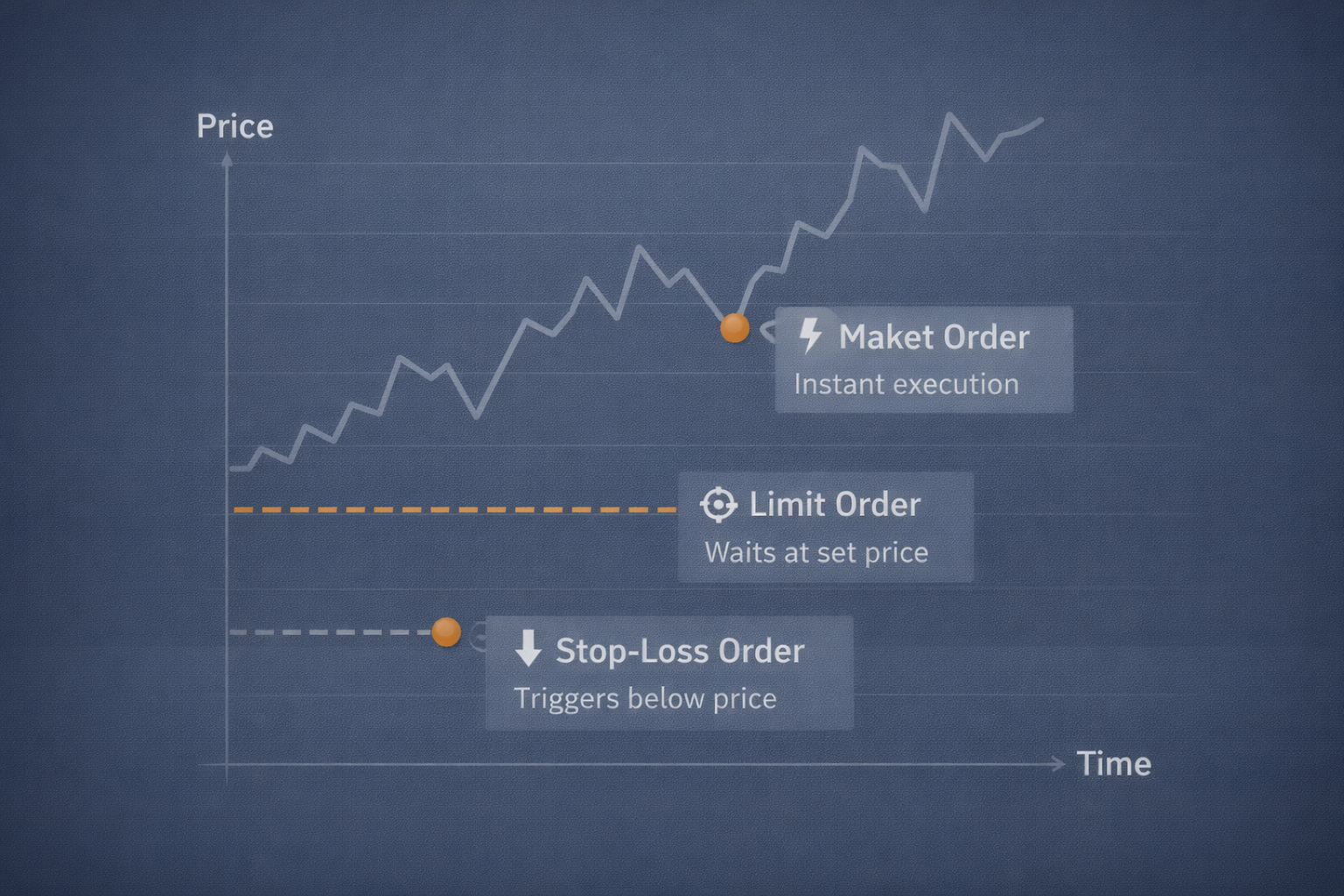
Understanding order types is central to spot trading. Market orders prioritize speed, executing immediately at the best available price. Limit orders prioritize price, executing only if the market reaches your specified level. Stop orders introduce conditional logic, allowing you to automate exits or entries based on price movement.
- Market order: executes immediately at the best available price
- Limit order: executes only at a specified price or better
- Stop order: triggers an order once a predefined price level is reached
Each order type has a role. The mistake is not using them, it is using them without understanding their implications.
Step-by-Step: How to Place Your First Bitcoin Trade
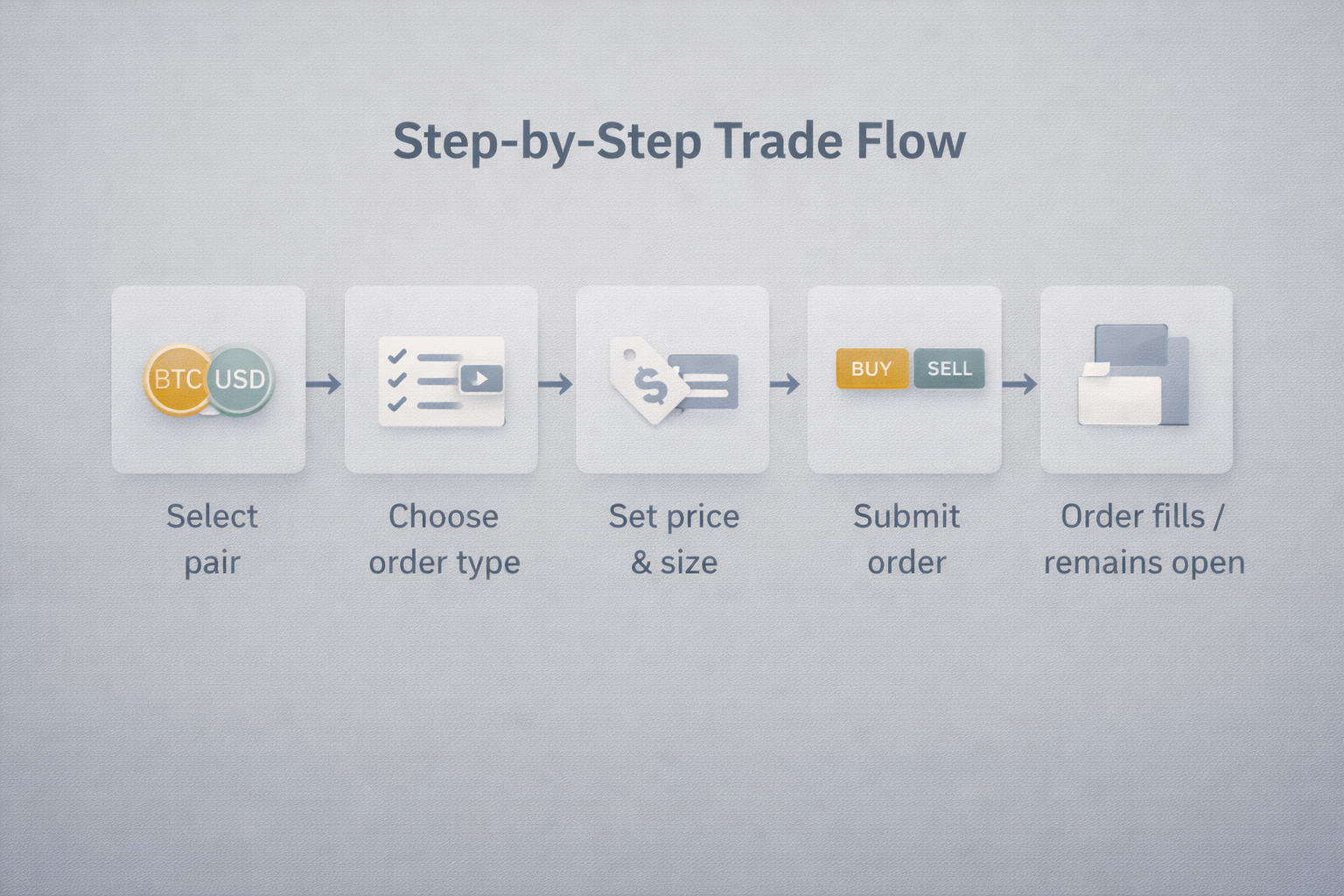 Placing a trade on Binance follows a consistent sequence. You select the trading pair, choose an order type, define size and price and submit the order. Execution then depends on market conditions and the type of order used.
After submission, open orders appear in your order panel until they are filled or canceled. Completed trades move to trade history, where you can review execution price and size. This feedback loop is important. Reviewing past trades helps identify patterns in execution quality and decision-making.
The first goal is not profit. It is familiarity. A trader who understands how orders behave under different conditions is better prepared for larger decisions later.
Fees, Costs and Slippage on Binance
Trading costs quietly shape long-term results. Binance charges trading fees based on whether you add liquidity (maker) or remove it (taker). While fees are relatively low, they accumulate over time, especially for active traders.
Slippage is another hidden cost. It occurs when the execution price differs from the expected price, often due to low liquidity or rapid price movement. Using market orders during volatile periods increases slippage risk.
Professional traders think in terms of net execution. The Bank for International Settlements has discussed how infrastructure, settlement design, and market structure shape outcomes in its work on tokenisation and financial market infrastructure. Fees, slippage and spread all matter. Ignoring them can turn a theoretically profitable strategy into a losing one.
Risk Management When Trading Bitcoin
Risk management is the defining skill in Bitcoin trading. A useful next step is building a broader framework for understanding crypto risk beyond hacks and volatility, since most trading losses come from structure, behavior, and execution rather than a single dramatic event. Entry points matter far less than position sizing and exit discipline. Bitcoin’s volatility amplifies both gains and losses, making unmanaged risk particularly dangerous.
- Define your risk before entering a trade
- Size positions so no single loss materially damages your account
- Use stop-losses to control downside, not to predict price
- Avoid increasing position size after losses
- Treat capital preservation as the primary objective
Most traders do not fail because they lack market insight; they fail because they underestimate risk. Overconfidence after a series of wins, combined with the temptation to increase position size, often leads to losses that erase weeks or months of progress. Without predefined limits, a single adverse move can have an outsized impact on capital and confidence.
Risk management is best understood as emotional insulation. Clear rules around position sizing and stop-loss placement exist not to limit opportunity, but to protect decision-making under pressure. By defining risk in advance, traders reduce the likelihood of impulsive reactions and create a framework that supports consistency. Over time, this discipline matters more than any individual trade outcome.
Position sizing determines how much capital is exposed to a single idea. Stop-loss orders define how much you are willing to lose if the market moves against you. Together, they create boundaries that protect you from emotional decision-making.
Overtrading is another common risk. Bitcoin trades continuously, but that does not mean you need to. Waiting for high-quality setups and avoiding impulsive trades is often more profitable than constant activity.
Using Charts and Indicators on Binance
Charts provide context, not certainty. Binance integrates charting tools that allow traders to analyze trends, ranges and momentum. Learning to identify support and resistance levels helps frame risk and reward.
Indicators such as moving averages or RSI can assist decision-making, but they should not replace judgment. Indicators summarize past price behavior; they do not predict future movement. Used correctly, they add structure. Used blindly, they create false confidence.
The most effective approach is minimalism. A clear chart with one or two well-understood tools is often more useful than a cluttered screen.
Spot Trading vs Margin and Futures: A High-Level Comparison
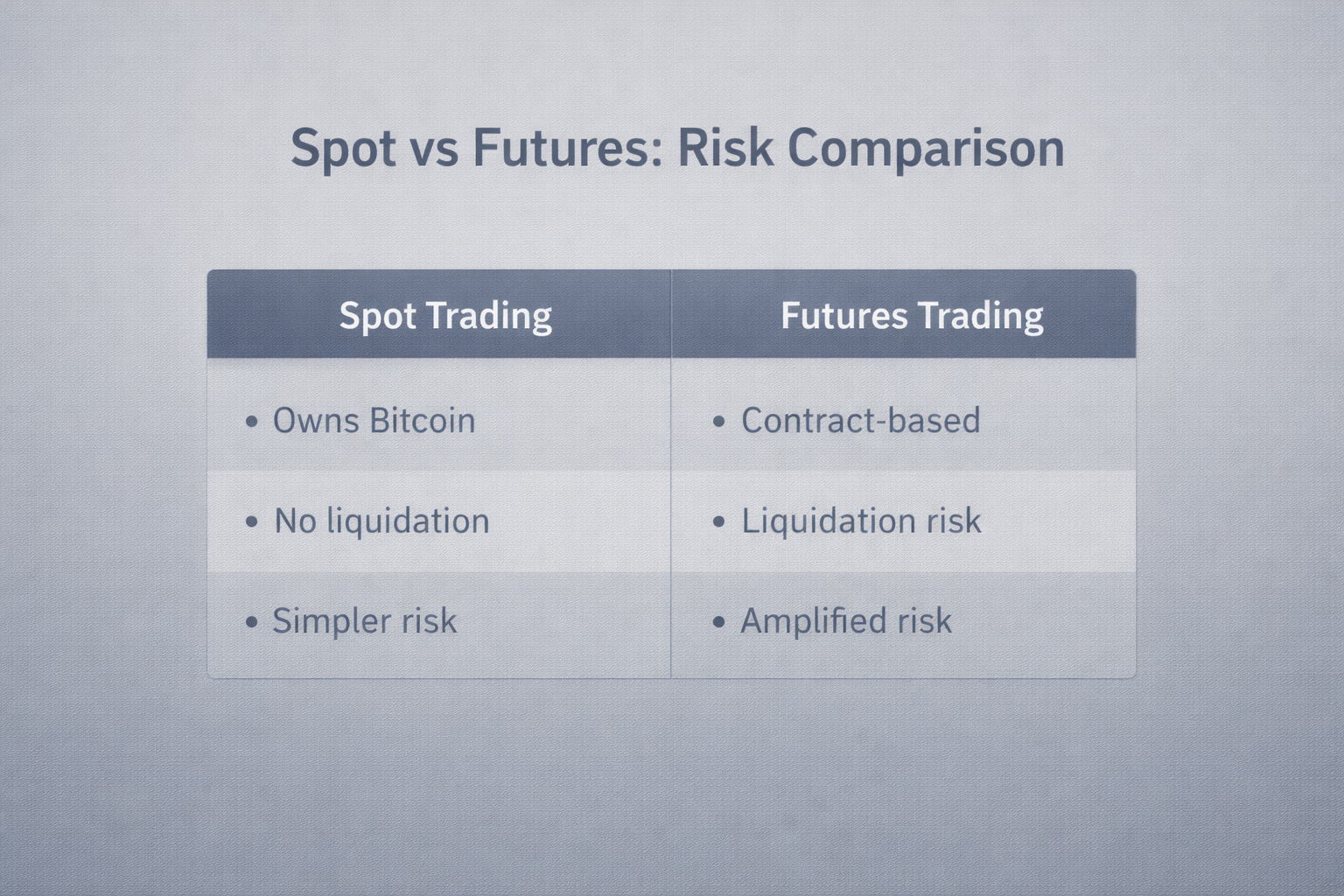 Binance also offers margin and futures trading, which introduce leverage. Leverage amplifies exposure, allowing traders to control larger positions with less capital. It also amplifies risk, including the possibility of forced liquidation.
For beginners, spot trading offers a safer learning environment. Leverage compresses the margin for error and punishes small mistakes. Many traders underestimate this dynamic and move into derivatives before developing consistent discipline.
Leverage fundamentally changes trader behavior. By compressing time horizons and magnifying exposure, it reduces tolerance for normal price fluctuations and increases sensitivity to short-term noise. Small execution errors or temporary market moves can trigger forced exits, turning manageable situations into irreversible losses. This dynamic often pushes traders toward reactive decision-making rather than structured analysis.
Spot trading, by contrast, provides an environment where skills can be developed without immediate liquidation risk. It encourages patience, proper position sizing and respect for volatility. The habits built through disciplined spot trading, planning entries, managing risk and accepting uncertainty transfer more effectively to advanced products than jumping into leveraged instruments prematurely.
Understanding that these products exist is useful. Using them responsibly requires experience and emotional control.
Managing Your Bitcoin After the Trade
After a trade is complete, the question becomes custody. Binance allows users to hold Bitcoin on the platform or withdraw it to a personal wallet. Each option has trade-offs.
Keeping funds on an exchange offers convenience and immediate liquidity. Self-custody offers greater control and reduces counterparty risk. Many experienced traders use a hybrid approach, keeping trading capital on exchanges and long-term holdings in personal wallets.
The key is intentionality. Assets should be held where they best serve their purpose.
Common Mistakes New Bitcoin Traders Make on Binance
- Trading without a predefined plan
- Chasing fast price movements instead of waiting for structure
- Ignoring fees, spreads and execution quality
- Increasing position size too quickly
- Letting emotions override risk rules
New traders often chase price movement rather than wait for structure. They may ignore fees, overuse market orders, or increase position size too quickly after early wins. Emotional reactions to losses frequently lead to revenge trading.
Another common mistake is confusing short-term trading with long-term conviction. Trading decisions should be based on setups and risk parameters, not beliefs about Bitcoin’s future.
Avoiding these mistakes does not require prediction. It requires discipline.
Is Binance the Right Place to Trade Bitcoin?
Binance offers deep liquidity, broad market access and a mature trading infrastructure. For many traders, it is a practical choice. However, regulatory availability varies by region and users should always be aware of local restrictions. The International Monetary Fund has analyzed how market structure and policy constraints interact with adoption and stability in its work on tokenization-related financial frictions and stability dynamics.
No exchange is perfect. The right platform is the one that aligns with your location, experience level and trading goals. Binance’s scale makes it a major venue for Bitcoin price discovery, which is why understanding how trading works there has broader relevance. As crypto markets expand into tokenized finance, including real-world asset tokenization, execution venues and settlement infrastructure become even more important to understand.
The Bigger Picture: Trading Bitcoin vs Owning Bitcoin
Trading and holding are not opposing philosophies. Many traders also hold Bitcoin long-term. Trading addresses short-term opportunity and risk management. Holding reflects long-term conviction.
Understanding this distinction prevents strategy confusion. A trader who treats every position as a long-term belief may fail to manage risk. An investor who trades constantly may undermine long-term accumulation.
Many experienced market participants separate trading activity from long-term ownership. Trading focuses on short to medium-term price movements and risk control, while holding reflects broader conviction and longer time horizons. Treating these approaches as distinct strategies helps prevent emotional interference, such as holding losing trades too long or trading against long-term positions impulsively.
Problems arise when strategies blur. Mixing trading decisions with investment beliefs often leads to inconsistent behavior, such as ignoring stop-losses due to long-term optimism or overtrading assets meant for holding. Clarity of intent, knowing whether a position is a trade or an investment acts as an additional layer of risk management, helping traders align actions with objectives rather than emotions.
How to Approach Bitcoin Trading on Binance Responsibly
Trading Bitcoin on Binance is not about speed, constant activity, or reacting to every price movement. It is about understanding market structure, managing risk deliberately and executing decisions consistently over time. The platform itself provides access to liquidity, order types and analytical tools, but none of those elements guarantee positive outcomes. What ultimately determines results is the trader’s ability to apply discipline in an environment designed to move continuously.
Responsible trading begins with accepting that not every moment offers an opportunity. Bitcoin markets operate twenty-four hours a day, which can create the illusion that constant engagement is necessary. This always-on operating model is part of a broader shift toward digitally native financial rails discussed in the World Economic Forum’s research on asset tokenization and financial system modernization. In practice, excessive activity often leads to higher costs, poorer execution and emotional fatigue. Effective traders learn to be selective. They define conditions under which they are willing to act and remain inactive when those conditions are not met. This restraint is not a limitation; it is a form of risk control.
Markets themselves are not static. Volatility expands and contracts, liquidity shifts and participant behavior changes across cycles. Strategies that work in trending environments may struggle in ranging markets and approaches that perform well during calm conditions may fail during periods of stress. While tactics evolve, the underlying principles do not. Execution quality, position sizing and emotional control remain the foundation of sustainable trading regardless of market regime.
Approaching Binance as a professional environment rather than a source of excitement changes how decisions are made. Trades are planned rather than improvised. Losses are treated as part of the process rather than personal failures. Capital preservation becomes a priority, not an afterthought. This mindset reduces the pressure to be right and increases the focus on managing what can be controlled.
Bitcoin trading ultimately rewards preparation more than prediction. No guide can eliminate uncertainty or guarantee results, but structured education builds resilience. Understanding how orders behave, how risk compounds and how emotions influence execution provides an edge that persists beyond individual trades. This guide is not an endpoint, but a starting point for developing those habits over time, habits that allow traders to engage with Bitcoin’s market thoughtfully, consistently and responsibly.



