



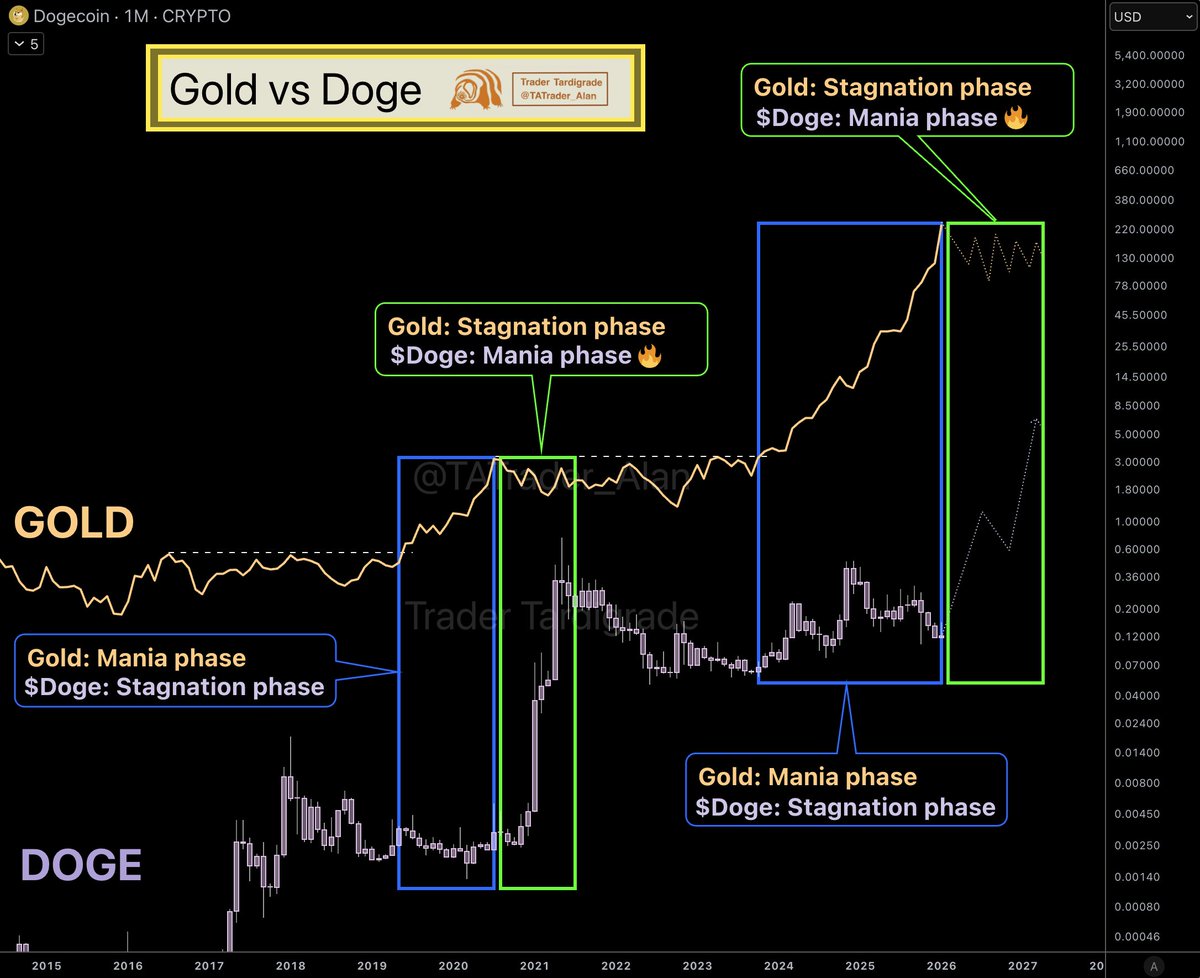
A long-term comparative chart shared by Trader Tardigrade highlights a recurring rotation pattern between gold and Dogecoin that has appeared across multiple market cycles.
The monthly view shows that periods of aggressive upside in gold have historically coincided with stagnation in Dogecoin, while DOGE’s strongest advances have tended to emerge only after gold’s momentum peaks and fades.
How the Gold–Dogecoin Cycle Has Repeated
The chart overlays gold’s price action with Dogecoin on a monthly timeframe and divides each cycle into two distinct phases:
- Gold mania phase / Dogecoin stagnation phase
During strong gold uptrends, capital appears concentrated in precious metals. In these periods, Dogecoin typically trades sideways, showing limited speculative interest and subdued volatility. - Gold stagnation phase / Dogecoin mania phase
Once gold’s rally exhausts and transitions into consolidation, speculative capital historically rotates outward. In prior cycles, this shift has aligned with explosive upside moves in Dogecoin, marking its “mania” phase.
This pattern is clearly visible around the 2019–2021 window, where gold’s post-rally consolidation overlapped with Dogecoin’s sharp breakout and parabolic advance. A similar sequence played out in the prior cycle as well, reinforcing the idea that DOGE’s strongest trends tend to lag gold rather than move alongside it.
Current Market Structure Mirrors Past Setups
In the most recent section of the chart, gold is again shown in an extended, high-momentum phase, while Dogecoin remains comparatively muted. According to the framework outlined in the analysis, this alignment resembles earlier periods where DOGE underperformed while gold absorbed the bulk of speculative and defensive capital.
The forward-looking projection on the chart suggests that if gold transitions from acceleration into a sideways or distribution phase, conditions may begin to favor renewed speculative interest in Dogecoin. Importantly, the thesis does not imply immediate upside, but rather a sequencing effect, where DOGE’s strongest moves historically come aftergold’s peak, not during it.
What This Means for Market Participants
The comparison underscores a broader macro-to-speculation rotation dynamic. Gold often benefits first from risk aversion and macro uncertainty, while assets like Dogecoin tend to respond later, once capital becomes more willing to rotate into higher-beta, sentiment-driven trades.
While past cycles do not guarantee future outcomes, the repeated structure shown on the monthly chart suggests that Dogecoin’s periods of relative inactivity during gold rallies have, historically, been followed by sharp repricing phases once gold momentum cools. For now, the chart implies patience rather than confirmation, with the key signal being a clear shift in gold from mania to stagnation.