





The cryptocurrency industry could be on the brink of a historic expansion, with global adoption projected to reach 4 billion users by 2030 and the market capitalization potentially soaring to $100 trillion, according to former hedge fund manager and Real Vision CEO Raoul Pal.
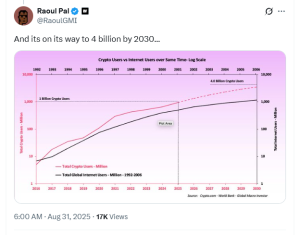
In an X post on Sunday, Pal drew comparisons between the growth trajectory of crypto adoption and the internet’s early expansion. He highlighted how crypto’s user base has been growing at a pace far exceeding that of the internet when it was at a similar stage of development.
Faster Than the Internet
Pal explained that crypto adoption can be measured by comparing the number of crypto wallets to the number of IP addresses in the early internet era. According to him, the global crypto user base has expanded at an average annual rate of 137% over the past nine years, reaching approximately 659 million users by the end of 2024.
By contrast, the number of internet users grew by 76% annually, hitting 187 million by the year 2000.
Looking ahead, Pal expects growth to moderate but remain significant, forecasting that crypto could hit 1 billion users in the next few years and eventually climb to 4 billion users by 2030, roughly one-eighth of the world’s population.
The $100 Trillion Market Cap Vision
Pal’s bullish outlook doesn’t stop at adoption numbers. He predicts that crypto’s market capitalization could cross the $100 trillion threshold within the next decade, potentially as early as 2032. In his view, two key drivers will underpin this explosive growth: global currency debasement and accelerating adoption.
“Debasement explains 90% of price action, while adoption explains 100% of outperformance versus debasement,” Pal stated, emphasizing how macroeconomic pressures and increased participation will shape the industry’s future.
Skepticism From the Community
Not everyone shares Pal’s optimism. Several responses to his post questioned the reliability of wallet counts as a measure of real adoption. Critics pointed out that individuals often create multiple wallets, and project founders can artificially inflate community size by distributing tokens across thousands of addresses.
One user noted, “I create a new wallet every six months and have been doing so for years. That doesn’t mean there are more actual users.” Pal countered this argument by reminding critics that internet adoption metrics were also imperfect, as individuals could hold multiple IP addresses.
Adoption Today: A Mixed Picture
Industry data presents a wide range of estimates regarding actual crypto usage. Triple-A, a B2B digital currency platform, reported more than 560 million crypto users by the end of 2024. Meanwhile, a report from Andreessen Horowitz’s crypto division suggested that 30 million to 60 million people actively use crypto on a monthly basis.
Whether Pal’s forecast proves accurate or overly optimistic, one thing is clear: the crypto industry is experiencing adoption at a pace rarely seen in financial history. If current trends hold, the coming decade could mark the transition of crypto from a niche investment into a mainstream global financial system.



