





When the price of safety rises, the cost of risk rises with it. That is what bond yields spiking simultaneously across multiple economies means for assets like Bitcoin.
What the Charts Show
Analyst Ash Crypto published a four-panel chart on March 22 showing government bond yields across the United States, European Union, Australia, and Canada, each in a clear upward trend across the visible window. US 10-year yields are trading at approximately 4.364%, the EU at 2.848%, Australia at 5.065%, and Canada at 3.055%. The direction across all four panels is the same. Yields are rising, and they are doing so simultaneously rather than in isolation.
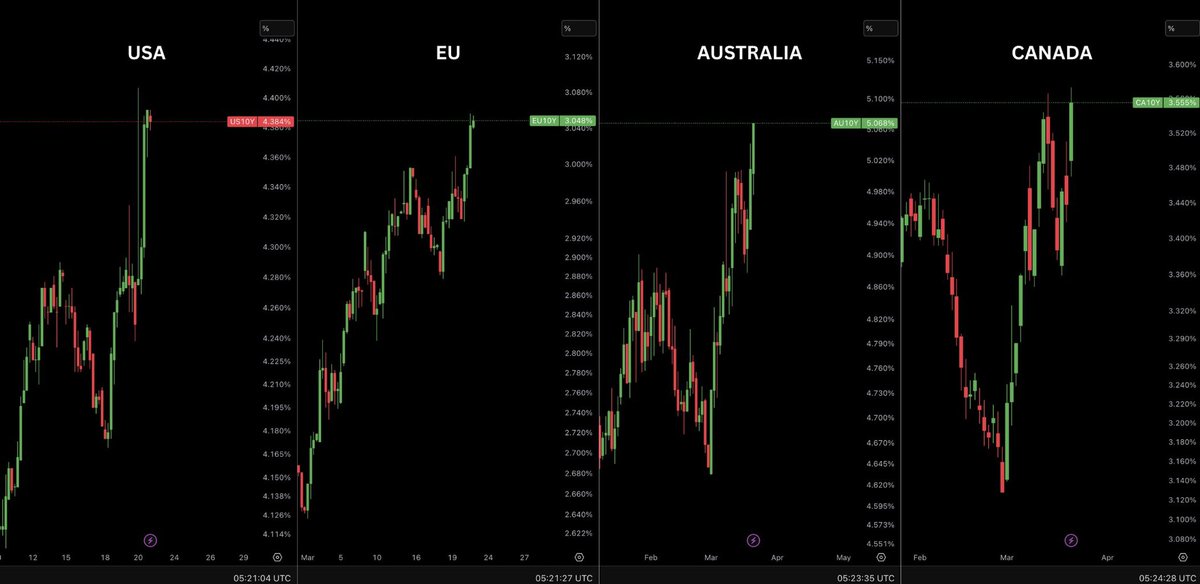
That synchronization matters. When a single country’s yields rise, it can reflect local factors like fiscal policy, election risk, or central bank divergence. When the US, EU, Australia, and Canada all move in the same direction at the same time, the driver is global rather than regional. Rising inflation expectations, geopolitical risk premium, or a broad repricing of the risk-free rate are the more likely explanations than any single country’s domestic conditions.
Why This Connects to Crypto
Bond yields and risk assets operate in a direct mechanical relationship. When yields rise, newly issued bonds pay more to holders. That makes the guaranteed return from holding government debt more attractive relative to the uncertain return from holding risk assets like equities or cryptocurrency. Investors reallocating toward bonds to capture higher guaranteed returns reduce the capital available for risk-on positions. The selling starts at the riskiest end of the spectrum first.
Bitcoin and crypto broadly sit at that end of the spectrum. They carry no yield, no dividend, and no contractual return. Their value is entirely dependent on demand, liquidity, and market sentiment. When the risk-free rate rises and capital has a more attractive alternative, the assets with the least structural support for their valuations face the most pressure. Bitcoin moves with liquidity conditions. When liquidity tightens because safer assets pay more, Bitcoin tends to feel that tightening before equities do and more severely than equities do.
The Current Setup
The bond yield spike arrives at a moment when Bitcoin is already under pressure from multiple directions. As covered throughout this week’s reporting, open interest sits near multi-month lows following October’s deleveraging event, ETF outflows have been persistent through March, retail participation has dropped to its lowest level since January 2025, and miners are operating at a 21% loss per block. Each of those conditions individually represents a headwind. Layering a global bond yield spike on top of them compounds the pressure on liquidity conditions that Bitcoin depends on for price support.
The geopolitical context reinforces the yield dynamic. Rising energy prices from the Iran conflict feed inflation expectations, which push yields higher as bond markets price in a longer period of elevated rates. That chain, from geopolitical tension to energy prices to inflation to yields to risk asset pressure, is the transmission mechanism that connects an event in the Strait of Hormuz to Bitcoin’s price structure.
What Would Change the Picture
If global bond yields stabilize or reverse, the pressure on risk assets eases correspondingly. Lower yields reduce the relative attractiveness of holding bonds over risk assets, pushing capital back toward the riskier end of the spectrum. That dynamic drove much of the 2024 rally as rate cut expectations built through the year.
For now the direction across all four panels is upward and synchronized. As Ash Crypto frames it, if global bonds continue to rise, more pressure on risk-on assets like crypto follows. That is not a prediction. It is a description of how the capital allocation mechanism works when the price of safety goes up.



