



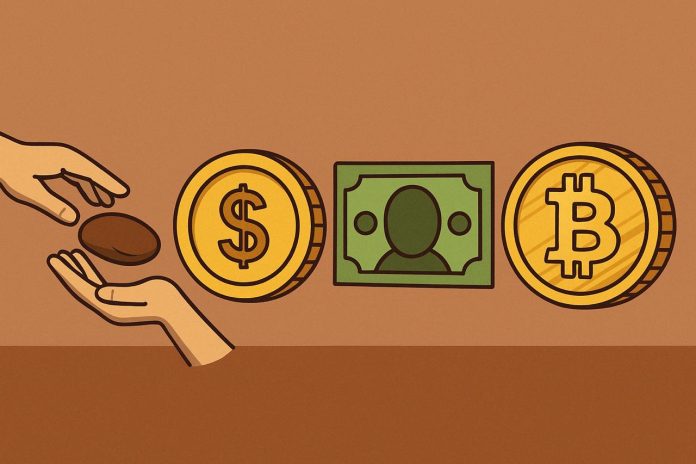

Binance, one of the world’s largest cryptocurrency exchanges, released a new educational post illustrating the evolution of money, from primitive barter systems to the era of digital currency led by Bitcoin.
The visual timeline, titled “Evolution of Money,” aims to highlight how finance has transformed across civilizations and how blockchain represents the latest leap in that journey.
From Barter to Fiat: The Foundations of Exchange
The journey of money began with barter, where goods and services were traded directly without standardized value systems. While effective for early societies, barter suffered from inefficiencies, a lack of portability, divisibility, and universal acceptance. Over time, gold and other commodities emerged as universally accepted mediums of exchange. Their scarcity and durability made them ideal for storing and transferring value.
From barter to digital currency, see how money has transformed through the ages 👇 pic.twitter.com/2GPtSgvqmn
— Binance (@binance) October 25, 2025
The next evolution came with metal coins, which introduced government-backed currency for the first time. Minted coins represented trust, value, and authority, turning economic exchange into a formalized system. As global trade expanded, societies transitioned to paper money, enabling faster transactions and easier large-scale commerce. Fiat currencies became the backbone of modern economies, backed by state institutions rather than physical commodities.
Enter Bitcoin: The Fifth Stage of Money
According to Binance, Bitcoin represents the fifth and most revolutionary stage, decentralized digital money. Unlike fiat, Bitcoin is not issued by any central authority. Instead, it operates on a peer-to-peer blockchain network, secured by cryptography and sustained by global consensus. Binance described Bitcoin as both “digital cash” and “digital gold,” recognizing its dual role as a medium of exchange and a store of value.
Bitcoin’s capped supply of 21 million coins mirrors the scarcity of precious metals while its digital nature enables near-instant, borderless transactions. For many, this combination makes it superior to both gold and fiat, particularly in an age where traditional financial systems face inflationary pressures and geopolitical uncertainty.
The Rise of Digital Finance
Binance’s post arrives at a time when digital currencies are gaining institutional acceptance. Over a dozen Bitcoin and Ethereum ETFs now trade globally, and major payment firms like PayPal, Stripe, and Mastercard have introduced blockchain-based settlement tools. Central banks are also experimenting with CBDCs (central bank digital currencies), signaling that digital money is not merely a niche innovation but an inevitable financial evolution.
By presenting Bitcoin as the culmination of centuries of progress, from barter to blockchain, Binance underscores its view that cryptocurrency represents the future of global finance. Just as gold and paper once reshaped economic systems, digital assets are poised to redefine how humanity stores, transfers, and perceives value in the 21st century.



