




On-chain analytics firm Santiment reports that the vast majority of major cryptocurrencies have now fallen into historically deep loss territory, with trader performance over the past 30 days flashing some of the most negative readings of the year.
According to the firm’s latest update, wallets active during the last month are showing average returns far below break-even, a signal that several assets are entering what Santiment calls “Extreme Buy Zones.”
Cardano, Chainlink, Ethereum Lead the Pain Metrics
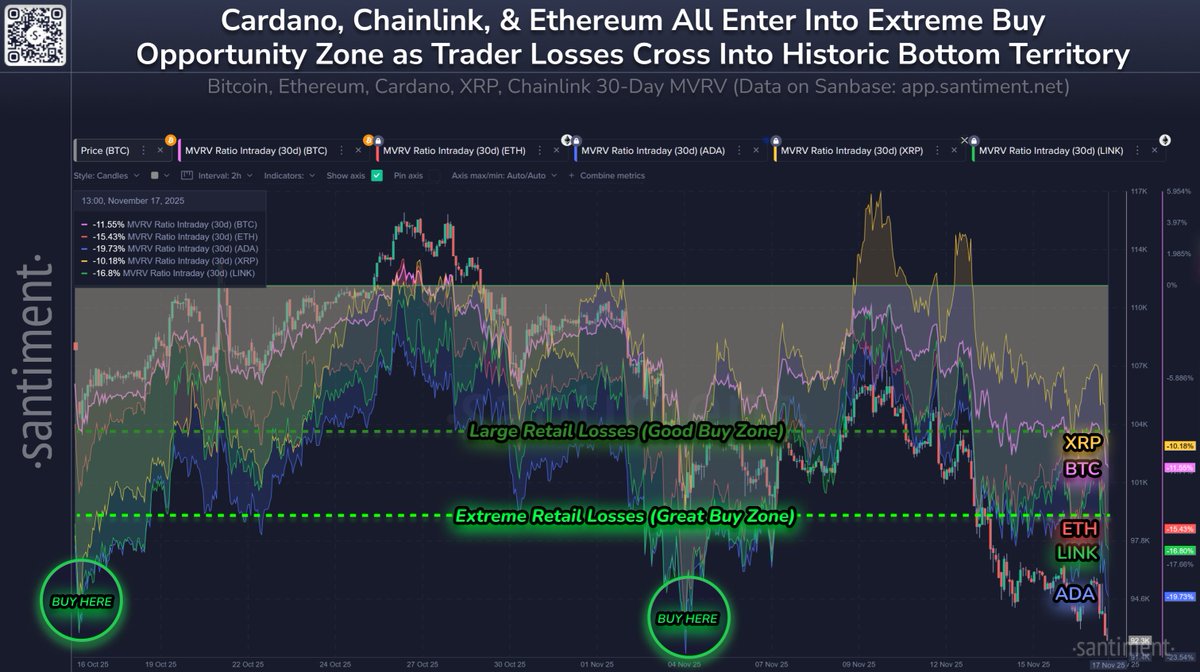
Santiment’s data shows the following 30-day average return losses:
- Cardano (ADA): −19.7% – Extreme Buy Zone
- Chainlink (LINK): −16.8% – Extreme Buy Zone
- Ethereum (ETH): −15.4% – Extreme Buy Zone
- Bitcoin (BTC): −11.5% – Good Buy Zone
- XRP Ledger (XRP): −10.2% – Good Buy Zone
These readings are derived from the 30-day MVRV ratio, which tracks the average profit or loss of recently active wallets. When MVRV falls into deeply negative territory, it indicates that traders who bought within the last month are heavily underwater, historically a condition that often precedes strong recovery phases.
Why MVRV Matters Now
Santiment emphasizes that MVRV offers a more data-driven way to define true “buy-low zones,” as opposed to relying solely on chart trendlines or psychological supports. In a zero-sum market, when the majority of recent buyers are at steep losses, the probability of a rebound increases.
The firm notes that the lower the MVRV goes, the higher the likelihood of an aggressive recovery, especially when several major assets simultaneously enter these zones, something not seen often outside major capitulation events.
Market Context: Multi-Asset Capitulation
The current alignment across ADA, LINK, ETH, BTC, and XRP suggests synchronized capitulation among retail traders. Santiment’s accompanying chart highlights multiple clusters where extreme negative MVRV readings previously marked the start of strong momentum reversals.
As volatility accelerates across crypto markets this week, Santiment’s indicators suggest that trader exhaustion may be approaching an inflection point, one that historically precedes rapid trend reversals.



