


Euro-denominated stablecoins represent just 0.35% of the $307.6 billion global stablecoin market, with EUR swap volume accounting for less than 0.1% of total stablecoin trading activity, according to analysis from Barter using DeFiLlama and Dune Analytics data.
The Scale of the Gap
The numbers illustrate how completely dollar stablecoins dominate DeFi infrastructure. Total USD-denominated stablecoin supply stands at $306.9 billion against $1.06 billion in EUR-denominated supply. Over the past 12 months, EUR stablecoin swaps totaled $3.17 billion compared to more than $3.20 trillion in USD stablecoin swaps. Euro stablecoins trade at a fraction of their already limited supply share, reflecting how difficult it is to route larger swaps or reuse euro liquidity efficiently across protocols.
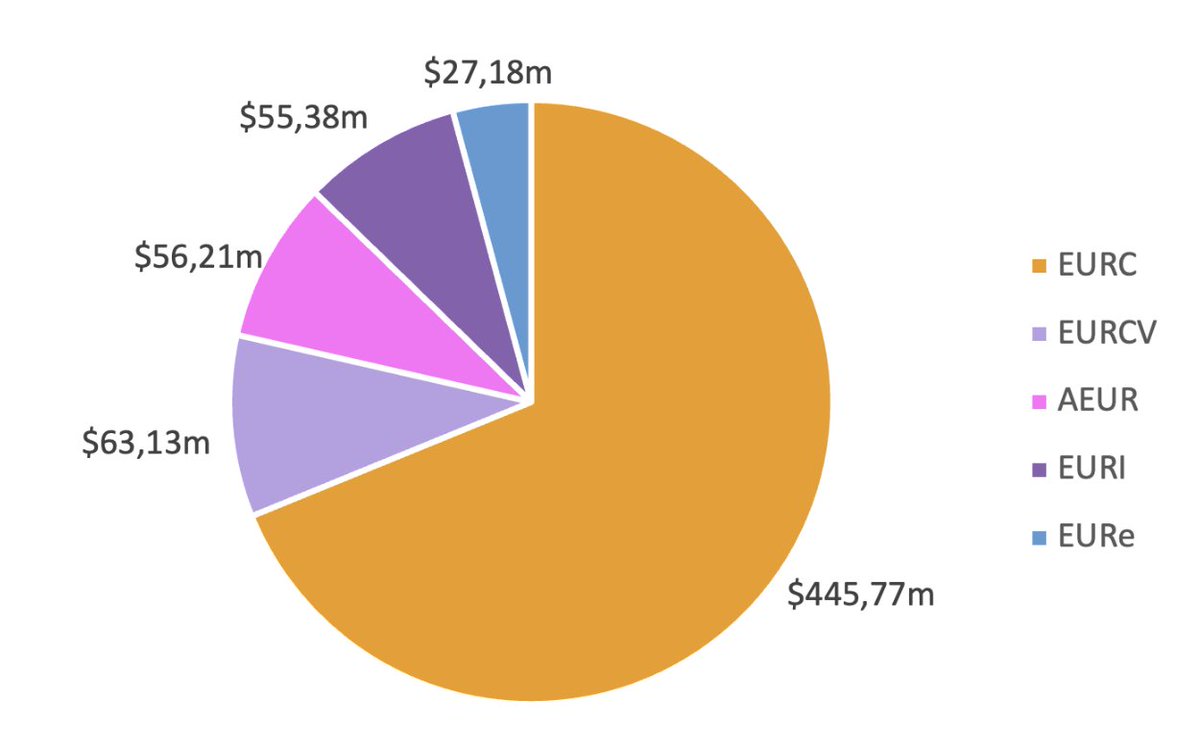
According to DefiLama data, the five leading euro stablecoins by market cap are Circle’s EURC at $445 million, Société Générale Forge’s EURCV at $63 million, Anchored Coins AEUR at $56 million, Banking Circle EURI at $55 million, and Monerium EURe at $27 million. Market cap alone does not capture actual usage. When measured by unique active holders over the past three months, the structure shifts significantly.
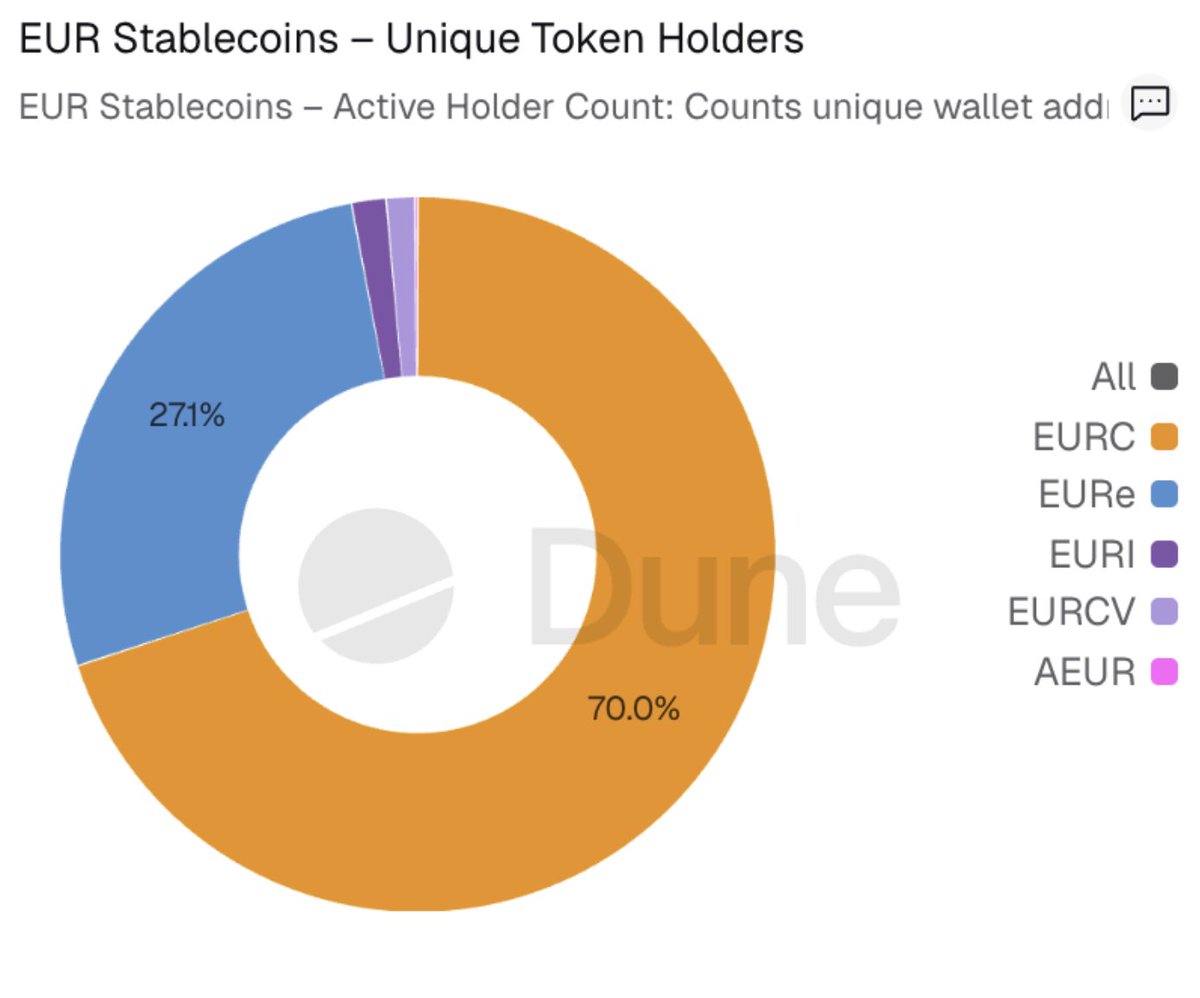
EURC leads with 60,107 active holders representing approximately 70% of activity. EURe follows at 23,247 holders representing roughly 27%. EURCV and EURI, despite meaningful TVL from large European banks, show only 1,341 and 1,111 active holders respectively, reflecting concentrated institutional balances rather than broad circulation.
Why Liquidity Has Stalled
The core problem is structural rather than regulatory. Euro stablecoin supply is spread too thinly across too many pools on too many venues, with the majority of swap volume concentrated within Uniswap, PancakeSwap, and Aerodrome. Fragmented liquidity creates a self-reinforcing cycle: shallow pools increase price impact, higher execution costs suppress trade size and frequency, lower activity discourages new liquidity provision, and depth per pool remains insufficient for larger swaps to execute efficiently.
Euro stablecoins are also less integrated into DeFi credit and leverage strategies than their USD counterparts. USDC and USDT serve as collateral, settlement assets, and yield-bearing instruments across hundreds of protocols simultaneously. Euro stablecoins remain primarily trading assets rather than foundational DeFi infrastructure, which limits the velocity and depth that would make them competitive with dollar alternatives for institutional use.
The Infrastructure Being Built to Close the Gap
The timing of this analysis sits inside a week where euro stablecoin infrastructure is being constructed from multiple directions simultaneously. The ECB’s Appia roadmap published Wednesday commits to a tokenized wholesale euro settlement framework with a 2028 completion target. The Nasdaq-Boerse Stuttgart Seturion partnership, covered earlier this week, builds DLT settlement infrastructure for European structured products with cash settlement available in central bank money or on-chain cash. AMINA Bank and 21X’s Stellar integration, also covered this week, uses EUR stablecoins as the settlement layer for EU DLT Pilot Regime compliant tokenized securities.
Barter’s hybrid execution model addresses the liquidity fragmentation problem directly by integrating Private Market Makers into the euro stablecoin execution layer, allowing large swaps to bypass static AMM curves and settle through off-chain pricing with on-chain settlement. Its partnership with Monerium adds atomic minting, where EURe tokens are created at the moment of trade rather than requiring pre-positioned liquidity. Together the two approaches target the depth and execution quality problem that has kept institutional volume away from euro DeFi infrastructure.
MiCA is the regulatory catalyst the market has been waiting for. A unified framework across 27 EU member states removes the jurisdiction-by-jurisdiction compliance barrier that has slowed euro stablecoin issuance and distribution. Whether 0.35% of supply becomes 3% or 10% depends on how quickly that regulatory clarity translates into infrastructure investment and institutional adoption.