


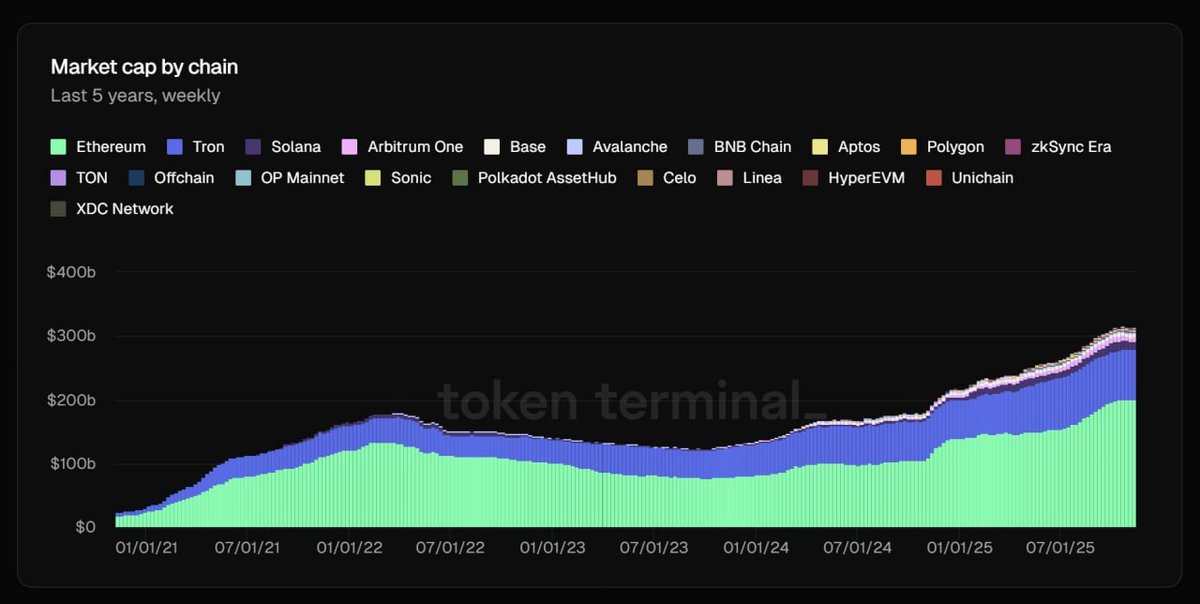
Ethereum’s dominance in the digital asset ecosystem has reached a new milestone. According to data shared by Token Terminal, the total market capitalization of assets tokenized on the Ethereum network has exceeded $200 billion, reflecting surging on-chain activity and expanding real-world use cases.
The growth highlights Ethereum’s continued role as the primary settlement layer for tokenized finance, from DeFi protocols and stablecoins to real-world assets and institutional funds. Over the past five years, the network’s on-chain economy has shown consistent expansion despite periods of market volatility, with Ethereum continuing to account for the majority of total smart contract activity.
Institutional Demand Drives On-Chain Expansion
The record figure coincides with a sharp decline in ETH balances held on centralized exchanges, now sitting near multi-year lows. This trend often signals a move toward self-custody and staking, both indicators of long-term confidence among holders and institutions.
Meanwhile, traditional finance players are accelerating their exposure to Ethereum’s ecosystem. Tokenized Treasury products, ETH-backed ETFs, and on-chain fund structures are fueling renewed demand, bridging the gap between decentralized finance and regulated markets. Analysts suggest that as the tokenization of assets expands globally, Ethereum is emerging as the default infrastructure layer for programmable value transfer.
Layer-2 Networks Strengthen the Ecosystem
Beyond the mainnet, Ethereum’s Layer-2 solutions, including Arbitrum, Base, and Optimism — continue to gain traction, contributing significantly to total value locked and daily transaction volume. Together, these scaling networks enhance Ethereum’s performance and affordability while expanding its total tokenized economy.
According to Token Terminal data, Layer-2 networks now account for a growing share of Ethereum’s cumulative market cap, supporting the thesis that Ethereum’s ecosystem value is not limited to ETH alone but extends across its modular architecture.
ETH Undervalued Relative to Fundamentals
Despite this fundamental strength, ETH’s price remains below its all-time highs, leading several analysts to argue the asset is undervalued compared to its underlying network growth. With more capital flowing into tokenized assets, staking yields remaining steady, and supply dynamics turning deflationary post-EIP-1559, Ethereum’s intrinsic value continues to climb even as market sentiment lags.
Long-term investors view the current environment as comparable to early 2020, when network activity began outpacing price performance, a setup that later preceded a major multi-year rally.
Conclusion: Ethereum Anchors the Tokenized Future
Ethereum’s $200 billion milestone confirms its position as the core infrastructure of the global tokenized economy. With exchange balances falling, institutional demand rising, and scaling networks thriving, the ecosystem is entering a new phase of capital efficiency and real-world integration.
If the current trajectory holds, Ethereum could soon transition from being the leading blockchain for decentralized finance to the backbone of institutional tokenization worldwide, a shift that may