






New data tracking the unrealized profit ratio across Ethereum’s largest wallet cohorts shows whale positions moving into negative territory as of early 2026, with the chart’s colored bands compressing toward and below zero in a pattern that has not appeared at this scale since the prolonged 2022 bear market.
What the Chart Measures
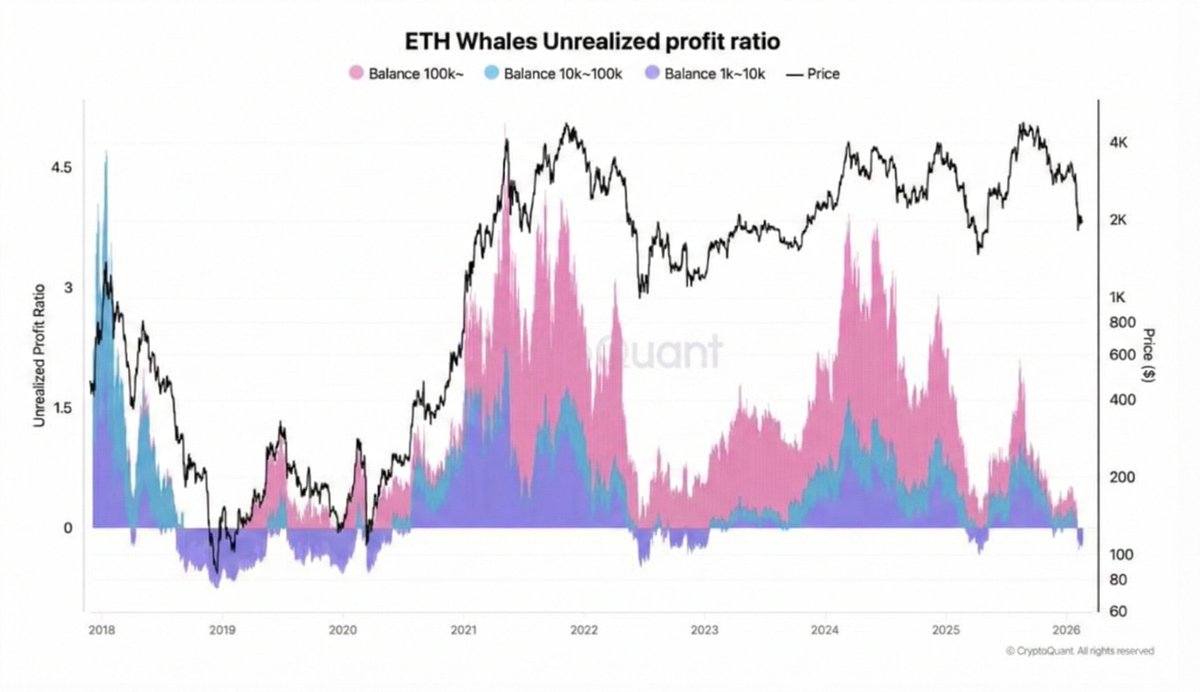
The ETH Whales Unrealized Profit Ratio chart from CryptoQuant segments large ETH holders into three balance tiers: wallets holding 100,000 ETH or more shown in pink, wallets holding 10,000 to 100,000 ETH shown in light blue, and wallets holding 1,000 to 10,000 ETH shown in purple. The ratio for each cohort measures the proportion of that group’s holdings that are currently in unrealized profit relative to the price at which those coins were last moved.
When the bands are elevated above zero, a significant share of each whale cohort is sitting in profit on their positions. When the bands compress toward zero or move below it, an increasing proportion of those large holders are underwater on their ETH at current prices.
What the Chart Shows Now
The most recent reading at the far right of the chart, early 2026, shows all three cohorts with their bands near or below the zero line. The pink band representing the largest wallet tier has contracted sharply. The purple and blue mid-tier bands have followed. ETH’s price on the right axis is visible near the $1,800 to $2,000 range, down significantly from the $4,000 peak visible around 2021 and 2024.
The last comparable period where the chart showed this degree of whale unrealized loss was 2022, when ETH fell from over $4,000 to under $1,000 during the prolonged bear market following the Luna collapse and the FTX implosion. That period saw the bands remain below or near zero for an extended duration before recovering as price eventually climbed back above the aggregate cost basis of each cohort.
The 2018 to 2019 period at the far left of the chart shows a similar compression and recovery sequence. In both prior instances, the whale unrealized loss phase preceded eventual price recovery, though the timeline varied considerably.
Why Whale Positioning Matters
Large ETH holders carry disproportionate influence over price dynamics for a straightforward reason: they hold a large share of the available supply. When those holders are in profit, they face a choice between realizing gains and continuing to hold. When they are underwater, the dynamic changes. Holders at a loss face either the decision to cut losses by selling, or to continue holding and wait for recovery.
The pattern visible in the chart across three separate bear market periods suggests that large ETH holders have historically demonstrated a willingness to hold through unrealized loss phases rather than capitulate at the lows. In both 2019 and the post-2022 recovery, the whale cohorts absorbed significant unrealized losses before the ratio recovered as price climbed back above their average cost basis.
The current reading places a substantial portion of Ethereum’s largest holders in a similar position. That does not mean the outcome will be identical to prior cycles, but it does identify where the weight of unrealized losses currently sits in the market’s holder distribution.
The Broader Context
Ethereum’s structural underperformance relative to Bitcoin this cycle has been documented across multiple on-chain frameworks, and the whale unrealized profit ratio is one of the more direct reflections of that underperformance. ETH peaked near $4,000 in the current cycle while Bitcoin approached $126,000, and the relative compression in ETH’s price has moved a larger proportion of its whale holders into loss territory than Bitcoin’s equivalent cohorts.
The ascending trendline support analysis from earlier in the week identified a critical weekly close as the next structural signal for Ethereum. The whale unrealized loss data adds a second layer of context to that technical picture: not only is price approaching a key support level, but the largest holders in the network are carrying positions that are increasingly underwater, which means the weight of potential capitulation risk sits at the top of the holder distribution rather than in smaller retail wallets.



