





According to a report shared by CryptoQuant, Ethereum has entered a rare on-chain condition where price has fallen below the Realized Price of whales holding at least 100,000 ETH, a cohort representing entities with roughly $200 million or more in exposure at current prices.
The information shows that Ethereum’s spot price recently moved below this realized cost basis, which currently stands near $2,075, marking a significant shift in large-holder positioning.
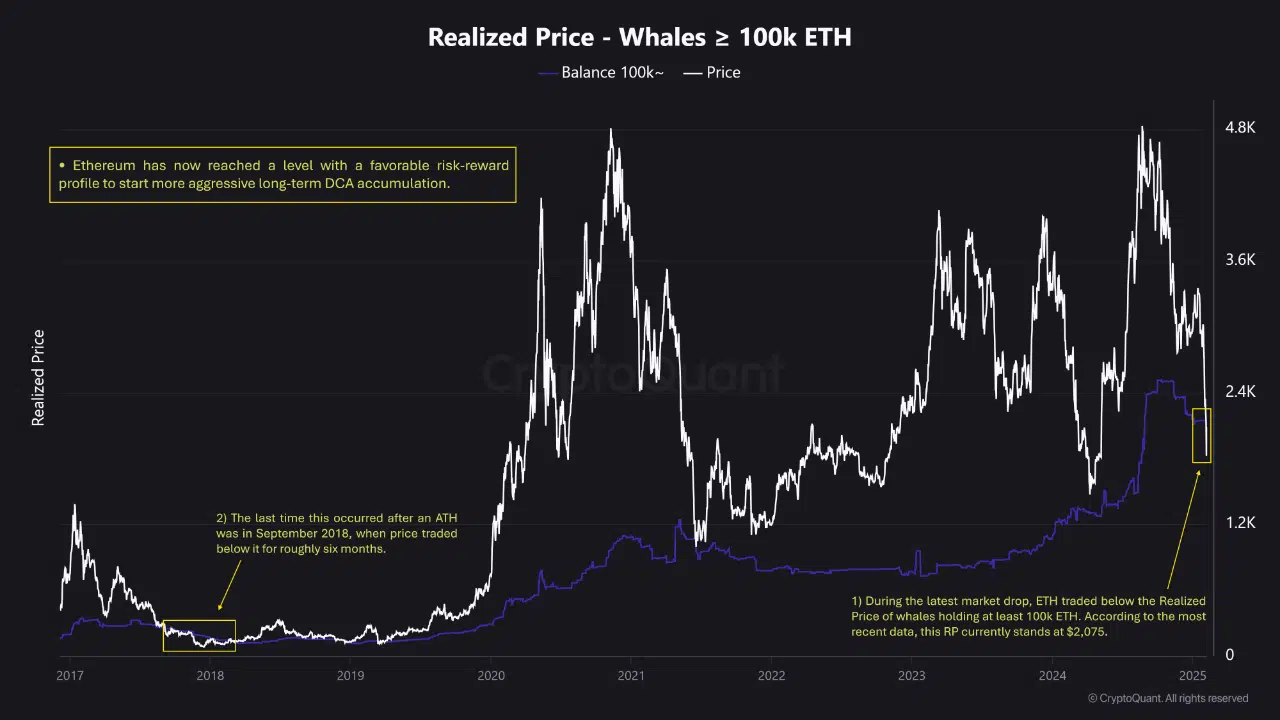
What the Chart Shows
The chart compares two primary data series:
- White line: Ethereum spot price
- Blue line: Realized Price of whales holding ≥100k ETH
The realized price reflects the average on-chain acquisition cost of this whale cohort, calculated based on when coins were last moved on-chain. When ETH trades above this level, these large holders are, on average, in profit. When price falls below it, they are temporarily holding unrealized losses.
During the latest market decline, Ethereum dipped below this whale realized price, placing price beneath a level that has historically acted as a cycle-level reference, rather than a short-term trading signal.
Historical Context From the Same Metric
The chart also marks the last comparable post–all-time-high occurrence, which took place in September 2018. Following that cycle peak, Ethereum traded below the realized price of ≥100k ETH whales for approximately six months.
This comparison highlights the rarity of the current setup. Post-ATH periods where price falls below the cost basis of the largest holders have historically aligned with extended consolidation or drawdown phases rather than brief corrections.
Structural Interpretation
From a structural standpoint, this condition suggests that mega-whales are now under cost-basis pressure, even if temporarily. This typically reflects broader market stress rather than isolated volatility, as these entities tend to operate with long time horizons and strong balance sheets.
At the same time, the whale realized price itself continues to trend upward over the long term, indicating that this cohort has consistently accumulated ETH at progressively higher prices across cycles.
Risk–Reward Framing From the Report
The CryptoQuant report notes that Ethereum has now reached a zone where the risk–reward profile becomes more favorable for long-term, incremental accumulation strategies, such as dollar-cost averaging. This framing is based on historical behavior around whale realized price levels rather than short-term price expectations.
Takeaway
Ethereum trading below the realized price of ≥100k ETH whales is a rare post-ATH signal that has historically coincided with prolonged adjustment phases. While it does not define timing or direction on its own, it highlights a shift in cost-basis dynamics among the largest holders that has previously marked important transitional periods in Ethereum’s market cycle.



